 Add to Chrome
 Add to Firefox
 Add to Edge
Warm Starts, Cold States: Exploiting Adiabaticity for Variational Ground-States
Feb 05, 2026
Reliable preparation of many-body ground states is an essential task in quantum computing, with applications spanning areas from chemistry and materials modeling to quantum optimization and benchmarking. A variety of approaches have been proposed to tackle this problem, including variational methods. However, variational training often struggle to navigate complex energy landscapes, frequently encountering suboptimal local minima or suffering from barren plateaus. In this work, we introduce an iterative strategy for ground-state preparation based on a stepwise (discretized) Hamiltonian deformation. By complementing the Variational Quantum Eigensolver (VQE) with adiabatic principles, we demonstrate that solving a sequence of intermediate problems facilitates tracking the ground-state manifold toward the target system, even as we scale the system size. We provide a rigorous theoretical foundation for this approach, proving a lower bound on the loss variance that suggests trainability throughout the deformation, provided the system remains away from gap closings. Numerical simulations, including the effects of shot noise, confirm that this path-dependent tracking consistently converges to the target ground state.

The role of data-induced randomness in quantum machine learning classification tasks
Nov 28, 2024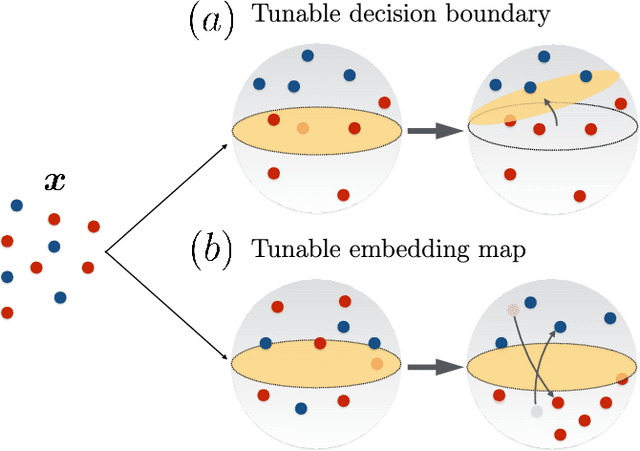
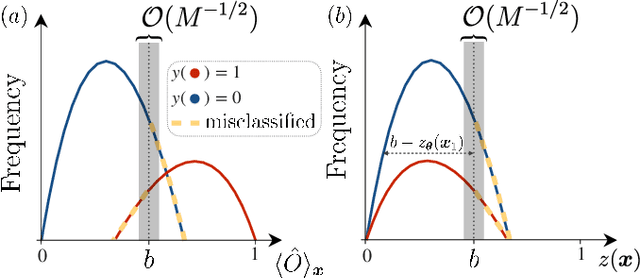
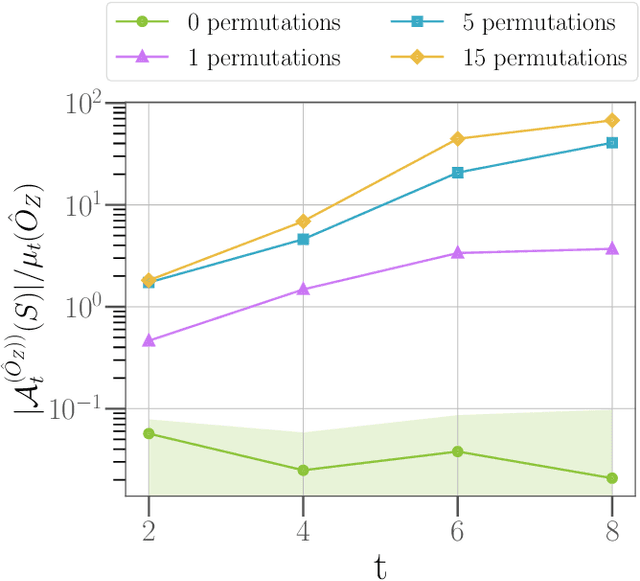
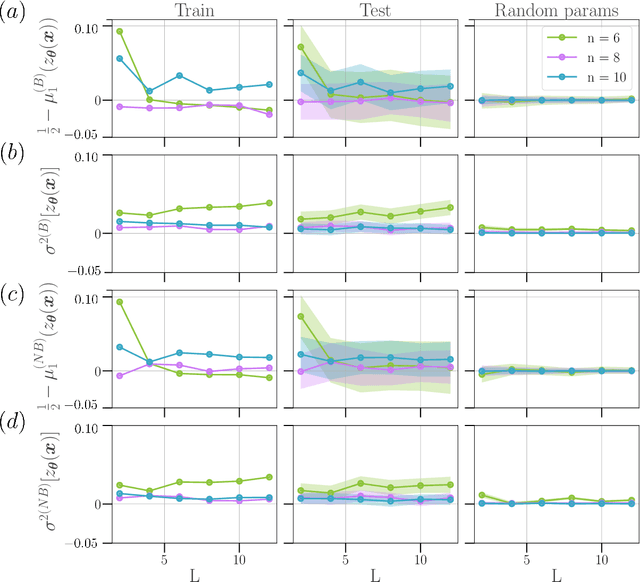
Quantum machine learning (QML) has surged as a prominent area of research with the objective to go beyond the capabilities of classical machine learning models. A critical aspect of any learning task is the process of data embedding, which directly impacts model performance. Poorly designed data-embedding strategies can significantly impact the success of a learning task. Despite its importance, rigorous analyses of data-embedding effects are limited, leaving many cases without effective assessment methods. In this work, we introduce a metric for binary classification tasks, the class margin, by merging the concepts of average randomness and classification margin. This metric analytically connects data-induced randomness with classification accuracy for a given data-embedding map. We benchmark a range of data-embedding strategies through class margin, demonstrating that data-induced randomness imposes a limit on classification performance. We expect this work to provide a new approach to evaluate QML models by their data-embedding processes, addressing gaps left by existing analytical tools.