 Add to Chrome
 Add to Firefox
 Add to Edge
Location as a service with a MEC architecture
Feb 13, 2026
In recent years, automated driving has become viable, and advanced driver assistance systems (ADAS) are now part of modern cars. These systems require highly precise positioning. In this paper, a cooperative approach to localization is presented. The GPS information from several road users is collected in a Mobile Edge Computing cloud, and the characteristics of GNSS positioning are used to provide lane-precise positioning for all participants by applying probabilistic filters and HD maps.

Railway LiDAR semantic segmentation based on intelligent semi-automated data annotation
Oct 17, 2024
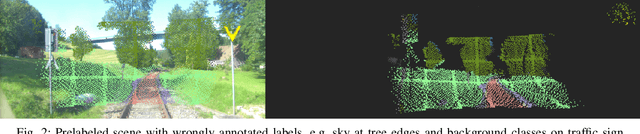
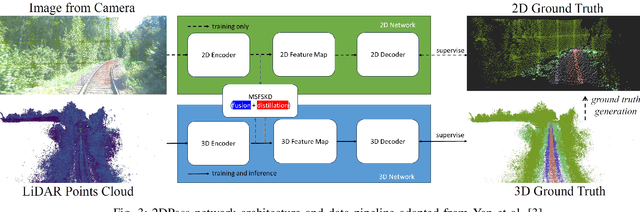
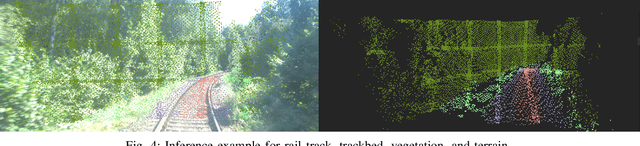
Automated vehicles rely on an accurate and robust perception of the environment. Similarly to automated cars, highly automated trains require an environmental perception. Although there is a lot of research based on either camera or LiDAR sensors in the automotive domain, very few contributions for this task exist yet for automated trains. Additionally, no public dataset or described approach for a 3D LiDAR semantic segmentation in the railway environment exists yet. Thus, we propose an approach for a point-wise 3D semantic segmentation based on the 2DPass network architecture using scans and images jointly. In addition, we present a semi-automated intelligent data annotation approach, which we use to efficiently and accurately label the required dataset recorded on a railway track in Germany. To improve performance despite a still small number of labeled scans, we apply an active learning approach to intelligently select scans for the training dataset. Our contributions are threefold: We annotate rail data including camera and LiDAR data from the railway environment, transfer label the raw LiDAR point clouds using an image segmentation network, and train a state-of-the-art 3D LiDAR semantic segmentation network efficiently leveraging active learning. The trained network achieves good segmentation results with a mean IoU of 71.48% of 9 classes.