 Add to Chrome
 Add to Firefox
 Add to Edge
Inductive Graph Layout with Implicit Neural Fields
Aug 09, 2026
A graph layout is normally a table of $N$ free coordinates. We optimise a function with a fixed number of parameters instead. This gives a drawing a sample complexity and an extensible domain. Force-directed algorithms remain the standard tools for graph drawing. The most accurate among them minimise stress in the Kamada-Kawai formulation by directly optimising the node coordinates, at a full objective cost of $O(N^2)$ in time and space. Here, we propose Fling (Field Layout via Implicit Neural Geometry), a small neural network mapping the distances of each node to a set of landmarks, positioning it in the plane by training on the layout energy. The full spring system then becomes tractable without its distance matrix, as rest lengths follow from a landmark bound in constant time per pair while a second network learns the majorisation sums from exact anchor rows, at $O(|\mathcal{A}|N)$ per step for $|\mathcal{A}|\ll N$ anchors. Unlike neural drawers that read the graph by message passing, we represent the drawing as a function of node features. An unseen node costs one forward pass, where sparse and low-rank majorisation remain transductive. As the unknowns are weights rather than coordinates, the energy only requires a small fraction of the nodes, and a field fitted that way outperforms PivotMDS, landmark MDS, and a kernel ridge trained on the same energy and features, when the task is fitting the energy of a graph from a sample of its nodes. In addition, the same parameterisation enables a stochastic pivot stress variant, an aesthetics-optimised variant carrying a neighbour-embedding energy with node-edge clearance and crossing terms on the same field, and conditioning on the weight between two energies gives a whole layout family from one run.

Adaptive Sampling for Continuous Group Equivariant Neural Networks
Sep 13, 2024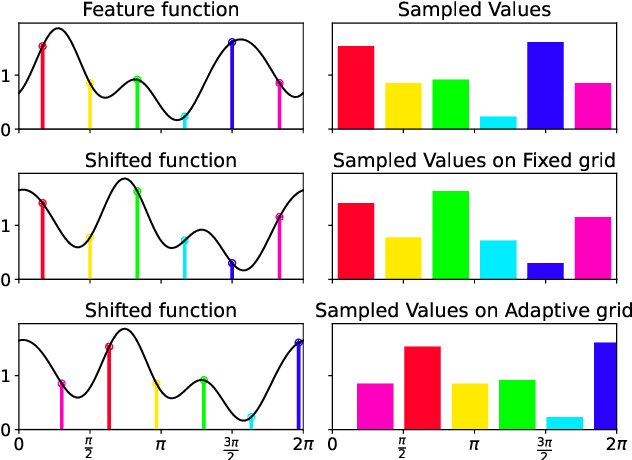
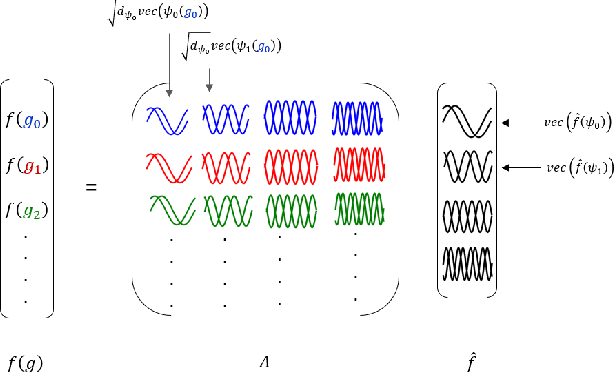
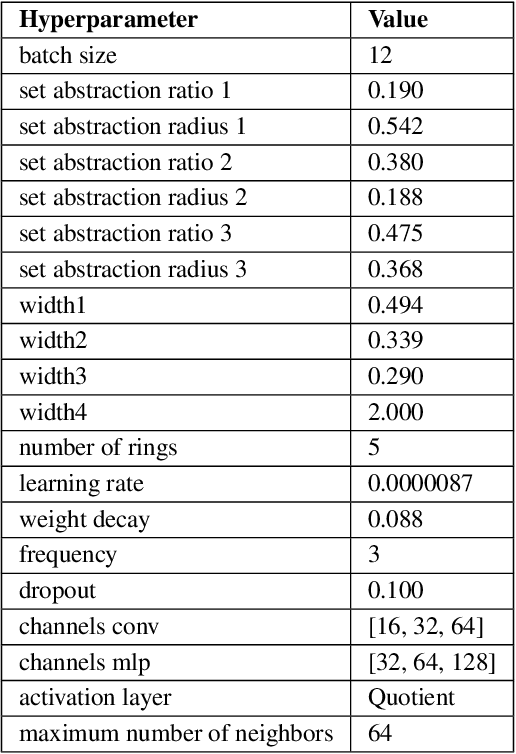
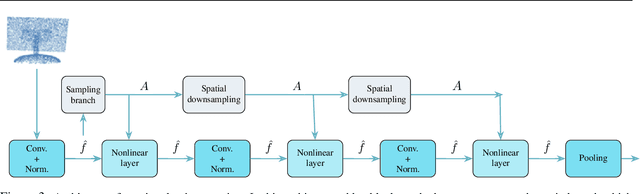
Steerable networks, which process data with intrinsic symmetries, often use Fourier-based nonlinearities that require sampling from the entire group, leading to a need for discretization in continuous groups. As the number of samples increases, both performance and equivariance improve, yet this also leads to higher computational costs. To address this, we introduce an adaptive sampling approach that dynamically adjusts the sampling process to the symmetries in the data, reducing the number of required group samples and lowering the computational demands. We explore various implementations and their effects on model performance, equivariance, and computational efficiency. Our findings demonstrate improved model performance, and a marginal increase in memory efficiency.
DC3DO: Diffusion Classifier for 3D Objects
Aug 13, 2024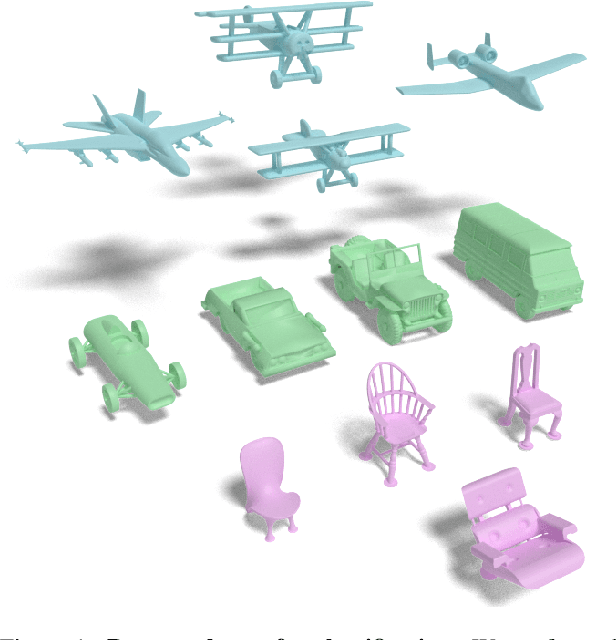
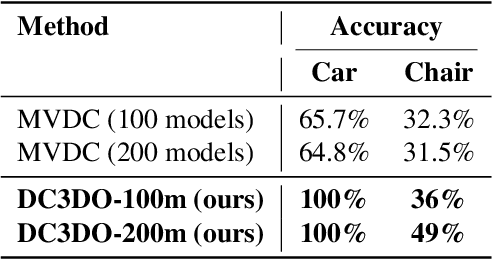
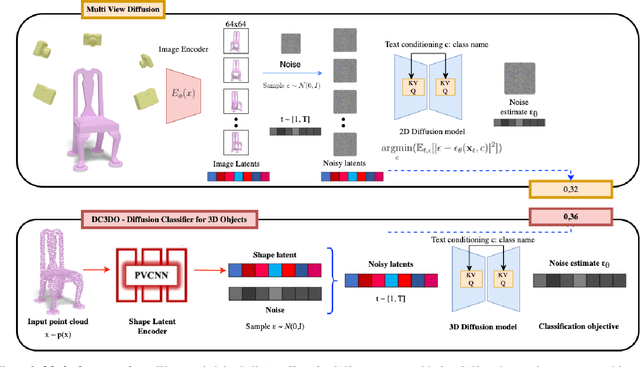
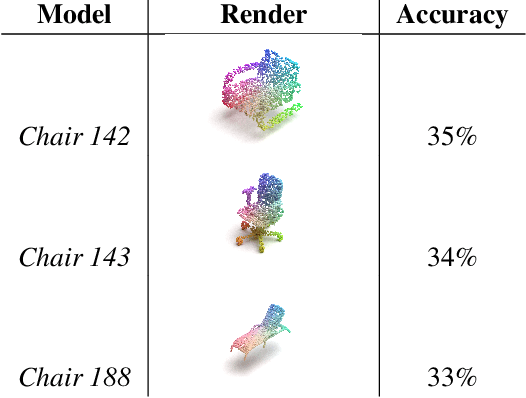
Inspired by Geoffrey Hinton emphasis on generative modeling, To recognize shapes, first learn to generate them, we explore the use of 3D diffusion models for object classification. Leveraging the density estimates from these models, our approach, the Diffusion Classifier for 3D Objects (DC3DO), enables zero-shot classification of 3D shapes without additional training. On average, our method achieves a 12.5 percent improvement compared to its multiview counterparts, demonstrating superior multimodal reasoning over discriminative approaches. DC3DO employs a class-conditional diffusion model trained on ShapeNet, and we run inferences on point clouds of chairs and cars. This work highlights the potential of generative models in 3D object classification.