 Add to Chrome
 Add to Firefox
 Add to Edge
MAST: Mask-Guided Attention Mass Allocation for Training-Free Multi-Style Transfer
Apr 14, 2026
Style transfer aims to render a content image with the visual characteristics of a reference style while preserving its underlying semantic layout and structural geometry. While recent diffusion-based models demonstrate strong stylization capabilities by leveraging powerful generative priors and controllable internal representations, they typically assume a single global style. Extending them to multi-style scenarios often leads to boundary artifacts, unstable stylization, and structural inconsistency due to interference between multiple style representations. To overcome these limitations, we propose MAST (Mask-Guided Attention Mass Allocation for Training-Free Multi-Style Transfer), a novel training-free framework that explicitly controls content-style interactions within the diffusion attention mechanism. To achieve artifact-free and structure-preserving stylization, MAST integrates four connected modules. First, Layout-preserving Query Anchoring prevents global layout collapse by firmly anchoring the semantic structure using content queries. Second, Logit-level Attention Mass Allocation deterministically distributes attention probability mass across spatial regions, seamlessly fusing multiple styles without boundary artifacts. Third, Sharpness-aware Temperature Scaling restores the attention sharpness degraded by multi-style expansion. Finally, Discrepancy-aware Detail Injection adaptively compensates for localized high-frequency detail losses by measuring structural discrepancies. Extensive experiments demonstrate that MAST effectively mitigates boundary artifacts and maintains structural consistency, preserving texture fidelity and spatial coherence even as the number of applied styles increases.

Text-to-Image Synthesis for Any Artistic Styles: Advancements in Personalized Artistic Image Generation via Subdivision and Dual Binding
Apr 08, 2024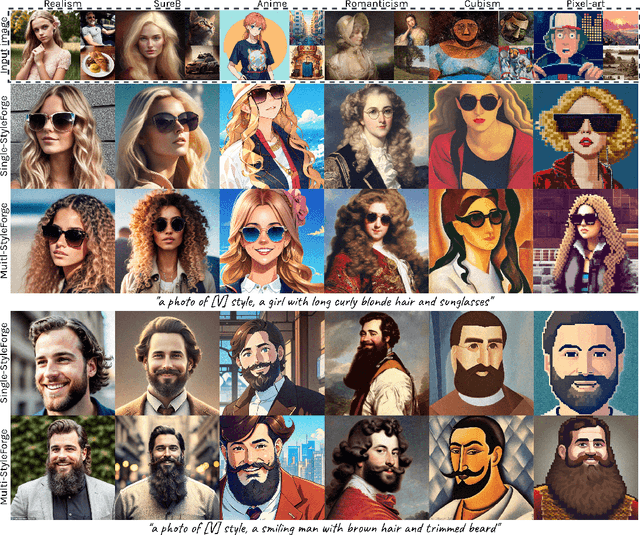

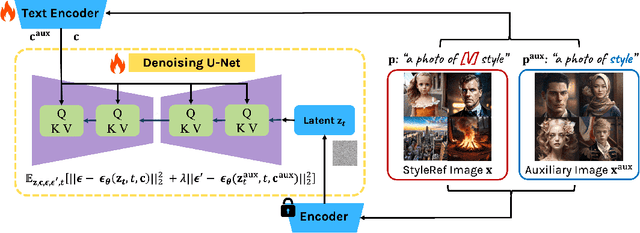

Recent advancements in text-to-image models, such as Stable Diffusion, have demonstrated their ability to synthesize visual images through natural language prompts. One approach of personalizing text-to-image models, exemplified by DreamBooth, fine-tunes the pre-trained model by binding unique text identifiers with a few images of a specific subject. Although existing fine-tuning methods have demonstrated competence in rendering images according to the styles of famous painters, it is still challenging to learn to produce images encapsulating distinct art styles due to abstract and broad visual perceptions of stylistic attributes such as lines, shapes, textures, and colors. In this paper, we introduce a new method, Single-StyleForge, for personalization. It fine-tunes pre-trained text-to-image diffusion models to generate diverse images in specified styles from text prompts. By using around 15-20 images of the target style, the approach establishes a foundational binding of a unique token identifier with a broad range of the target style. It also utilizes auxiliary images to strengthen this binding, resulting in offering specific guidance on representing elements such as persons in a target style-consistent manner. In addition, we present ways to improve the quality of style and text-image alignment through a method called Multi-StyleForge, which inherits the strategy used in StyleForge and learns tokens in multiple. Experimental evaluation conducted on six distinct artistic styles demonstrates substantial improvements in both the quality of generated images and the perceptual fidelity metrics, such as FID, KID, and CLIP scores.