 Add to Chrome
 Add to Firefox
 Add to Edge
MTL-FNO: A Lightweight Multi-Task Fourier Neural Operator for Sparse Field Reconstruction
May 26, 2026
Efficient onboard multi-field sparse reconstruction is essential for the autonomous operation of aerospace vehicles. While existing deep learning models exhibit promise for single-field reconstruction, deploying multiple independent models leads to prohibitive model size growth and fails to exploit cross-field correlations, particularly under few-shot conditions. To address these challenges, we first propose a lightweight multi-task Fourier neural operator (MTL-FNO), an end-to-end joint training framework based on hard parameter sharing. In each layer, the parameters are divided into shared and task-specific components to capture common features across fields while preserving task-specific characteristics. Moreover, the task-specific fine-tuning parameters are implemented as low-rank terms, achieving substantial model compression. Second, to address the difficulty of co-optimizing shared and task-specific parameters along with their real and imaginary parts, we revisit the FNO's spectral weight from a polar-form perspective and devise a physically meaningful decoupled optimization scheme. Specifically, we apply polar decomposition to slice-wise disentangle the spectral weight into a unitary tensor encoding phase information and a positive semi-definite tensor characterizing amplitude. By decoupling the optimization of phase and amplitude, our method can effectively mitigate tasks conflict. Meanwhile, to preserve unitary geometric fidelity during training, the Cayley transform is introduced to reparameterize the unitary tensor, converting the constrained optimization problem to an unconstrained one. Finally, the effectiveness of the proposed method under few-shot conditions is validated on two representative engineering cases. Results show that MTL-FNO achieves accuracy comparable to or even surpassing that of standard FNO, while reducing total model size by 76% and 60%, respectively.

Enriched Physics-informed Neural Networks for Dynamic Poisson-Nernst-Planck Systems
Feb 01, 2024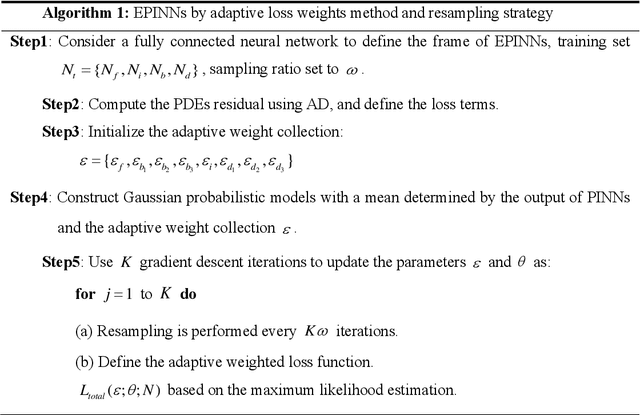
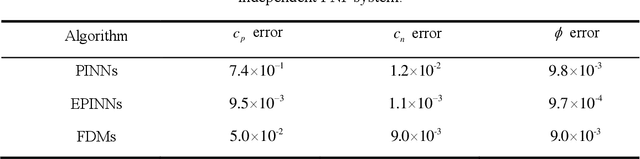
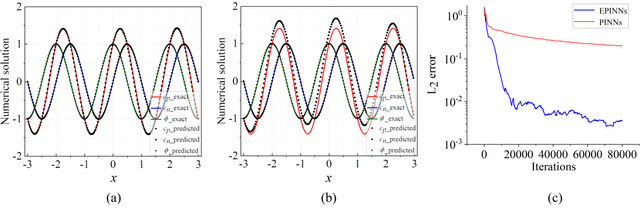

This paper proposes a meshless deep learning algorithm, enriched physics-informed neural networks (EPINNs), to solve dynamic Poisson-Nernst-Planck (PNP) equations with strong coupling and nonlinear characteristics. The EPINNs takes the traditional physics-informed neural networks as the foundation framework, and adds the adaptive loss weight to balance the loss functions, which automatically assigns the weights of losses by updating the parameters in each iteration based on the maximum likelihood estimate. The resampling strategy is employed in the EPINNs to accelerate the convergence of loss function. Meanwhile, the GPU parallel computing technique is adopted to accelerate the solving process. Four examples are provided to demonstrate the validity and effectiveness of the proposed method. Numerical results indicate that the new method has better applicability than traditional numerical methods in solving such coupled nonlinear systems. More importantly, the EPINNs is more accurate, stable, and fast than the traditional physics-informed neural networks. This work provides a simple and high-performance numerical tool for addressing PNPs with arbitrary boundary shapes and boundary conditions.