 Add to Chrome
 Add to Firefox
 Add to Edge
MTL-FNO: A Lightweight Multi-Task Fourier Neural Operator for Sparse Field Reconstruction
May 26, 2026
Efficient onboard multi-field sparse reconstruction is essential for the autonomous operation of aerospace vehicles. While existing deep learning models exhibit promise for single-field reconstruction, deploying multiple independent models leads to prohibitive model size growth and fails to exploit cross-field correlations, particularly under few-shot conditions. To address these challenges, we first propose a lightweight multi-task Fourier neural operator (MTL-FNO), an end-to-end joint training framework based on hard parameter sharing. In each layer, the parameters are divided into shared and task-specific components to capture common features across fields while preserving task-specific characteristics. Moreover, the task-specific fine-tuning parameters are implemented as low-rank terms, achieving substantial model compression. Second, to address the difficulty of co-optimizing shared and task-specific parameters along with their real and imaginary parts, we revisit the FNO's spectral weight from a polar-form perspective and devise a physically meaningful decoupled optimization scheme. Specifically, we apply polar decomposition to slice-wise disentangle the spectral weight into a unitary tensor encoding phase information and a positive semi-definite tensor characterizing amplitude. By decoupling the optimization of phase and amplitude, our method can effectively mitigate tasks conflict. Meanwhile, to preserve unitary geometric fidelity during training, the Cayley transform is introduced to reparameterize the unitary tensor, converting the constrained optimization problem to an unconstrained one. Finally, the effectiveness of the proposed method under few-shot conditions is validated on two representative engineering cases. Results show that MTL-FNO achieves accuracy comparable to or even surpassing that of standard FNO, while reducing total model size by 76% and 60%, respectively.

VibeServe: Can AI Agents Build Bespoke LLM Serving Systems?
May 07, 2026For years, we have built LLM serving systems like any other critical infrastructure: a single general-purpose stack, hand-tuned over many engineer-years, meant to support every model and workload. In this paper, we take the opposite bet: a multi-agent loop that automatically synthesizes bespoke serving systems for different usage scenarios. We propose VibeServe, the first agentic loop that generates entire LLM serving stacks end-to-end. VibeServe uses an outer loop to plan and track the search over system designs, and an inner loop to implement candidates, check correctness, and measure performance on the target benchmark. In the standard deployment setting, where existing stacks are highly optimized, VibeServe remains competitive with vLLM, showing that generation-time specialization need not come at the cost of performance. More interestingly, in non-standard scenarios, VibeServe outperforms existing systems by exploiting opportunities that generic systems miss in six scenarios involving non-standard model architectures, workload knowledge, and hardware-specific optimizations. Together, these results suggest a different point in the design space for infrastructure software: generation-time specialization rather than runtime generality. Code is available at https://github.com/uw-syfi/vibe-serve.
SynergyWarpNet: Attention-Guided Cooperative Warping for Neural Portrait Animation
Dec 19, 2025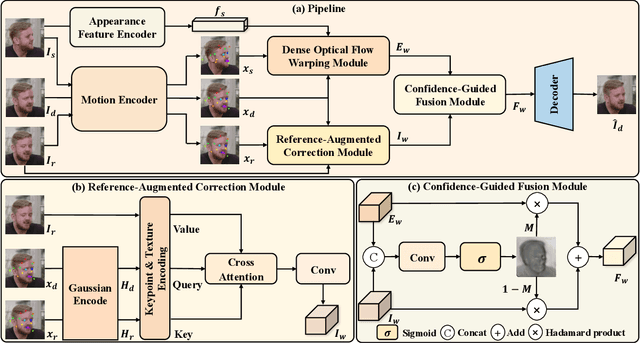
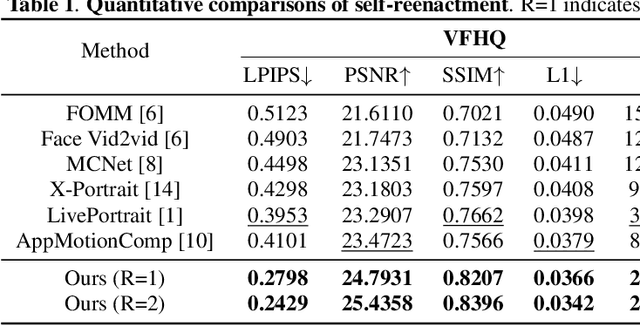
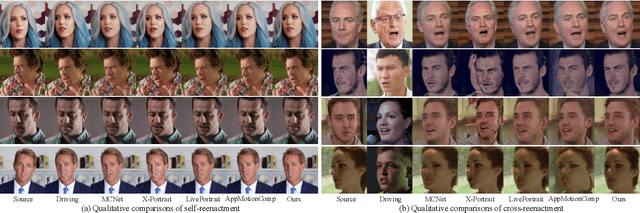
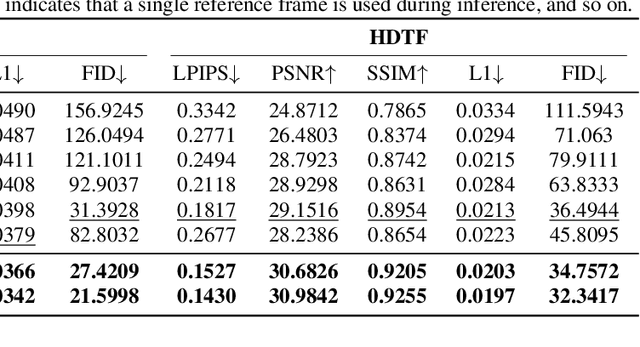
Recent advances in neural portrait animation have demonstrated remarked potential for applications in virtual avatars, telepresence, and digital content creation. However, traditional explicit warping approaches often struggle with accurate motion transfer or recovering missing regions, while recent attention-based warping methods, though effective, frequently suffer from high complexity and weak geometric grounding. To address these issues, we propose SynergyWarpNet, an attention-guided cooperative warping framework designed for high-fidelity talking head synthesis. Given a source portrait, a driving image, and a set of reference images, our model progressively refines the animation in three stages. First, an explicit warping module performs coarse spatial alignment between the source and driving image using 3D dense optical flow. Next, a reference-augmented correction module leverages cross-attention across 3D keypoints and texture features from multiple reference images to semantically complete occluded or distorted regions. Finally, a confidence-guided fusion module integrates the warped outputs with spatially-adaptive fusing, using a learned confidence map to balance structural alignment and visual consistency. Comprehensive evaluations on benchmark datasets demonstrate state-of-the-art performance.
Physics-Guided Reinforcement Learning System for Realistic Vehicle Active Suspension Control
Aug 15, 2024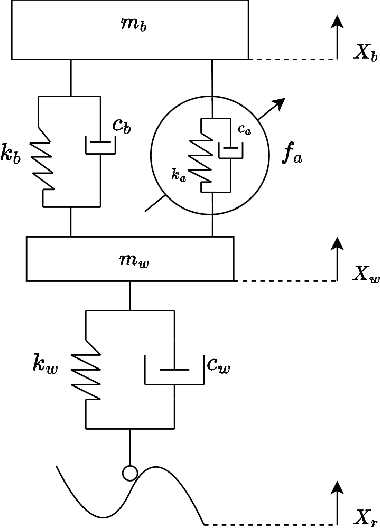
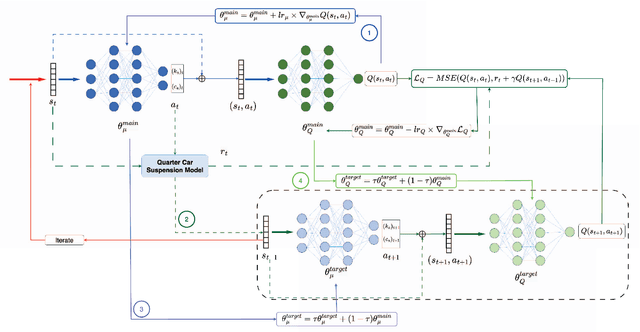
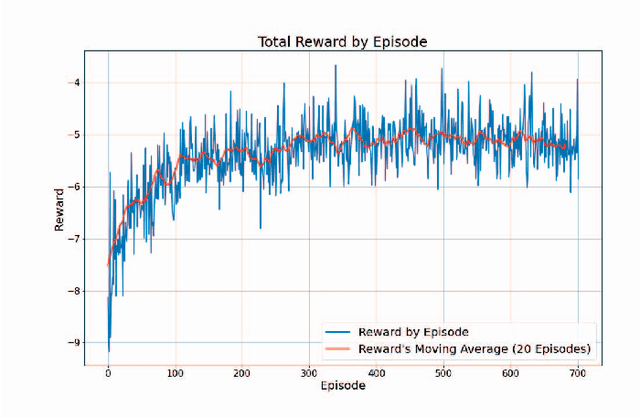
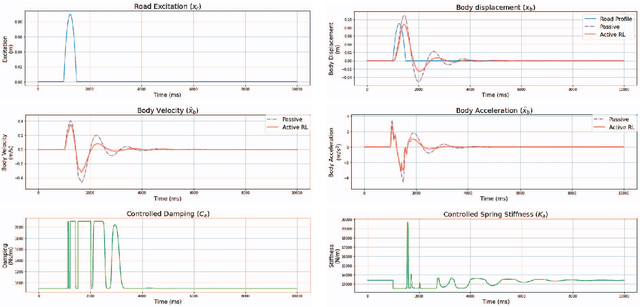
The suspension system is a crucial part of the automotive chassis, improving vehicle ride comfort and isolating passengers from rough road excitation. Unlike passive suspension, which has constant spring and damping coefficients, active suspension incorporates electronic actuators into the system to dynamically control stiffness and damping variables. However, effectively controlling the suspension system poses a challenging task that necessitates real-time adaptability to various road conditions. This paper presents the Physics-Guided Deep Reinforcement Learning (DRL) for adjusting an active suspension system's variable kinematics and compliance properties for a quarter-car model in real time. Specifically, the outputs of the model are defined as actuator stiffness and damping control, which are bound within physically realistic ranges to maintain the system's physical compliance. The proposed model was trained on stochastic road profiles according to ISO 8608 standards to optimize the actuator's control policy. According to qualitative results on simulations, the vehicle body reacts smoothly to various novel real-world road conditions, having a much lower degree of oscillation. These observations mean a higher level of passenger comfort and better vehicle stability. Quantitatively, DRL outperforms passive systems in reducing the average vehicle body velocity and acceleration by 43.58% and 17.22%, respectively, minimizing the vertical movement impacts on the passengers. The code is publicly available at github.com/anh-nn01/RL4Suspension-ICMLA23.
* \c{opyright} 2024 IEEE. Personal use of this material is permitted. Permission from IEEE must be obtained for all other uses, in any current or future media, including reprinting/republishing this material for advertising or promotional purposes, creating new collective works, for resale or redistribution to servers or lists, or reuse of any copyrighted component of this work in other works