 Add to Chrome
 Add to Firefox
 Add to Edge
Agnosiophobia in a virtual agent: behavioral and dynamical architecture in Lenia
May 29, 2026
All embodied agents are fundamentally patterns in physiological or other excitable media, blurring the distinction between objects and processes. Emergent patterns with complex behaviors, such as Gliders in the Game of Life and virtual patterns in Lenia, are powerful model systems in which to understand the properties and origins of behavioral traits in novel agents. To evaluate the behavior of patterns in Lenia, we introduce regions into their environment from which no sensory information is available - in effect, making creatures blind to parts of their surroundings. Complementing the conventional concept of infotaxis, we find that creatures tend to avoid these regions, a behavior we term agnosiophobia. To explain this behavior, we map each test creature's sensitivity to targeted occlusions and interpret the results in the language of dynamical systems. We observe Lenia creatures taking advantage of their freedom to change heading in order to achieve what appears to be a more fundamental goal: the preservation of their morphology. This work illustrates the beginning of an important roadmap to understand how emergent agents' behavioral propensities interact with the informational, not only tangible, topography of their world.

A Little Rank Goes a Long Way: Random Scaffolds with LoRA Adapters Are All You Need
Apr 13, 2026How many of a neural network's parameters actually encode task-specific information? We investigate this question with LottaLoRA, a training paradigm in which every backbone weight is drawn at random and frozen; only low-rank LoRA adapters are trained. Across nine benchmarks spanning diverse architecture families from single-layer classifiers to 900M parameter Transformers low-rank adapters over frozen random backbones recover 96-100% of fully trained performance while training only 0.5-40% of the parameters. The task-specific signal therefore occupies a subspace orders of magnitude smaller than the full parameter count suggests. Three mechanistic findings underpin this result:(1) the frozen backbone is actively exploited when static the learned scaling~$β$ remains strictly positive across all architectures but when the scaffold is destabilized, the optimizer silences it and the LoRA factors absorb all task information; (2) the frozen backbone is preferable but interchangeable any random initialization works equally well, provided it remains fixed throughout training; and (3) the minimum LoRA rank at which performance saturates estimates the intrinsic dimensionality of the task, reminiscent of the number of components retained in Principal Component Analysis (PCA). The construction is formally analogous to Reservoir Computing unfolded along the depth axis of a feedforward network. Because the backbone is determined by a random seed alone, models can be distributed as adapters plus seed a footprint that grows with task complexity, not model size, so that storage and memory savings compound as architectures scale.
BraiNCA: brain-inspired neural cellular automata and applications to morphogenesis and motor control
Apr 02, 2026Most of the Neural Cellular Automata (NCAs) defined in the literature have a common theme: they are based on regular grids with a Moore neighborhood (one-hop neighbour). They do not take into account long-range connections and more complex topologies as we can find in the brain. In this paper, we introduce BraiNCA, a brain-inspired NCA with an attention layer, long-range connections and complex topology. BraiNCAs shows better results in terms of robustness and speed of learning on the two tasks compared to Vanilla NCAs establishing that incorporating attention-based message selection together with explicit long-range edges can yield more sample-efficient and damage-tolerant self-organization than purely local, grid-based update rules. These results support the hypothesis that, for tasks requiring distributed coordination over extended spatial and temporal scales, the choice of interaction topology and the ability to dynamically route information will impact the robustness and speed of learning of an NCA. More broadly, BraiNCA provides brain-inspired NCA formulation that preserves the decentralized local update principle while better reflecting non-local connectivity patterns, making it a promising substrate for studying collective computation under biologically-realistic network structure and evolving cognitive substrates.
Evolving Symbiosis, from Barricelli's Legacy to Collective Intelligence: a simulated and conceptual approach
Mar 09, 2026This report documents the work of our group (named SymBa) at the ALICE 2026 workshop in Copenhagen. Inspired by the pioneering work by Nils Aall Barricelli on symbiogenesis of numerical organisms (i.e., 1D cellular automata) in 1953 (70+ years ago!!), we discussed the role of symbiogenesis as mechanism contributing to the origins of life, open-endedness, and collective intelligence. We report replications of Barricelli's original work in 1D worlds, an extension to 2D symbioorganisms, and preliminary experimentation with DNA-norms. We discuss the implications of symbiogenesis for artifical life and artificial intelligence, and outline several opportunities for future works, both at the conceptual level as well as using different substrates (neural networks, neural cellular automata, etc.)
Remapping and navigation of an embedding space via error minimization: a fundamental organizational principle of cognition in natural and artificial systems
Jan 20, 2026The emerging field of diverse intelligence seeks an integrated view of problem-solving in agents of very different provenance, composition, and substrates. From subcellular chemical networks to swarms of organisms, and across evolved, engineered, and chimeric systems, it is hypothesized that scale-invariant principles of decision-making can be discovered. We propose that cognition in both natural and synthetic systems can be characterized and understood by the interplay between two equally important invariants: (1) the remapping of embedding spaces, and (2) the navigation within these spaces. Biological collectives, from single cells to entire organisms (and beyond), remap transcriptional, morphological, physiological, or 3D spaces to maintain homeostasis and regenerate structure, while navigating these spaces through distributed error correction. Modern Artificial Intelligence (AI) systems, including transformers, diffusion models, and neural cellular automata enact analogous processes by remapping data into latent embeddings and refining them iteratively through contextualization. We argue that this dual principle - remapping and navigation of embedding spaces via iterative error minimization - constitutes a substrate-independent invariant of cognition. Recognizing this shared mechanism not only illuminates deep parallels between living systems and artificial models, but also provides a unifying framework for engineering adaptive intelligence across scales.
Heuristically Adaptive Diffusion-Model Evolutionary Strategy
Nov 20, 2024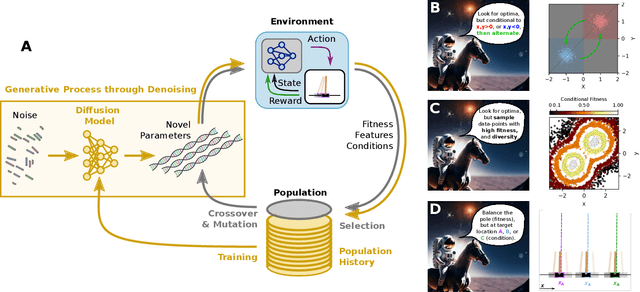
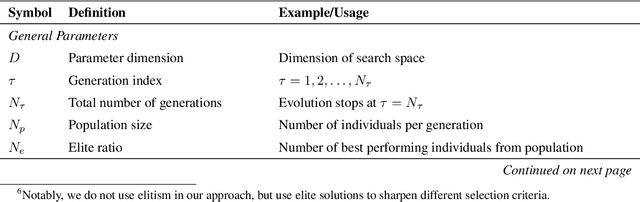
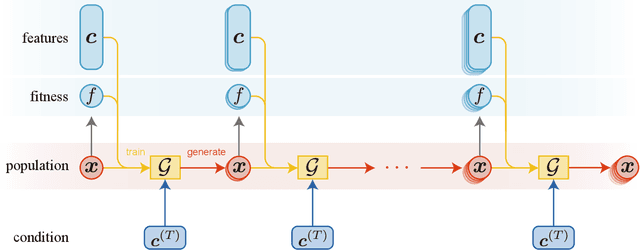
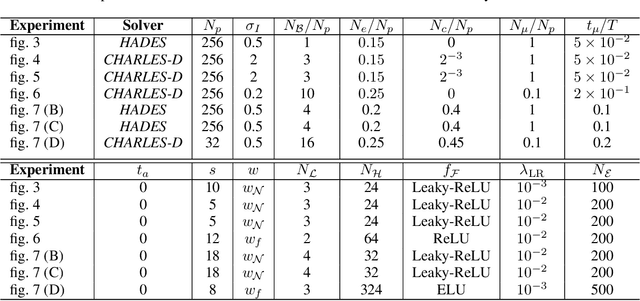
Diffusion Models represent a significant advancement in generative modeling, employing a dual-phase process that first degrades domain-specific information via Gaussian noise and restores it through a trainable model. This framework enables pure noise-to-data generation and modular reconstruction of, images or videos. Concurrently, evolutionary algorithms employ optimization methods inspired by biological principles to refine sets of numerical parameters encoding potential solutions to rugged objective functions. Our research reveals a fundamental connection between diffusion models and evolutionary algorithms through their shared underlying generative mechanisms: both methods generate high-quality samples via iterative refinement on random initial distributions. By employing deep learning-based diffusion models as generative models across diverse evolutionary tasks and iteratively refining diffusion models with heuristically acquired databases, we can iteratively sample potentially better-adapted offspring parameters, integrating them into successive generations of the diffusion model. This approach achieves efficient convergence toward high-fitness parameters while maintaining explorative diversity. Diffusion models introduce enhanced memory capabilities into evolutionary algorithms, retaining historical information across generations and leveraging subtle data correlations to generate refined samples. We elevate evolutionary algorithms from procedures with shallow heuristics to frameworks with deep memory. By deploying classifier-free guidance for conditional sampling at the parameter level, we achieve precise control over evolutionary search dynamics to further specific genotypical, phenotypical, or population-wide traits. Our framework marks a major heuristic and algorithmic transition, offering increased flexibility, precision, and control in evolutionary optimization processes.
Diffusion Models are Evolutionary Algorithms
Oct 03, 2024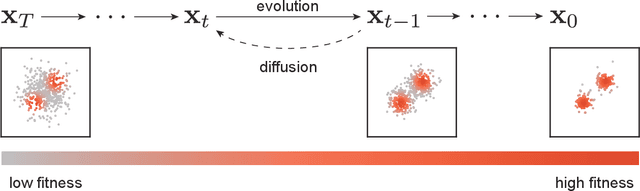
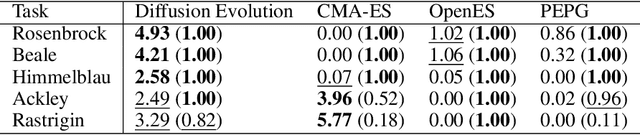
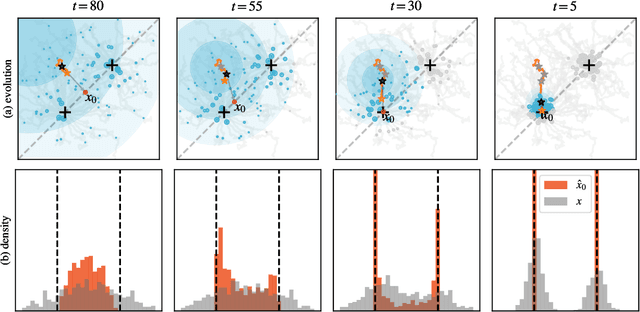
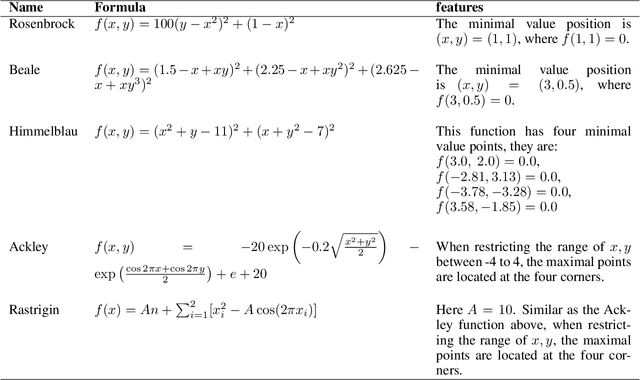
In a convergence of machine learning and biology, we reveal that diffusion models are evolutionary algorithms. By considering evolution as a denoising process and reversed evolution as diffusion, we mathematically demonstrate that diffusion models inherently perform evolutionary algorithms, naturally encompassing selection, mutation, and reproductive isolation. Building on this equivalence, we propose the Diffusion Evolution method: an evolutionary algorithm utilizing iterative denoising -- as originally introduced in the context of diffusion models -- to heuristically refine solutions in parameter spaces. Unlike traditional approaches, Diffusion Evolution efficiently identifies multiple optimal solutions and outperforms prominent mainstream evolutionary algorithms. Furthermore, leveraging advanced concepts from diffusion models, namely latent space diffusion and accelerated sampling, we introduce Latent Space Diffusion Evolution, which finds solutions for evolutionary tasks in high-dimensional complex parameter space while significantly reducing computational steps. This parallel between diffusion and evolution not only bridges two different fields but also opens new avenues for mutual enhancement, raising questions about open-ended evolution and potentially utilizing non-Gaussian or discrete diffusion models in the context of Diffusion Evolution.