 Add to Chrome
 Add to Firefox
 Add to Edge
DARTH-PUM: A Hybrid Processing-Using-Memory Architecture
Feb 17, 2026
Analog processing-using-memory (PUM; a.k.a. in-memory computing) makes use of electrical interactions inside memory arrays to perform bulk matrix-vector multiplication (MVM) operations. However, many popular matrix-based kernels need to execute non-MVM operations, which analog PUM cannot directly perform. To retain its energy efficiency, analog PUM architectures augment memory arrays with CMOS-based domain-specific fixed-function hardware to provide complete kernel functionality, but the difficulty of integrating such specialized CMOS logic with memory arrays has largely limited analog PUM to being an accelerator for machine learning inference, or for closely related kernels. An opportunity exists to harness analog PUM for general-purpose computation: recent works have shown that memory arrays can also perform Boolean PUM operations, albeit with very different supporting hardware and electrical signals than analog PUM. We propose DARTH-PUM, a general-purpose hybrid PUM architecture that tackles key hardware and software challenges to integrating analog PUM and digital PUM. We propose optimized peripheral circuitry, coordinating hardware to manage and interface between both types of PUM, an easy-to-use programming interface, and low-cost support for flexible data widths. These design elements allow us to build a practical PUM architecture that can execute kernels fully in memory, and can scale easily to cater to domains ranging from embedded applications to large-scale data-driven computing. We show how three popular applications (AES encryption, convolutional neural networks, large-language models) can map to and benefit from DARTH-PUM, with speedups of 59.4x, 14.8x, and 40.8x over an analog+CPU baseline.

Incorruptible Neural Networks: Training Models that can Generalize to Large Internal Perturbations
Feb 07, 2026Flat regions of the neural network loss landscape have long been hypothesized to correlate with better generalization properties. A closely related but distinct problem is training models that are robust to internal perturbations to their weights, which may be an important need for future low-power hardware platforms. In this paper, we explore the usage of two methods, sharpness-aware minimization (SAM) and random-weight perturbation (RWP), to find minima robust to a variety of random corruptions to weights. We consider the problem from two angles: generalization (how do we reduce the noise-robust generalization gap) and optimization (how do we maximize performance from optimizers when subject to strong perturbations). First, we establish, both theoretically and empirically, that an over-regularized RWP training objective is optimal for noise-robust generalization. For small-magnitude noise, we find that SAM's adversarial objective further improves performance over any RWP configuration, but performs poorly for large-magnitude noise. We link the cause of this to a vanishing-gradient effect, caused by unevenness in the loss landscape, affecting both SAM and RWP. Lastly, we demonstrate that dynamically adjusting the perturbation strength to match the evolution of the loss landscape improves optimizing for these perturbed objectives.
Analog fast Fourier transforms for scalable and efficient signal processing
Sep 27, 2024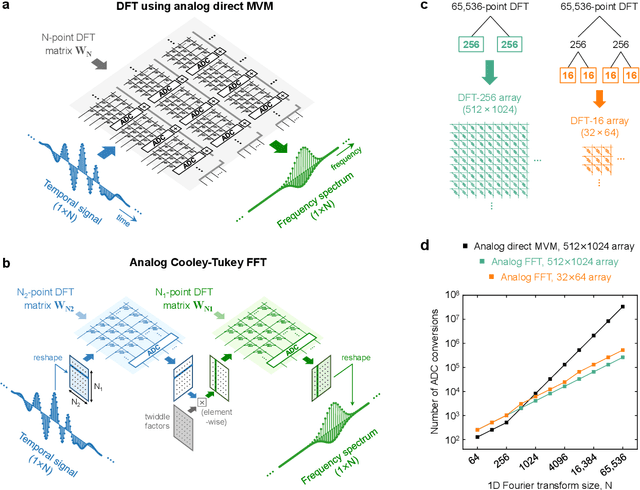
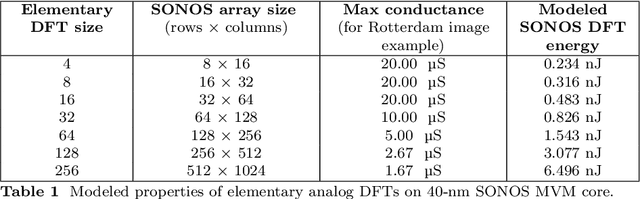
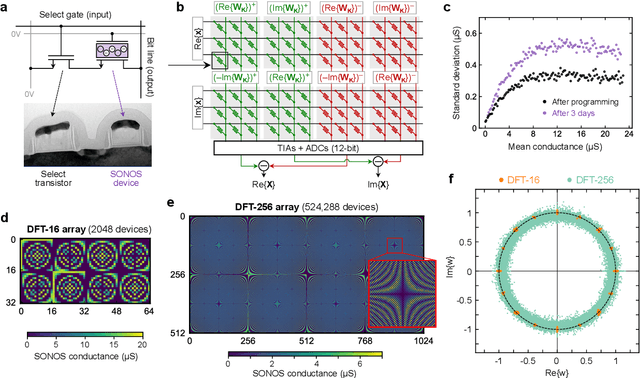
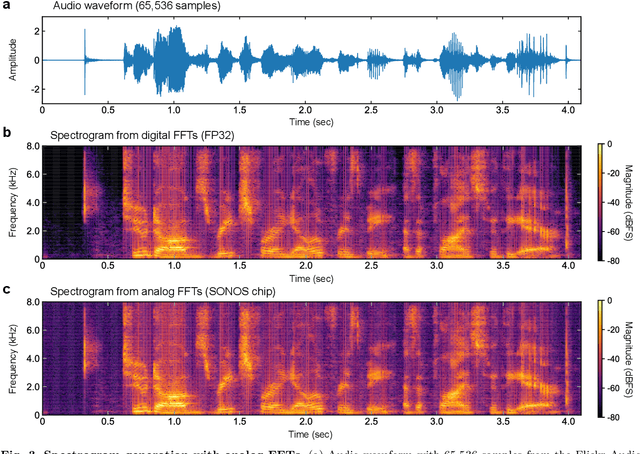
Edge devices are being deployed at increasing volumes to sense and act on information from the physical world. The discrete Fourier transform (DFT) is often necessary to make this sensed data suitable for further processing $\unicode{x2013}$ such as by artificial intelligence (AI) algorithms $\unicode{x2013}$ and for transmission over communication networks. Analog in-memory computing has been shown to be a fast and energy-efficient solution for processing edge AI workloads, but not for Fourier transforms. This is because of the existence of the fast Fourier transform (FFT) algorithm, which enormously reduces the complexity of the DFT but has so far belonged only to digital processors. Here, we show that the FFT can be mapped to analog in-memory computing systems, enabling them to efficiently scale to arbitrarily large Fourier transforms without requiring large sizes or large numbers of non-volatile memory arrays. We experimentally demonstrate analog FFTs on 1D audio and 2D image signals, using a large-scale charge-trapping memory array with precisely tunable, low-conductance analog states. The scalability of both the new analog FFT approach and the charge-trapping memory device is leveraged to compute a 65,536-point analog DFT, a scale that is otherwise inaccessible by analog systems and which is $>$1000$\times$ larger than any previous analog DFT demonstration. The analog FFT also provides more numerically precise DFTs with greater tolerance to device and circuit non-idealities than a direct matrix-vector multiplication approach. We show that the extension of the FFT algorithm to analog in-memory processors leads to design considerations that differ markedly from digital implementations, and that analog Fourier transforms have a substantial power efficiency advantage at all size scales over FFTs implemented on state-of-the-art digital hardware.
On the Accuracy of Analog Neural Network Inference Accelerators
Sep 12, 2021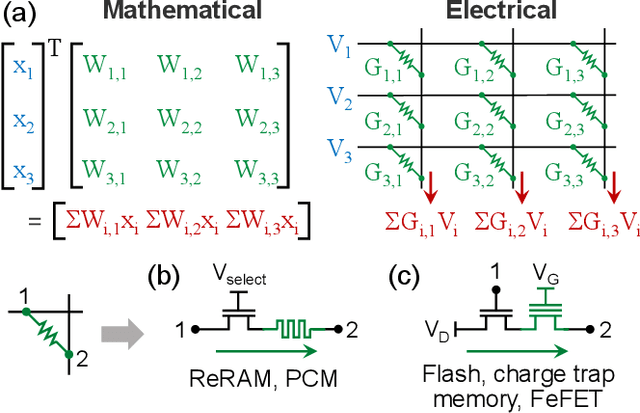
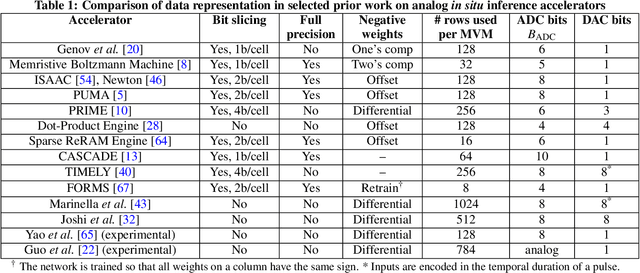
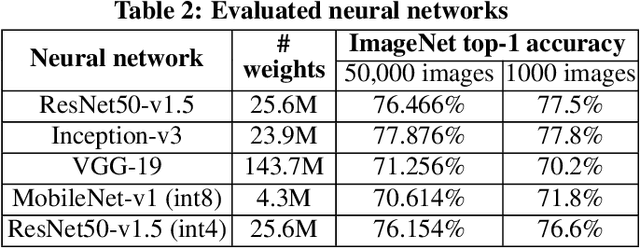
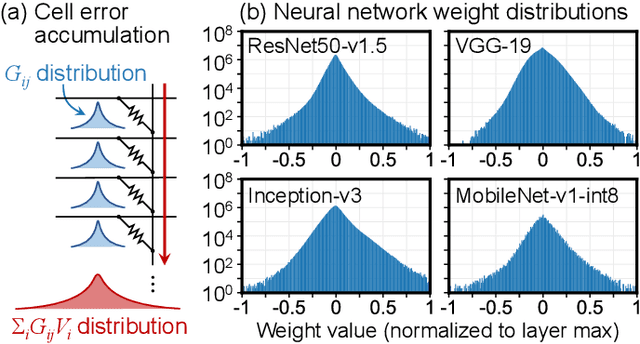
Specialized accelerators have recently garnered attention as a method to reduce the power consumption of neural network inference. A promising category of accelerators utilizes nonvolatile memory arrays to both store weights and perform $\textit{in situ}$ analog computation inside the array. While prior work has explored the design space of analog accelerators to optimize performance and energy efficiency, there is seldom a rigorous evaluation of the accuracy of these accelerators. This work shows how architectural design decisions, particularly in mapping neural network parameters to analog memory cells, influence inference accuracy. When evaluated using ResNet50 on ImageNet, the resilience of the system to analog non-idealities - cell programming errors, analog-to-digital converter resolution, and array parasitic resistances - all improve when analog quantities in the hardware are made proportional to the weights in the network. Moreover, contrary to the assumptions of prior work, nearly equivalent resilience to cell imprecision can be achieved by fully storing weights as analog quantities, rather than spreading weight bits across multiple devices, often referred to as bit slicing. By exploiting proportionality, analog system designers have the freedom to match the precision of the hardware to the needs of the algorithm, rather than attempting to guarantee the same level of precision in the intermediate results as an equivalent digital accelerator. This ultimately results in an analog accelerator that is more accurate, more robust to analog errors, and more energy-efficient.
Device-aware inference operations in SONOS nonvolatile memory arrays
Apr 02, 2020
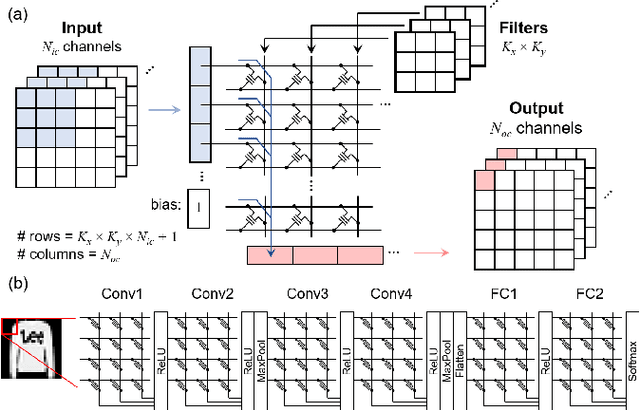


Non-volatile memory arrays can deploy pre-trained neural network models for edge inference. However, these systems are affected by device-level noise and retention issues. Here, we examine damage caused by these effects, introduce a mitigation strategy, and demonstrate its use in fabricated array of SONOS (Silicon-Oxide-Nitride-Oxide-Silicon) devices. On MNIST, fashion-MNIST, and CIFAR-10 tasks, our approach increases resilience to synaptic noise and drift. We also show strong performance can be realized with ADCs of 5-8 bits precision.
Evaluating complexity and resilience trade-offs in emerging memory inference machines
Feb 25, 2020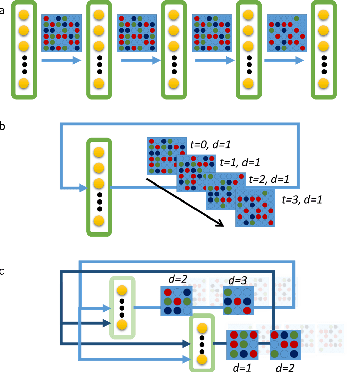
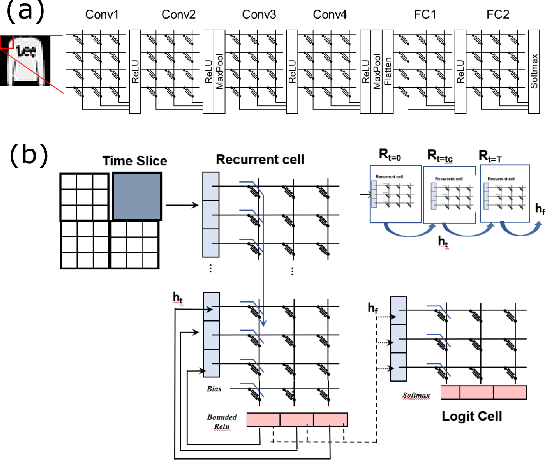

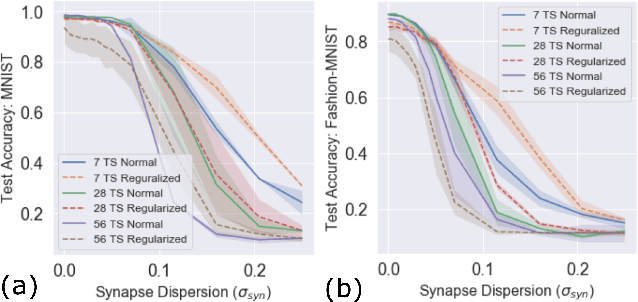
Neuromorphic-style inference only works well if limited hardware resources are maximized properly, e.g. accuracy continues to scale with parameters and complexity in the face of potential disturbance. In this work, we use realistic crossbar simulations to highlight that compact implementations of deep neural networks are unexpectedly susceptible to collapse from multiple system disturbances. Our work proposes a middle path towards high performance and strong resilience utilizing the Mosaics framework, and specifically by re-using synaptic connections in a recurrent neural network implementation that possesses a natural form of noise-immunity.