 Add to Chrome
 Add to Firefox
 Add to Edge
Spatial-IQ: Deconstructing Spatial Intelligence via Hierarchical Capability Tests
Jul 24, 2026
Multimodal large language models (MLLMs) excel at visual interpretation but fail on spatial reasoning tasks that humans solve reliably. Existing benchmarks evaluate these models as black boxes, limiting their ability to identify the underlying causes of lower performance: when a model fails a spatial reasoning task, it remains difficult to ascertain whether the hurdle is perceptual, such as recognizing object boundaries, or cognitive, such as reasoning about occlusion to infer hidden geometry. We introduce Spatial-IQ, a hierarchical diagnostic framework that decomposes object counting in stacked 3D structures into 9 perceptual and cognitive sub-tasks organized by the developmental stages of human spatial cognition, with mental rotation as an additional target probe. Using NVIDIA Isaac Sim, we procedurally generated a diverse dataset of roughly 80,000 stacked 3D structures with per-task ground truth. We evaluate models across three output formats (free-response text, multiple-choice images, and image editing) alongside a human baseline. The Spatial-IQ framework shows that top-performing models often succeed at the target task (object counting) without succeeding on the lower-level sub-tasks intended to support it, and that models differ in how much of these hierarchical chains they preserve, often revealing shortcut behavior that raw target-task accuracy alone would obscure. Finally, we demonstrate that training models with chain-of-thought (CoT) supervision over our hierarchical sub-tasks, combined with reinforcement learning with verifiable rewards, significantly improves both spatial consistency across sub-tasks and target-task accuracy, supporting the value of the proposed decomposition as both a diagnostic tool and a training signal.

SIDOD: A Synthetic Image Dataset for 3D Object Pose Recognition with Distractors
Aug 12, 2020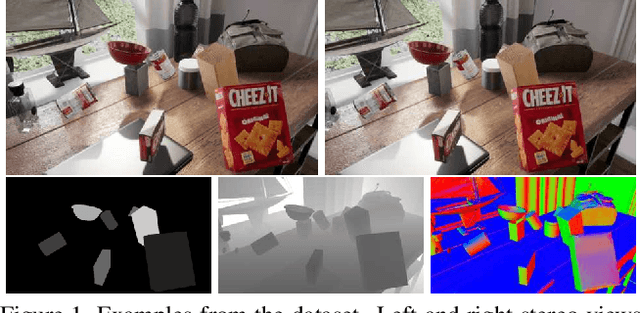
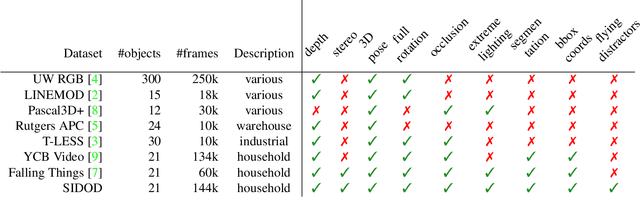
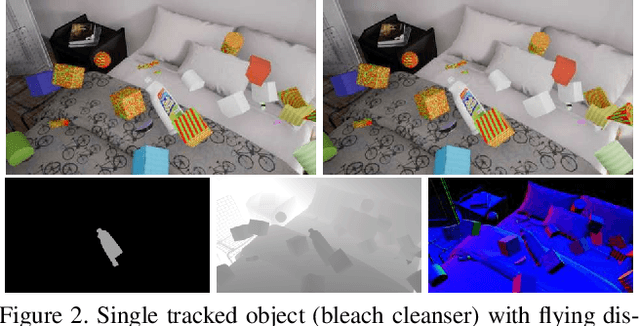
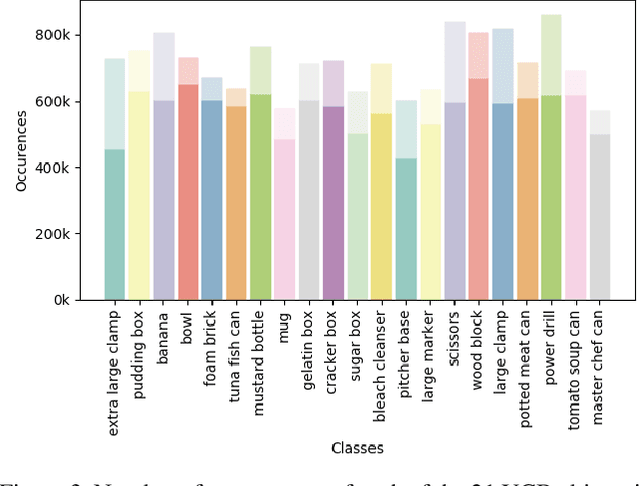
We present a new, publicly-available image dataset generated by the NVIDIA Deep Learning Data Synthesizer intended for use in object detection, pose estimation, and tracking applications. This dataset contains 144k stereo image pairs that synthetically combine 18 camera viewpoints of three photorealistic virtual environments with up to 10 objects (chosen randomly from the 21 object models of the YCB dataset [1]) and flying distractors. Object and camera pose, scene lighting, and quantity of objects and distractors were randomized. Each provided view includes RGB, depth, segmentation, and surface normal images, all pixel level. We describe our approach for domain randomization and provide insight into the decisions that produced the dataset.
Toward Standardized Classification of Foveated Displays
May 03, 2019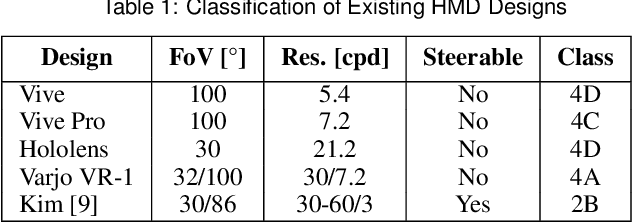
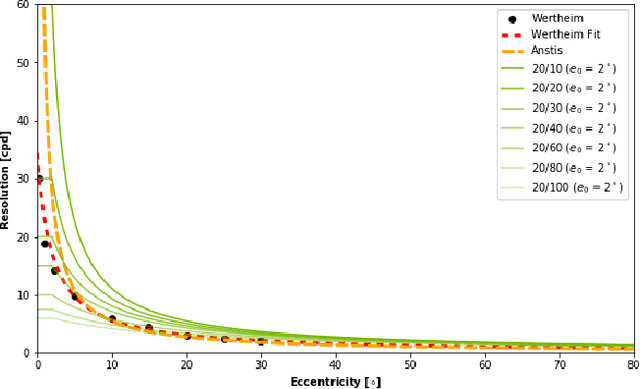
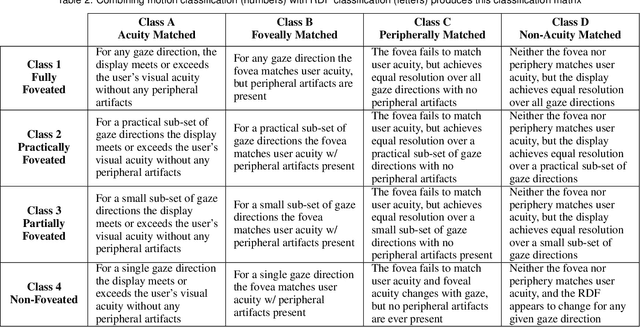
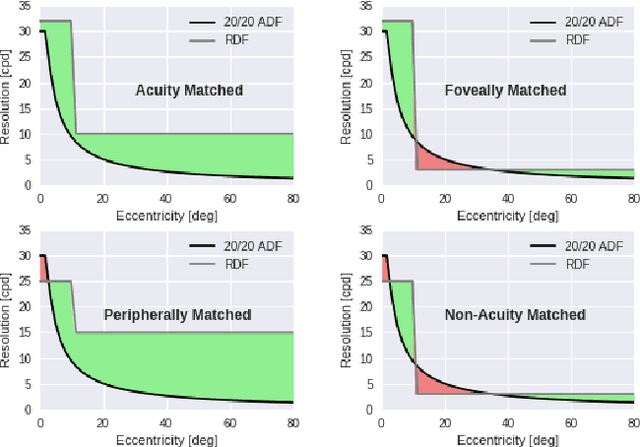
Emergent in the field of head mounted display design is a desire to leverage the limitations of the human visual system to reduce the computation, communication, and display workload in power and form-factor constrained systems. Fundamental to this reduced workload is the ability to match display resolution to the acuity of the human visual system, along with a resulting need to follow the gaze of the eye as it moves, a process referred to as foveation. A display that moves its content along with the eye may be called a Foveated Display, though this term is also commonly used to describe displays with non-uniform resolution that attempt to mimic human visual acuity. We therefore recommend a definition for the term Foveated Display that accepts both of these interpretations. Furthermore, we include a simplified model for human visual Acuity Distribution Functions (ADFs) at various levels of visual acuity, across wide fields of view and propose comparison of this ADF with the Resolution Distribution Function of a foveated display for evaluation of its resolution at a particular gaze direction. We also provide a taxonomy to allow the field to meaningfully compare and contrast various aspects of foveated displays in a display and optical technology-agnostic manner.