 Add to Chrome
 Add to Firefox
 Add to Edge
A Longitudinal Attribute-Conditioned Neural Network for Modeling Health-State Transition Probabilities in Temporally Irregular Data: The LANTERN Framework
Jun 11, 2026
Accurate estimation of long-term care transition probabilities is central to disability insurance pricing, reserving, and solvency assessment. Classical actuarial multi-state models commonly rely on Markov, semi-Markov, or proportional-hazard specifications, which provide a direct connection to cohort projection but may be restrictive for irregular longitudinal health data with nonlinear aging patterns and heterogeneous covariate histories. This paper develops a well-calibrated estimator of multi-state transition probabilities for irregular longitudinal health data. The model learns from individual health history, incorporates the time elapsed between observations, and conditions transition probabilities on demographic and socioeconomic attributes. It produces a valid probability distribution over the next observed health state, with four possible states: healthy, mild disability, severe disability, and death. Individual probabilities are aggregated by age group and origin state to form transition matrices compatible with actuarial cohort projection. Using longitudinal data from the Health and Retirement Study, we compare the proposed estimator with logistic regression, gradient-boosted trees, a recurrent neural network, and a last-state persistence benchmark. The evaluation considers probabilistic accuracy, endpoint discrimination and calibration for severe disability and death, risk concentration, and transition matrix error after aggregation. The proposed estimator improves severe disability discrimination relative to logistic regression and gradient-boosted tree benchmarks, maintains strong calibration, and yields the lowest transition matrix error among the evaluated models in the held-out test analysis. Results show that a structured machine learning estimator can support long-term care transition modeling when judged by calibration and projection fidelity, beyond discrimination.

A Novel Dataset Towards Extracting Virus-Host Interactions
May 11, 2023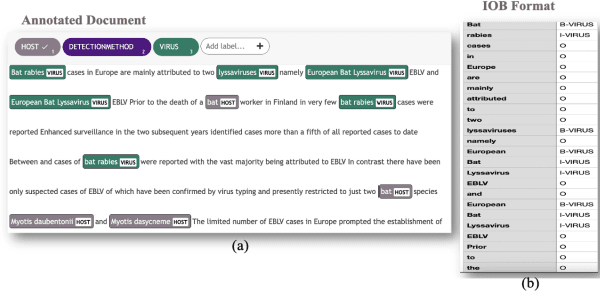
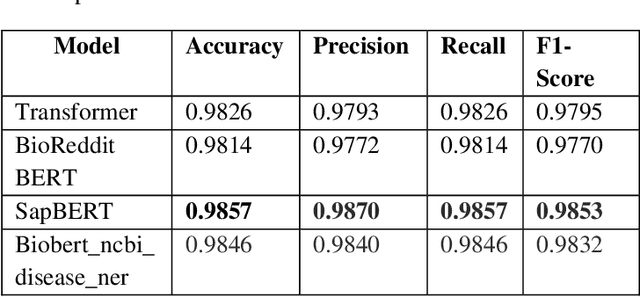
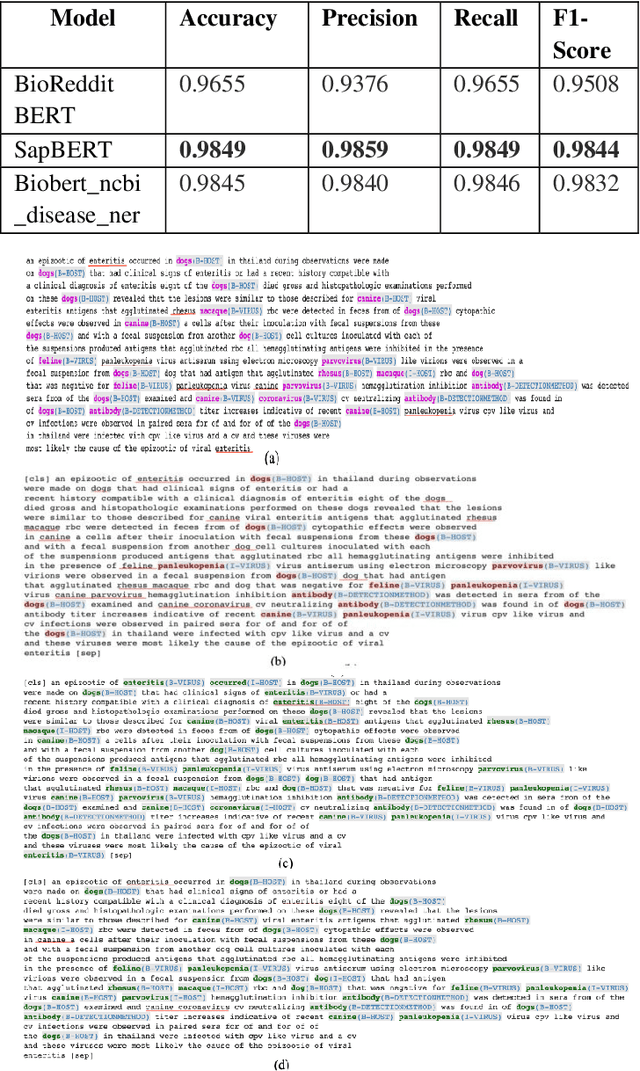
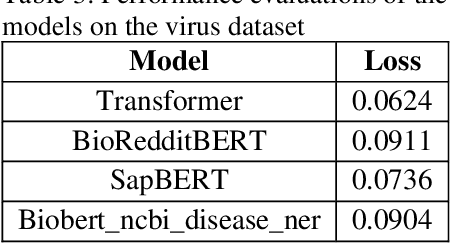
We describe a novel dataset for the automated recognition of named taxonomic and other entities relevant to the association of viruses with their hosts. We further describe some initial results using pre-trained models on the named-entity recognition (NER) task on this novel dataset. We propose that our dataset of manually annotated abstracts now offers a Gold Standard Corpus for training future NER models in the automated extraction of host-pathogen detection methods from scientific publications, and further explain how our work makes first steps towards predicting the important human health-related concept of viral spillover risk automatically from the scientific literature.