 Add to Chrome
 Add to Firefox
 Add to Edge
Learning inflection classes using Adaptive Resonance Theory
Dec 17, 2025
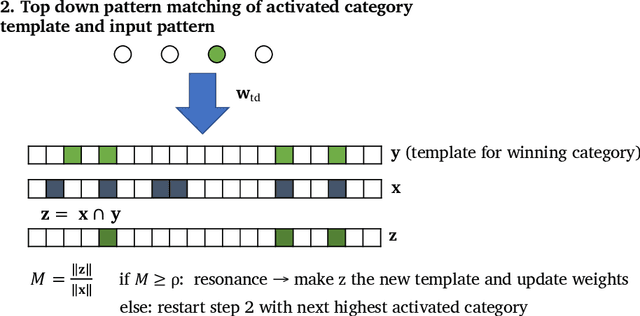
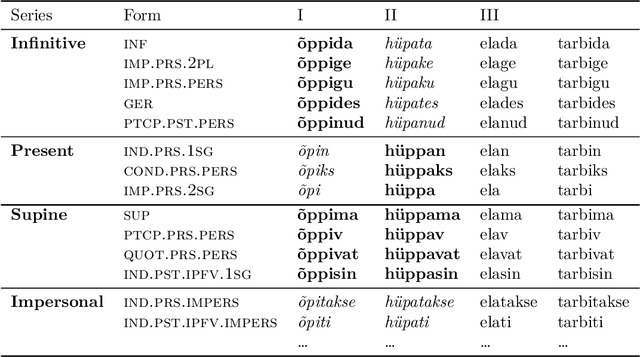
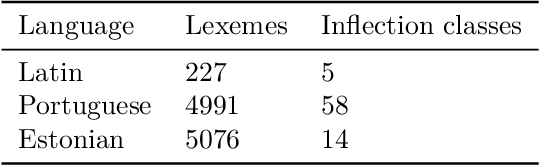
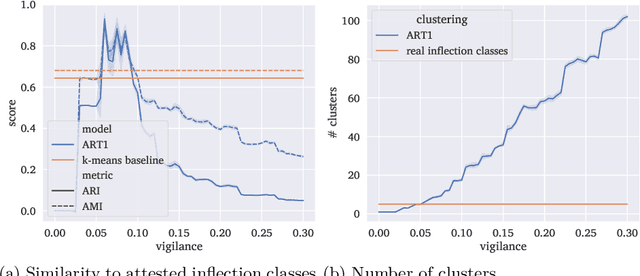
The concept of inflection classes is an abstraction used by linguists, and provides a means to describe patterns in languages that give an analogical base for deducing previously unencountered forms. This ability is an important part of morphological acquisition and processing. We study the learnability of a system of verbal inflection classes by the individual language user by performing unsupervised clustering of lexemes into inflection classes. As a cognitively plausible and interpretable computational model, we use Adaptive Resonance Theory, a neural network with a parameter that determines the degree of generalisation (vigilance). The model is applied to Latin, Portuguese and Estonian. The similarity of clustering to attested inflection classes varies depending on the complexity of the inflectional system. We find the best performance in a narrow region of the generalisation parameter. The learned features extracted from the model show similarity with linguistic descriptions of the inflection classes. The proposed model could be used to study change in inflection classes in the future, by including it in an agent-based model.

Smooth InfoMax -- Towards easier Post-Hoc interpretability
Aug 23, 2024

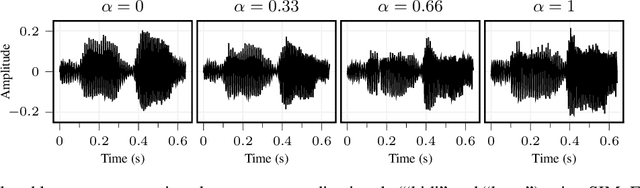

We introduce Smooth InfoMax (SIM), a novel method for self-supervised representation learning that incorporates an interpretability constraint into the learned representations at various depths of the neural network. SIM's architecture is split up into probabilistic modules, each locally optimized using the InfoNCE bound. Inspired by VAEs, the representations from these modules are designed to be samples from Gaussian distributions and are further constrained to be close to the standard normal distribution. This results in a smooth and predictable space, enabling traversal of the latent space through a decoder for easier post-hoc analysis of the learned representations. We evaluate SIM's performance on sequential speech data, showing that it performs competitively with its less interpretable counterpart, Greedy InfoMax (GIM). Moreover, we provide insights into SIM's internal representations, demonstrating that the contained information is less entangled throughout the representation and more concentrated in a smaller subset of the dimensions. This further highlights the improved interpretability of SIM.