 Add to Chrome
 Add to Firefox
 Add to Edge
Reinforcement Learning Disrupts Gradient-Based Adversarial Optimization
Jun 10, 2026
Gradient-based adversarial attacks remain a dominant threat to deep neural networks (DNNs), as they exploit gradient information to efficiently optimize adversarial perturbations. To address this, we investigate whether reinforcement learning (RL) training can disrupt the gradient structure used by attackers by training image classifiers with policy-gradient objectives and epsilon-greedy exploration. Through systematic experiments across CIFAR-10, CIFAR-100, and ImageNet-100 with multiple architectures, we find that RL-trained classifiers significantly disrupt gradient-based adversarial optimization. To explain this, we conduct a comprehensive mechanism analysis using loss landscape visualization, static and dynamic gradient indicators, and predictive entropy. Our analysis reveals that RL acts as an implicit regularizer, producing models with highly unstable gradient directions and smaller gradient magnitudes. This combination makes each PGD step both unreliable in direction and limited in magnitude, causing gradient-based attacks to fail within practical iteration budgets. We further show that combining RL with adversarial training (RL-adv) provides a dual-layer defense operating at two complementary levels: RL degrades gradient information available to attackers (gradient-level defense), while adversarial training strengthens decision boundaries (boundary-level defense). RL-adv achieves the highest robustness across all major attack types evaluated, including gradient-based (PGD, AutoAttack), transfer-based, and query-based attacks, outperforming SL-adv by a significant margin. These findings identify RL-induced gradient disruption as a complementary robustness mechanism and motivate future research on hybrid SL-RL training schedules that combine SL's efficiency with RL's gradient-regularization properties.

Impact of Data Duplication on Deep Neural Network-Based Image Classifiers: Robust vs. Standard Models
Apr 01, 2025The accuracy and robustness of machine learning models against adversarial attacks are significantly influenced by factors such as training data quality, model architecture, the training process, and the deployment environment. In recent years, duplicated data in training sets, especially in language models, has attracted considerable attention. It has been shown that deduplication enhances both training performance and model accuracy in language models. While the importance of data quality in training image classifier Deep Neural Networks (DNNs) is widely recognized, the impact of duplicated images in the training set on model generalization and performance has received little attention. In this paper, we address this gap and provide a comprehensive study on the effect of duplicates in image classification. Our analysis indicates that the presence of duplicated images in the training set not only negatively affects the efficiency of model training but also may result in lower accuracy of the image classifier. This negative impact of duplication on accuracy is particularly evident when duplicated data is non-uniform across classes or when duplication, whether uniform or non-uniform, occurs in the training set of an adversarially trained model. Even when duplicated samples are selected in a uniform way, increasing the amount of duplication does not lead to a significant improvement in accuracy.
GitHub Copilot: the perfect Code compLeeter?
Jun 17, 2024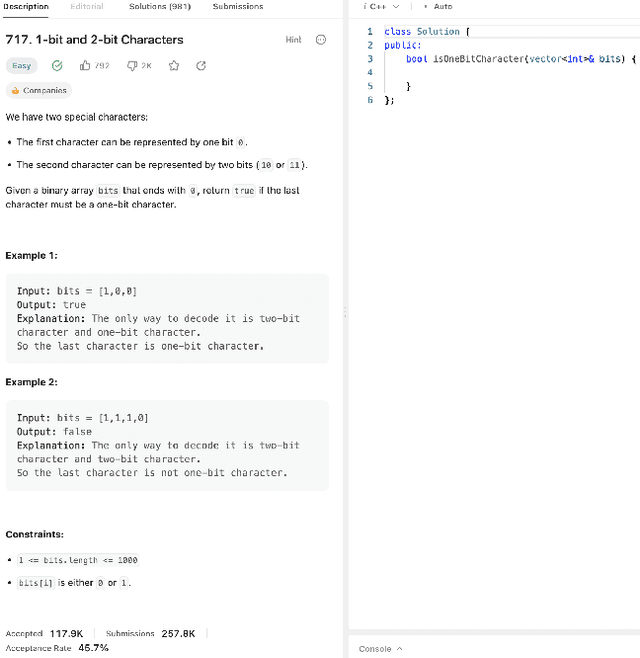
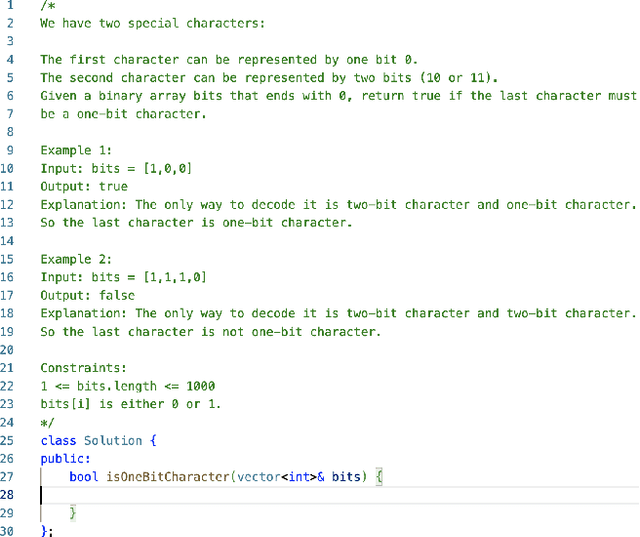
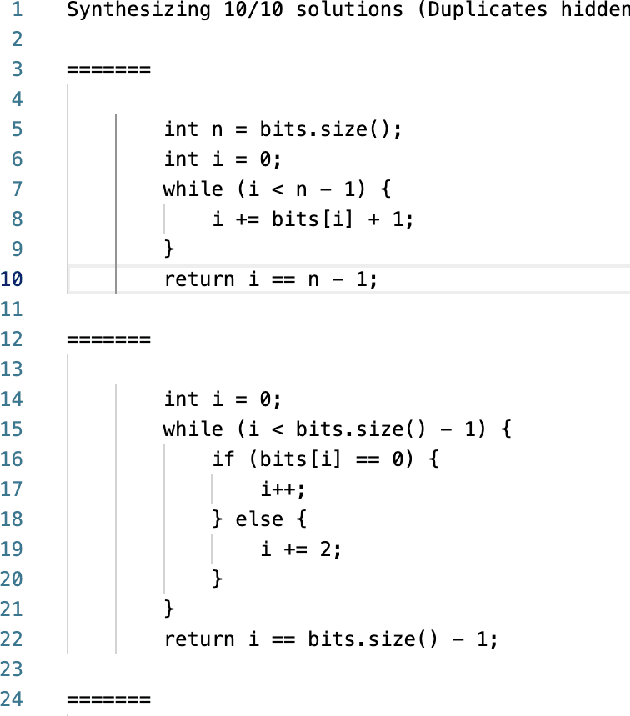
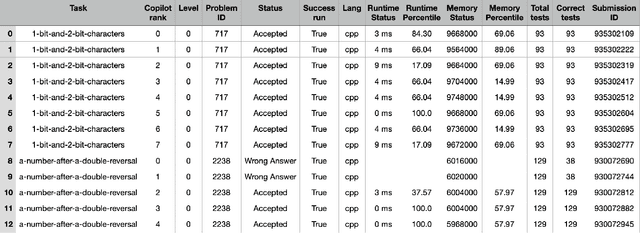
This paper aims to evaluate GitHub Copilot's generated code quality based on the LeetCode problem set using a custom automated framework. We evaluate the results of Copilot for 4 programming languages: Java, C++, Python3 and Rust. We aim to evaluate Copilot's reliability in the code generation stage, the correctness of the generated code and its dependency on the programming language, problem's difficulty level and problem's topic. In addition to that, we evaluate code's time and memory efficiency and compare it to the average human results. In total, we generate solutions for 1760 problems for each programming language and evaluate all the Copilot's suggestions for each problem, resulting in over 50000 submissions to LeetCode spread over a 2-month period. We found that Copilot successfully solved most of the problems. However, Copilot was rather more successful in generating code in Java and C++ than in Python3 and Rust. Moreover, in case of Python3 Copilot proved to be rather unreliable in the code generation phase. We also discovered that Copilot's top-ranked suggestions are not always the best. In addition, we analysed how the topic of the problem impacts the correctness rate. Finally, based on statistics information from LeetCode, we can conclude that Copilot generates more efficient code than an average human.