 Add to Chrome
 Add to Firefox
 Add to Edge
Drop the mask! GAMM-A Taxonomy for Graph Attributes Missing Mechanisms
Feb 09, 2026
Exploring missing data in attributed graphs introduces unique challenges beyond those found in tabular datasets. In this work, we extend the taxonomy for missing data mechanisms to attributed graphs by proposing GAMM (Graph Attributes Missing Mechanisms), a framework that systematically links missingness probability to both node attributes and the underlying graph structure. Our taxonomy enriches the conventional definitions of masking mechanisms by introducing graph-specific dependencies. We empirically demonstrate that state-of-the-art imputation methods, while effective on traditional masks, significantly struggle when confronted with these more realistic graph-aware missingness scenarios.

From GNNs to Symbolic Surrogates via Kolmogorov-Arnold Networks for Delay Prediction
Dec 24, 2025Accurate prediction of flow delay is essential for optimizing and managing modern communication networks. We investigate three levels of modeling for this task. First, we implement a heterogeneous GNN with attention-based message passing, establishing a strong neural baseline. Second, we propose FlowKANet in which Kolmogorov-Arnold Networks replace standard MLP layers, reducing trainable parameters while maintaining competitive predictive performance. FlowKANet integrates KAMP-Attn (Kolmogorov-Arnold Message Passing with Attention), embedding KAN operators directly into message-passing and attention computation. Finally, we distill the model into symbolic surrogate models using block-wise regression, producing closed-form equations that eliminate trainable weights while preserving graph-structured dependencies. The results show that KAN layers provide a favorable trade-off between efficiency and accuracy and that symbolic surrogates emphasize the potential for lightweight deployment and enhanced transparency.
Database Transposition for Constrained (Closed) Pattern Mining
Feb 07, 2009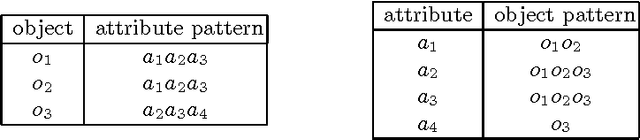
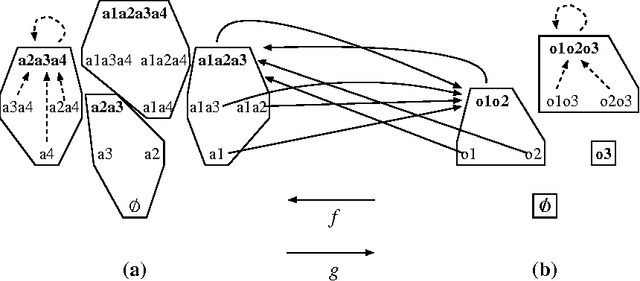
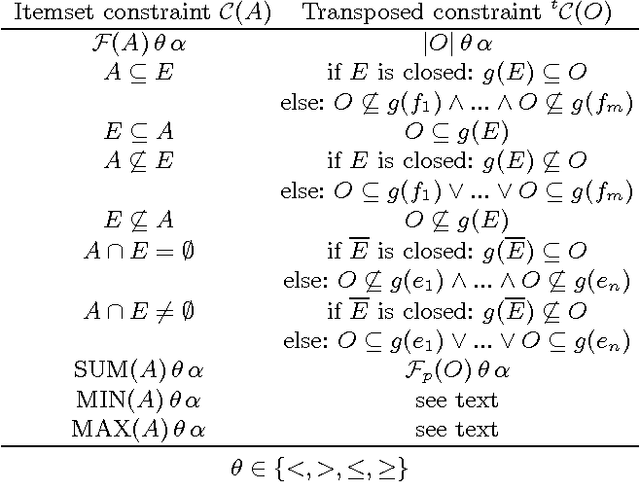
Recently, different works proposed a new way to mine patterns in databases with pathological size. For example, experiments in genome biology usually provide databases with thousands of attributes (genes) but only tens of objects (experiments). In this case, mining the "transposed" database runs through a smaller search space, and the Galois connection allows to infer the closed patterns of the original database. We focus here on constrained pattern mining for those unusual databases and give a theoretical framework for database and constraint transposition. We discuss the properties of constraint transposition and look into classical constraints. We then address the problem of generating the closed patterns of the original database satisfying the constraint, starting from those mined in the "transposed" database. Finally, we show how to generate all the patterns satisfying the constraint from the closed ones.
Extraction de concepts sous contraintes dans des données d'expression de gènes
Feb 07, 2009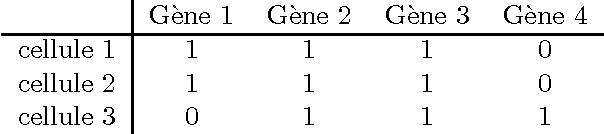
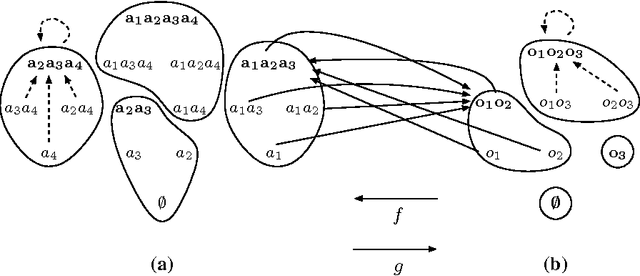


In this paper, we propose a technique to extract constrained formal concepts.
A Model for Managing Collections of Patterns
Feb 06, 2009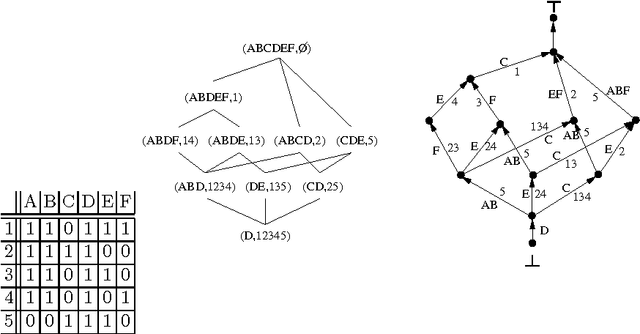
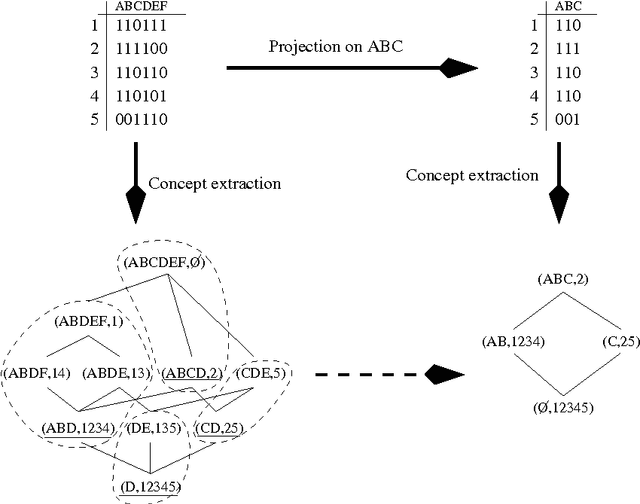
Data mining algorithms are now able to efficiently deal with huge amount of data. Various kinds of patterns may be discovered and may have some great impact on the general development of knowledge. In many domains, end users may want to have their data mined by data mining tools in order to extract patterns that could impact their business. Nevertheless, those users are often overwhelmed by the large quantity of patterns extracted in such a situation. Moreover, some privacy issues, or some commercial one may lead the users not to be able to mine the data by themselves. Thus, the users may not have the possibility to perform many experiments integrating various constraints in order to focus on specific patterns they would like to extract. Post processing of patterns may be an answer to that drawback. Thus, in this paper we present a framework that could allow end users to manage collections of patterns. We propose to use an efficient data structure on which some algebraic operators may be used in order to retrieve or access patterns in pattern bases.