 Add to Chrome
 Add to Firefox
 Add to Edge
An Objective Performance Evaluation of the LSTM Networks in Time Series Classification
May 19, 2026
The rapid adoption of deep learning has increasingly led to data-driven models replacing classical model-based algorithms, even in domains governed by well-understood physical laws. While data-driven models, such as long short-term memory (LSTM) networks, have become a popular choice for time-series analysis, their performance relative to model-based approaches in structured environments is rarely evaluated objectively. This paper presents a performance evaluation framework comparing an LSTM classifier against a model-based expectation maximization (EM) classifier for binary time-series classification. The evaluation is conducted on two scalar linear Gaussian state space models differing only in their noise statistics, where the Kalman filter likelihood ratio test with true parameters serves as a reference for the best achievable classification performance.Through Monte Carlo simulations, the classifiers are evaluated across three axes: task difficulty, controlled by the separation in process or measurement noise between the two models; sequence length; and training dataset size. The results show that the EM classifier, which exploits the known model structure, performs strongly when the data conform to the assumed model class. The LSTM classifier requires a larger separation in noise statistics to achieve reliable classification, and its performance saturates below the reference classifier when the models differ only in measurement noise, regardless of sequence length or training dataset size.

An Improved Approach to Estimate the Internal Resistance of a Battery
May 09, 2025
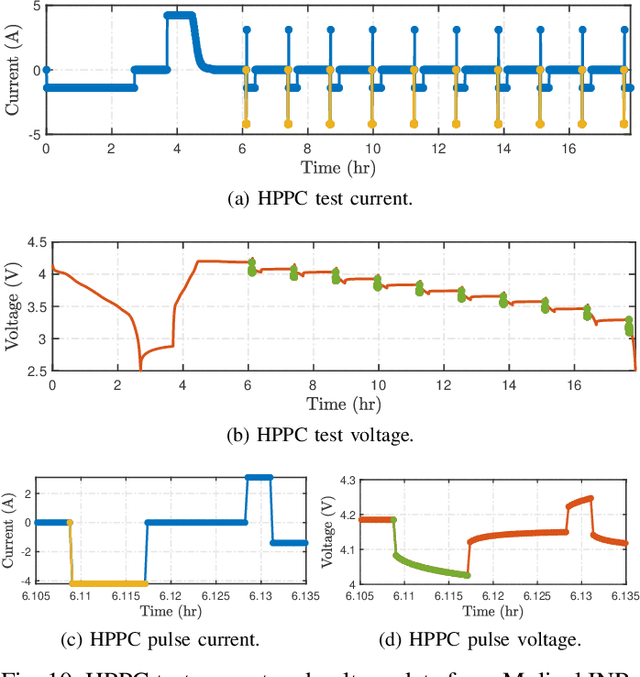
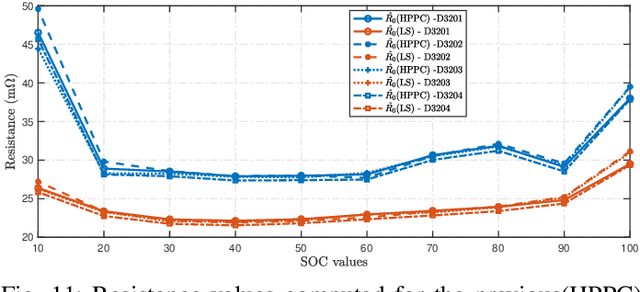
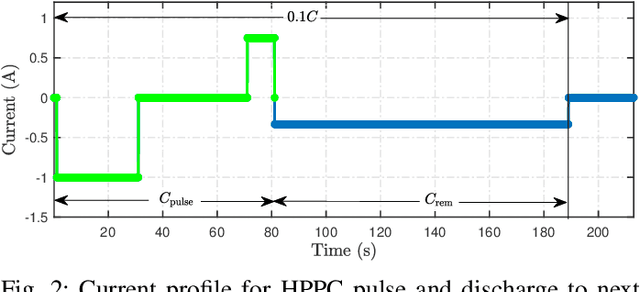
This paper considers the problem of resistance estimation in electronic systems including battery management systems (BMS) and battery chargers. In typical applications, the battery resistance is obtained through an approximate method computed as the ratio of the voltage difference to the applied current excitation pulse or vice versa for admittance. When estimating the battery resistance, this approach ignores the change in the open circuit voltage (OCV) as a result of the excitation signal. In this paper, we formally demonstrate and quantify the effect of the OCV drop on the errors in internal resistance estimation. Then, we propose a novel method to accurately estimate the internal resistance by accounting for the change in OCV caused by the applied current excitation signal. The proposed approach is based on a novel observation model that allows one to estimate the effect of OCV without requiring any additional information, such as the state of charge (SOC), parameters of the OCV-SOC curve, and the battery capacity. As such, the proposed approach is independent of the battery chemistry, size, age, and the ambient temperature. A performance analysis of the proposed approach using the battery simulator shows significant performance gain in the range of 30% to more than 250% in percentage estimation error. Then, the proposed approach is applied for resistance estimation during the hybrid pulse power characterization (HPPC) of cylindrical Li-ion battery cells. Results from tested batteries show that the proposed approach reduced the overestimated internal resistance of the batteries by up to 20 m{\Omega}.