 Add to Chrome
 Add to Firefox
 Add to Edge
COMPOT: Calibration-Optimized Matrix Procrustes Orthogonalization for Transformers Compression
Feb 16, 2026
Post-training compression of Transformer models commonly relies on truncated singular value decomposition (SVD). However, enforcing a single shared subspace can degrade accuracy even at moderate compression. Sparse dictionary learning provides a more flexible union-of-subspaces representation, but existing approaches often suffer from iterative dictionary and coefficient updates. We propose COMPOT (Calibration-Optimized Matrix Procrustes Orthogonalization for Transformers), a training-free compression framework that uses a small calibration dataset to estimate a sparse weight factorization. COMPOT employs orthogonal dictionaries that enable closed-form Procrustes updates for the dictionary and analytical single-step sparse coding for the coefficients, eliminating iterative optimization. To handle heterogeneous layer sensitivity under a global compression budget, COMPOT further introduces a one-shot dynamic allocation strategy that adaptively redistributes layer-wise compression rates. Extensive experiments across diverse architectures and tasks show that COMPOT consistently delivers a superior quality-compression trade-off over strong low-rank and sparse baselines, while remaining fully compatible with post-training quantization for extreme compression. Code is available $\href{https://github.com/mts-ai/COMPOT}{here}$.

ROCKET: Rapid Optimization via Calibration-guided Knapsack Enhanced Truncation for Efficient Model Compression
Feb 11, 2026We present ROCKET, a training-free model compression method that achieves state-of-the-art performance in comparison with factorization, structured-sparsification and dynamic compression baselines. Operating under a global compression budget, ROCKET comprises two key innovations: First, it formulates layer-wise compression allocation as a multi-choice knapsack problem, selecting the optimal compression level for each layer to minimize total reconstruction error while adhering to a target model size. Second, it introduces a single-step sparse matrix factorization inspired by dictionary learning: using only a small calibration set, it sparsifies weight coefficients based on activation-weights sensitivity and then updates the dictionary in closed form via least squares bypassing iterative optimization, sparse coding, or backpropagation entirely. ROCKET consistently outperforms existing compression approaches across different model architectures at 20-50\% compression rates. Notably, it retains over 90\% of the original model's performance at 30\% compression without any fine-tuning. Moreover, when applying a light fine-tuning phase, recovery is substantially enhanced: for instance, compressing Qwen3-14B to an 8B-parameter model and healing it with just 30 million tokens yields performance nearly on par with the original Qwen3-8B. The code for ROCKET is at github.com/mts-ai/ROCKET/tree/main.
Speak, Edit, Repeat: High-Fidelity Voice Editing and Zero-Shot TTS with Cross-Attentive Mamba
Oct 06, 2025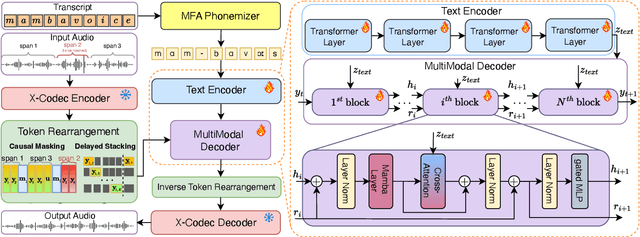
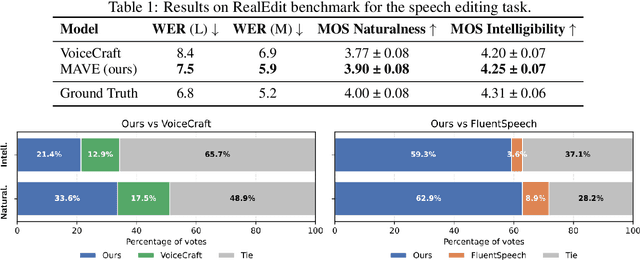


We introduce MAVE (Mamba with Cross-Attention for Voice Editing and Synthesis), a novel autoregressive architecture for text-conditioned voice editing and high-fidelity text-to-speech (TTS) synthesis, built on a cross-attentive Mamba backbone. MAVE achieves state-of-the-art performance in speech editing and very competitive results in zero-shot TTS, while not being explicitly trained on the latter task, outperforming leading autoregressive and diffusion models on diverse, real-world audio. By integrating Mamba for efficient audio sequence modeling with cross-attention for precise text-acoustic alignment, MAVE enables context-aware voice editing with exceptional naturalness and speaker consistency. In pairwise human evaluations on a random 40-sample subset of the RealEdit benchmark (400 judgments), 57.2% of listeners rated MAVE - edited speech as perceptually equal to the original, while 24.8% prefered the original and 18.0% MAVE - demonstrating that in the majority of cases edits are indistinguishable from the source. MAVE compares favorably with VoiceCraft and FluentSpeech both on pairwise comparisons and standalone mean opinion score (MOS) evaluations. For zero-shot TTS, MAVE exceeds VoiceCraft in both speaker similarity and naturalness, without requiring multiple inference runs or post-processing. Remarkably, these quality gains come with a significantly lower memory cost and approximately the same latency: MAVE requires ~6x less memory than VoiceCraft during inference on utterances from the RealEdit database (mean duration: 6.21s, A100, FP16, batch size 1). Our results demonstrate that MAVE establishes a new standard for flexible, high-fidelity voice editing and synthesis through the synergistic integration of structured state-space modeling and cross-modal attention.
Cross-level Requirement Traceability: A Novel Approach Integrating Bag-of-Words and Word Embedding for Enhanced Similarity Functionality
Jun 20, 2024Requirement traceability is the process of identifying the inter-dependencies between requirements. It poses a significant challenge when conducted manually, especially when dealing with requirements at various levels of abstraction. In this work, we propose a novel approach to automate the task of linking high-level business requirements with more technical system requirements. The proposed approach begins by representing each requirement using a Bag of-Words (BOW) model combined with the Term Frequency-Inverse Document Frequency (TF-IDF) scoring function. Then, we suggested an enhanced cosine similarity that uses recent advances in word embedding representation to correct traditional cosine similarity function limitations. To evaluate the effectiveness of our approach, we conducted experiments on three well-known datasets: COEST, WARC(NFR), and WARC(FRS). The results demonstrate that our approach significantly improves efficiency compared to existing methods. We achieved better results with an increase of approximately 18.4% in one of the datasets, as measured by the F2 score.