 Add to Chrome
 Add to Firefox
 Add to Edge
Temporal-Logic-Aware Frontier-Based Exploration
Feb 21, 2026
This paper addresses the problem of temporal logic motion planning for an autonomous robot operating in an unknown environment. The objective is to enable the robot to satisfy a syntactically co-safe Linear Temporal Logic (scLTL) specification when the exact locations of the desired labels are not known a priori. We introduce a new type of automaton state, referred to as commit states. These states capture intermediate task progress resulting from actions whose consequences are irreversible. In other words, certain future paths to satisfaction become not feasible after taking those actions that lead to the commit states. By leveraging commit states, we propose a sound and complete frontier-based exploration algorithm that strategically guides the robot to make progress toward the task while preserving all possible ways of satisfying it. The efficacy of the proposed method is validated through simulations.

Motion Planning Under Temporal Logic Specifications In Semantically Unknown Environments
Nov 05, 2025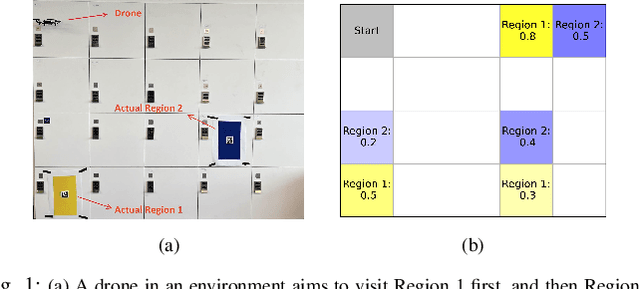
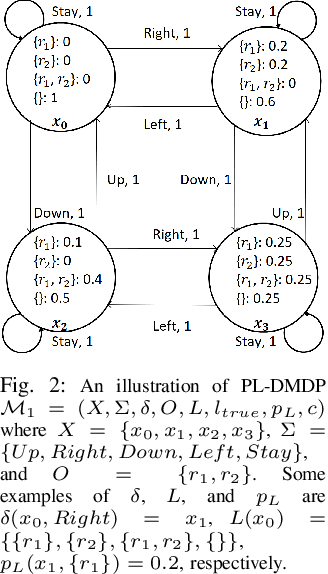
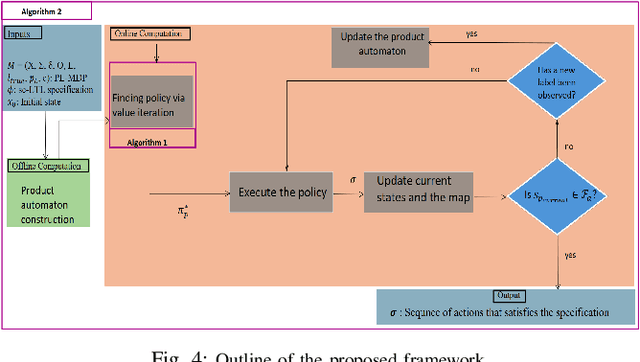
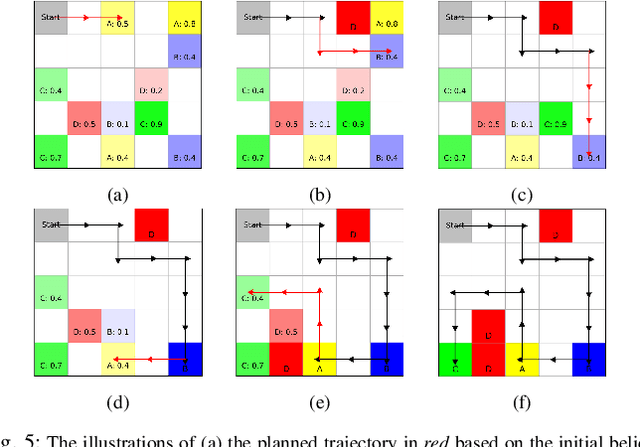
This paper addresses a motion planning problem to achieve spatio-temporal-logical tasks, expressed by syntactically co-safe linear temporal logic specifications (scLTL\next), in uncertain environments. Here, the uncertainty is modeled as some probabilistic knowledge on the semantic labels of the environment. For example, the task is "first go to region 1, then go to region 2"; however, the exact locations of regions 1 and 2 are not known a priori, instead a probabilistic belief is available. We propose a novel automata-theoretic approach, where a special product automaton is constructed to capture the uncertainty related to semantic labels, and a reward function is designed for each edge of this product automaton. The proposed algorithm utilizes value iteration for online replanning. We show some theoretical results and present some simulations/experiments to demonstrate the efficacy of the proposed approach.