 Add to Chrome
 Add to Firefox
 Add to Edge
Robust Beamforming Design for Secure Uplink NOMA-ISAC
Jun 15, 2026
Integrated sensing and communication is an important technology for sixth-generation (6G) mobile networks, enabling the joint use of communication and radar sensing within a unified system. While offering significant benefits in terms of spectral efficiency, ISAC introduces new security challenges. In particular, the joint use of resources for sensing and communication can increase vulnerability to eavesdropping and information leakage. In this paper, we study an uplink Non-Orthogonal Multiple Access (NOMA) system where the base station (BS) simultaneously receives user data and senses a potential eavesdropper (Eve) with uncertain location. To enhance the physical-layer security, a robust sensing signal is designed to both sense and jam Eve. We formulate a joint optimization problem that aims to maximize the users' sum rate and the BS sensing performance while maintaining security against Eve. Since the resulting optimization problem is non-convex, we develop an iterative alternating optimization (AO) algorithm that decomposes it into two tractable subproblems. In the first subproblem, the receive combining vectors are optimized in closed form using generalized eigenvalue decomposition. In the second subproblem, the transmit beamforming matrices and sensing power are jointly optimized via semidefinite relaxation (SDR) and successive convex approximation (SCA). Simulation results demonstrate the effectiveness of our solution in terms of fast convergence and resource allocation.

RIS-Assisted Interference Mitigation for Uplink NOMA
Jan 31, 2023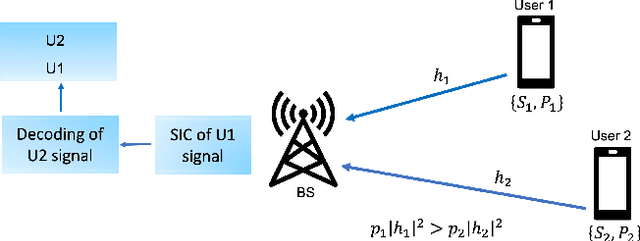
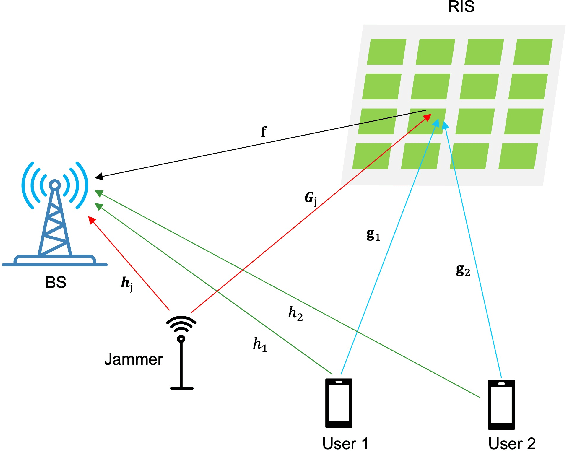
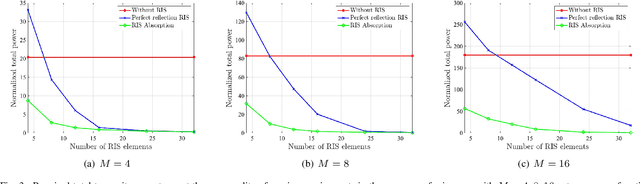
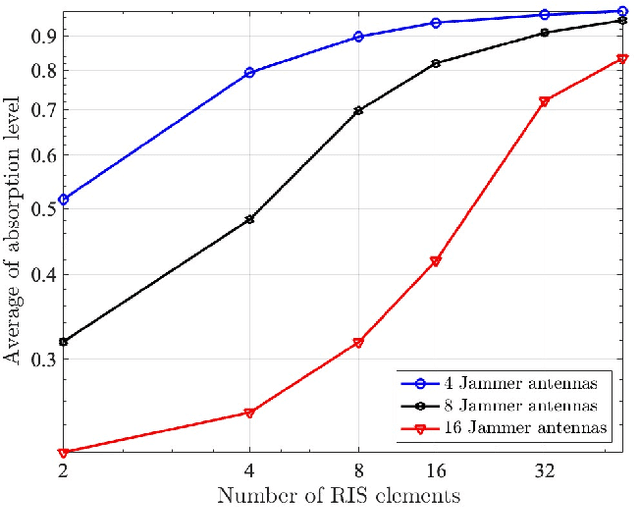
Non-orthogonal multiple access (NOMA) has become a promising technology for next-generation wireless communications systems due to its capability to provide access for multiple users on the same resource. In this paper, we consider an uplink power-domain NOMA system aided by a reconfigurable intelligent surface (RIS) in the presence of a jammer that aims to maximize its interference on the base station (BS) uplink receiver. We consider two kinds of RISs, a regular RIS whose elements can only change the phase of the incoming wave, and an RIS whose elements can also attenuate the incoming wave. Our aim is to minimize the total power transmitted by the user terminals under quality-of-service constraints by controlling both the propagation from the users and the jammer to the BS with help of the RIS. The resulting objective function and constraints are both non-linear and non-convex, so we address this problem using numerical optimization. Our numerical results show that the RIS can help to dramatically reduce the per user required transmit power in an interference-limited scenario.