 Add to Chrome
 Add to Firefox
 Add to Edge
Face Time Traveller : Travel Through Ages Without Losing Identity
Feb 26, 2026
Face aging, an ill-posed problem shaped by environmental and genetic factors, is vital in entertainment, forensics, and digital archiving, where realistic age transformations must preserve both identity and visual realism. However, existing works relying on numerical age representations overlook the interplay of biological and contextual cues. Despite progress in recent face aging models, they struggle with identity preservation in wide age transformations, also static attention and optimization-heavy inversion in diffusion limit adaptability, fine-grained control and background consistency. To address these challenges, we propose Face Time Traveller (FaceTT), a diffusion-based framework that achieves high-fidelity, identity-consistent age transformation. Here, we introduce a Face-Attribute-Aware Prompt Refinement strategy that encodes intrinsic (biological) and extrinsic (environmental) aging cues for context-aware conditioning. A tuning-free Angular Inversion method is proposed that efficiently maps real faces into the diffusion latent space for fast and accurate reconstruction. Moreover, an Adaptive Attention Control mechanism is introduced that dynamically balances cross-attention for semantic aging cues and self-attention for structural and identity preservation. Extensive experiments on benchmark datasets and in-the-wild testset demonstrate that FaceTT achieves superior identity retention, background preservation and aging realism over state-of-the-art (SOTA) methods.

Cross-Modal Fusion and Attention Mechanism for Weakly Supervised Video Anomaly Detection
Dec 29, 2024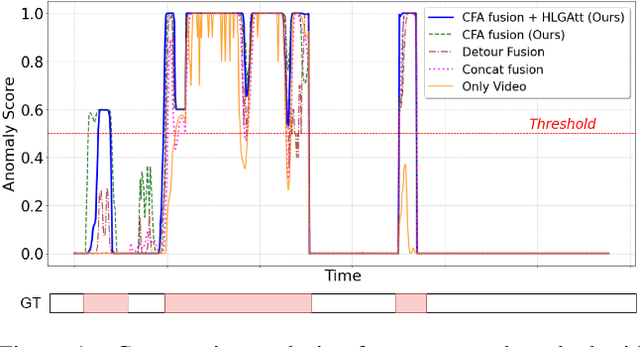
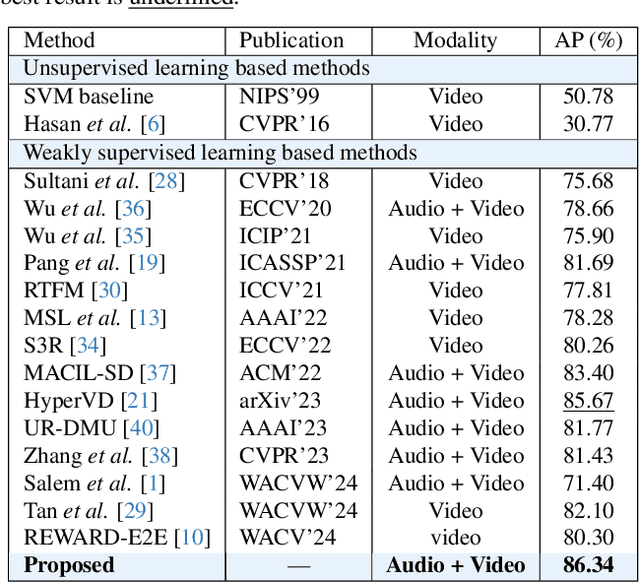
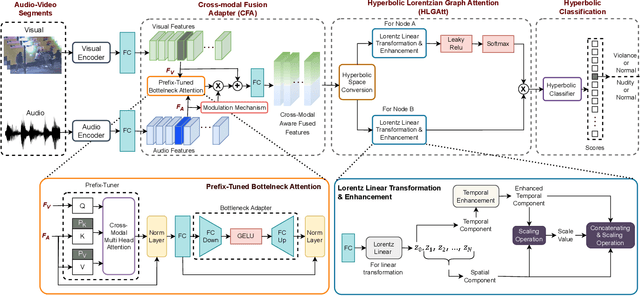
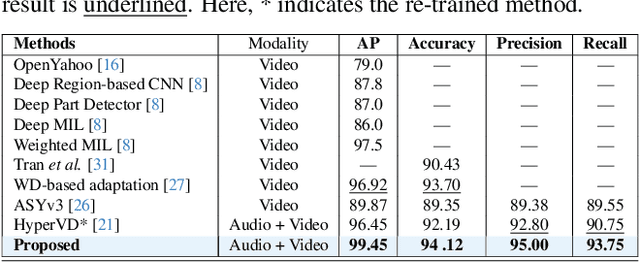
Recently, weakly supervised video anomaly detection (WS-VAD) has emerged as a contemporary research direction to identify anomaly events like violence and nudity in videos using only video-level labels. However, this task has substantial challenges, including addressing imbalanced modality information and consistently distinguishing between normal and abnormal features. In this paper, we address these challenges and propose a multi-modal WS-VAD framework to accurately detect anomalies such as violence and nudity. Within the proposed framework, we introduce a new fusion mechanism known as the Cross-modal Fusion Adapter (CFA), which dynamically selects and enhances highly relevant audio-visual features in relation to the visual modality. Additionally, we introduce a Hyperbolic Lorentzian Graph Attention (HLGAtt) to effectively capture the hierarchical relationships between normal and abnormal representations, thereby enhancing feature separation accuracy. Through extensive experiments, we demonstrate that the proposed model achieves state-of-the-art results on benchmark datasets of violence and nudity detection.