 Add to Chrome
 Add to Firefox
 Add to Edge
Modular Robotic Catheters for Endovascular Aneurysm Repair
Jul 28, 2026
Fenestrated/Branched endovascular aneurysm repair (FEVAR/BEVAR) require surgeons to navigate catheters and guidewires into various branches of the abdominal aorta, before deploying stent grafts to alleviate pressure on the aneurysm. Previous clinical studies suggests that surgeons continue to struggle with vessel access using standard commercial instruments, prolonging the procedural time and inducing further complications. In this work, we present two contributions to solving this problem: 1) A bespoke 2-segment steerable catheter, consisting of 4 degrees of freedom to enhance dexterity. 2) An expandable, modular tendon-driven actuation platform that can accommodate for the redundancies introduced in our system. To fabricate the catheter, we capitalized on thermal fiber drawing, a technique that creates high-aspect ratio devices at scale, and processed the catheter with laser micro-machining to soften its tip. We evaluated the system using simulations, where we investigated the catheter's bending stiffness, then its steerability with in-vitro experiments in vascular phantoms. This handheld, robotic steerable catheter system has the potential to shorten the length of future endovascular surgeries, and give clinicians the tools to resolve challenging clinical cases.

Investigating the Effect of a Series Elastic Actuation Retrofit to Black-Box Actuators
May 22, 2026In robotic applications, actuators are typically designed to be stiff with minimal backlash to ensure precision and repeatability. However, this limits compliance, leading to potential damage and poor force control in uncertain environments. Series Elastic Actuation (SEA) introduces compliance to enhance disturbance rejection and enable force measurement via Hooke's Law but reduces system bandwidth. A custom Series Elastic (SE) element was retrofitted to a black-box actuator to mitigate non-linearities like backlash and static friction. Integrating the SE element enabled high-fidelity force measurements, improving force control bandwidth and performance. A torsional SE element was designed through Finite Element (FE) analysis, yielding a stiffness of 2155.4 Nm/rad. Open-loop force control bandwidth was measured for the original motor and the SEA-integrated configuration, while closed-loop bandwidth was assessed using feedback from the SEA and a commercial force sensor. The SEA module increased bandwidth from 10.32 Hz to 30.32 Hz, a 2.93X improvement. Additionally, it outperformed the commercial sensor by 7.63% despite costing 25 GBP, a fraction of the price.
Towards a Procedure Optimised Steerable Microcatheter for Deep Seated Neurosurgery
Mar 03, 2023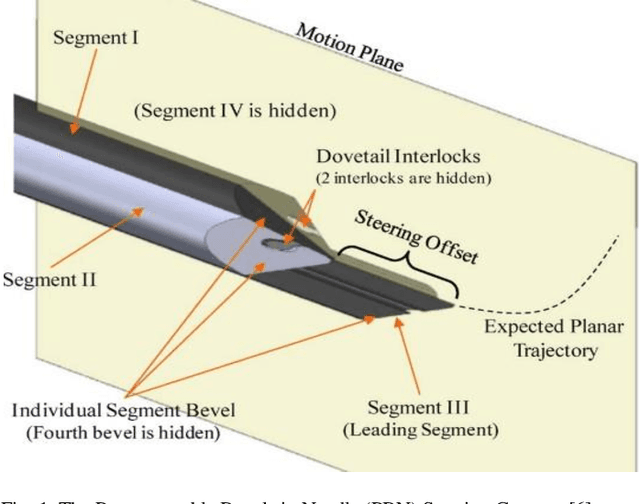
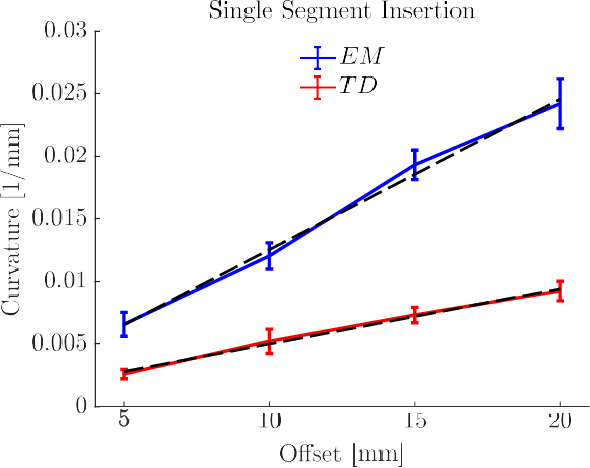
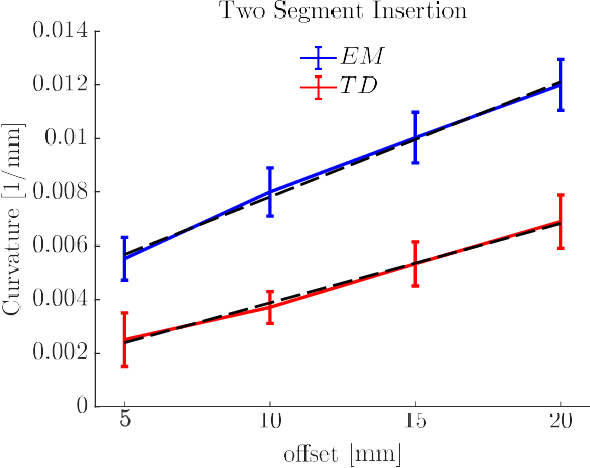
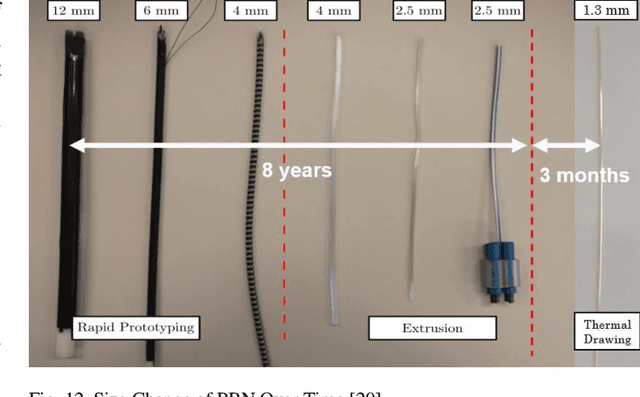
In recent years, the steerable needles have attracted significant interest in Minimally Invasive Surgery (MIS). Amongst these, the flexible Programmable-bevel tip needle (PBN) concept has successfully achieved an in-vivo demonstration to evaluate the feasibility of Convection Enhanced Delivery (CED) of chemotherapeutics within the ovine model, with a 2.5 mm PBN prototype. However, further size reduction is necessary for other diagnostic and therapeutic procedures involving deep-seated tissue structures. Since PBNs have a complex cross-section geometry, standard production methods, such as extrusion, fails as the outer diameter is reduced further. This paper presents our first attempt to demonstrate a new manufacturing method for the PBN that employs thermal drawing technology. Experimental characterisation tests were performed for the 2.5 mm PBN and a new 1.3 mm Thermally Drawn (TD) PBN prototype described here. The results show that thermal drawing presents a significant advantage in miniaturising complex needle structures. However, the steering behaviour is affected due to the choice of material in this first attempt, a limitation which will be addressed in future work.