 Add to Chrome
 Add to Firefox
 Add to Edge
Noninvasive Intracranial Pressure Estimation Using Subspace System Identification and Bespoke Machine Learning Algorithms: A Learning-to-Rank Approach
Jan 28, 2026
Objective: Accurate noninvasive estimation of intracranial pressure (ICP) remains a major challenge in critical care. We developed a bespoke machine learning algorithm that integrates system identification and ranking-constrained optimization to estimate mean ICP from noninvasive signals. Methods: A machine learning framework was proposed to obtain accurate mean ICP values using arbitrary noninvasive signals. The subspace system identification algorithm is employed to identify cerebral hemodynamics models for ICP simulation using arterial blood pressure (ABP), cerebral blood velocity (CBv), and R-wave to R-wave interval (R-R interval) signals in a comprehensive database. A mapping function to describe the relationship between the features of noninvasive signals and the estimation errors is learned using innovative ranking constraints through convex optimization. Patients across multiple clinical settings were randomly split into testing and training datasets for performance evaluation of the mapping function. Results: The results indicate that about 31.88% of testing entries achieved estimation errors within 2 mmHg and 34.07% of testing entries between 2 mmHg to 6 mmHg from the nonlinear mapping with constraints. Conclusion: Our results demonstrate the feasibility of the proposed noninvasive ICP estimation approach. Significance: Further validation and technical refinement are required before clinical deployment, but this work lays the foundation for safe and broadly accessible ICP monitoring in patients with acute brain injury and related conditions.

Generalist vs Specialist Time Series Foundation Models: Investigating Potential Emergent Behaviors in Assessing Human Health Using PPG Signals
Oct 16, 2025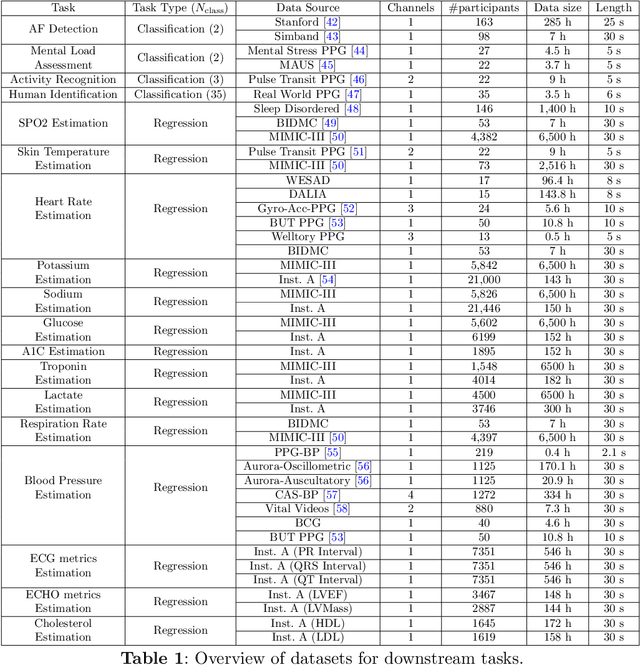
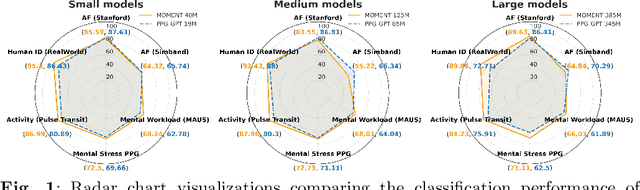
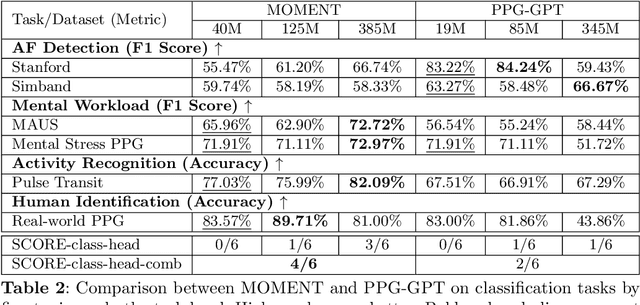
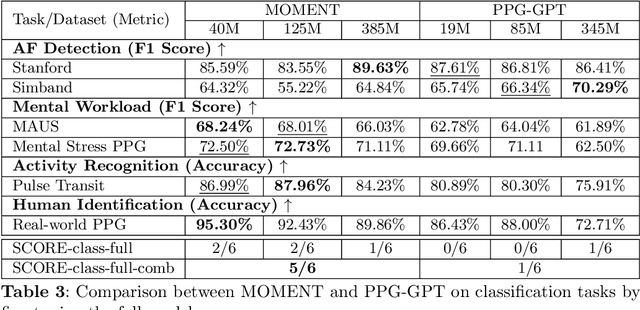
Foundation models are large-scale machine learning models that are pre-trained on massive amounts of data and can be adapted for various downstream tasks. They have been extensively applied to tasks in Natural Language Processing and Computer Vision with models such as GPT, BERT, and CLIP. They are now also increasingly gaining attention in time-series analysis, particularly for physiological sensing. However, most time series foundation models are specialist models - with data in pre-training and testing of the same type, such as Electrocardiogram, Electroencephalogram, and Photoplethysmogram (PPG). Recent works, such as MOMENT, train a generalist time series foundation model with data from multiple domains, such as weather, traffic, and electricity. This paper aims to conduct a comprehensive benchmarking study to compare the performance of generalist and specialist models, with a focus on PPG signals. Through an extensive suite of total 51 tasks covering cardiac state assessment, laboratory value estimation, and cross-modal inference, we comprehensively evaluate both models across seven dimensions, including win score, average performance, feature quality, tuning gain, performance variance, transferability, and scalability. These metrics jointly capture not only the models' capability but also their adaptability, robustness, and efficiency under different fine-tuning strategies, providing a holistic understanding of their strengths and limitations for diverse downstream scenarios. In a full-tuning scenario, we demonstrate that the specialist model achieves a 27% higher win score. Finally, we provide further analysis on generalization, fairness, attention visualizations, and the importance of training data choice.