 Add to Chrome
 Add to Firefox
 Add to Edge
Protein Graph Neural Networks for Heterogeneous Cryo-EM Reconstruction
Feb 25, 2026
We present a geometry-aware method for heterogeneous single-particle cryogenic electron microscopy (cryo-EM) reconstruction that predicts atomic backbone conformations. To incorporate protein-structure priors, we represent the backbone as a graph and use a graph neural network (GNN) autodecoder that maps per-image latent variables to 3D displacements of a template conformation. The objective combines a data-discrepancy term based on a differentiable cryo-EM forward model with geometric regularization, and it supports unknown orientations via ellipsoidal support lifting (ESL) pose estimation. On synthetic datasets derived from molecular dynamics trajectories, the proposed GNN achieves higher accuracy compared to a multilayer perceptron (MLP) of comparable size, highlighting the benefits of a geometry-informed inductive bias.

Moment-based Posterior Sampling for Multi-reference Alignment
Oct 14, 2025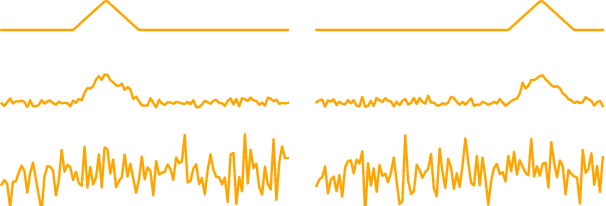
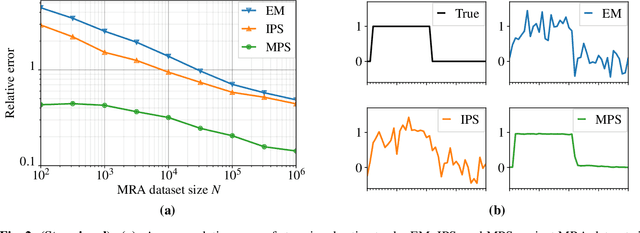
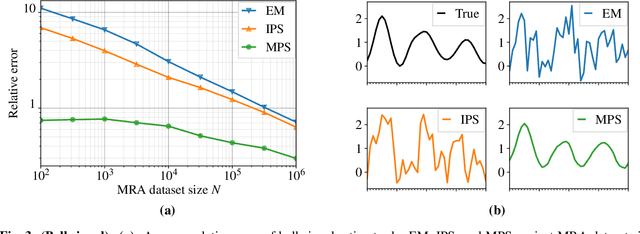
We propose a Bayesian approach to the problem of multi-reference alignment -- the recovery of signals from noisy, randomly shifted observations. While existing frequentist methods accurately recover the signal at arbitrarily low signal-to-noise ratios, they require a large number of samples to do so. In contrast, our proposed method leverages diffusion models as data-driven plug-and-play priors, conditioning these on the sample power spectrum (a shift-invariant statistic) enabling both accurate posterior sampling and uncertainty quantification. The use of an appropriate prior significantly reduces the required number of samples, as illustrated in simulation experiments with comparisons to state-of-the-art methods such as expectation--maximization and bispectrum inversion. These findings establish our approach as a promising framework for other orbit recovery problems, such as cryogenic electron microscopy (cryo-EM).