 Add to Chrome
 Add to Firefox
 Add to Edge
A unified deeplearning framework for contrast-phase-specific virtual monochromatic imaging
May 28, 2026
Dual-energy CT (DECT) enables virtual monochromatic imaging (VMI) and improved contrast resolution, but its clinical adoption is limited by hardware complexity and cost. In this work, we propose a unified deep learning framework that synthesizes contrast-phase-specific virtual monochromatic 50 keV images from single-energy CT (SECT) data by leveraging contrast phase information as a prior. The model is trained using DECT-derived 70 keV and 50 keV image pairs across four contrast phases -- Angio, Arterial, Portal, and Delayed -- using a novel prior conditioning architecture that integrates contrast phase priors into the energy transformation process. We demonstrate that the proposed unified model achieves contrast enhancement and generalizes well across contrast phases. Additionally, we show that the model can generate 50 keV-like images from SECT inputs, preserving contrast phase-specific dynamics.

One-shot Localization and Segmentation of Medical Images with Foundation Models
Oct 28, 2023
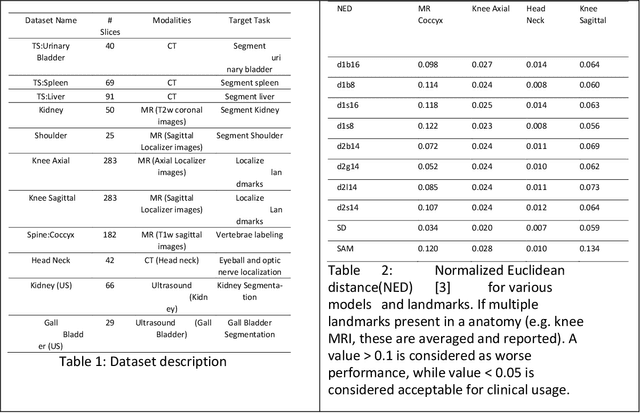

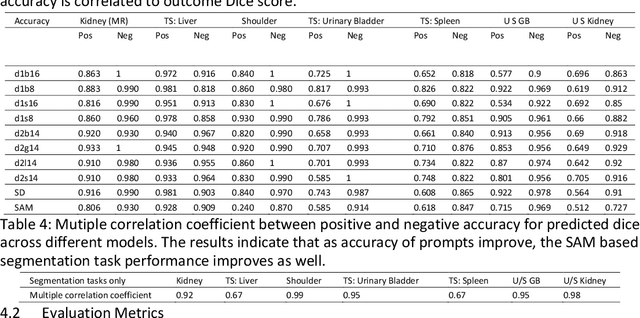
Recent advances in Vision Transformers (ViT) and Stable Diffusion (SD) models with their ability to capture rich semantic features of the image have been used for image correspondence tasks on natural images. In this paper, we examine the ability of a variety of pre-trained ViT (DINO, DINOv2, SAM, CLIP) and SD models, trained exclusively on natural images, for solving the correspondence problems on medical images. While many works have made a case for in-domain training, we show that the models trained on natural images can offer good performance on medical images across different modalities (CT,MR,Ultrasound) sourced from various manufacturers, over multiple anatomical regions (brain, thorax, abdomen, extremities), and on wide variety of tasks. Further, we leverage the correspondence with respect to a template image to prompt a Segment Anything (SAM) model to arrive at single shot segmentation, achieving dice range of 62%-90% across tasks, using just one image as reference. We also show that our single-shot method outperforms the recently proposed few-shot segmentation method - UniverSeg (Dice range 47%-80%) on most of the semantic segmentation tasks(six out of seven) across medical imaging modalities.