 Add to Chrome
 Add to Firefox
 Add to Edge
Search Your Block Floating Point Scales!
May 12, 2026
Quantization has emerged as a standard technique for accelerating inference for generative models by enabling faster low-precision computations and reduced memory transfers. Recently, GPU accelerators have added first-class support for microscaling Block Floating Point (BFP) formats. Standard BFP algorithms use a fixed scale based on the maximum magnitude of the block. We observe that this scale choice can be suboptimal with respect to quantization errors. In this work, we propose ScaleSearch, an alternative strategy for selecting these scale factors: using a fine-grained search leveraging the mantissa bits in microscaling formats to minimize the quantization error for the given distribution. ScaleSearch can be integrated with existing quantization methods such as Post Training Quantization and low-precision attention, and is shown to improve their performance. Additionally, we introduce ScaleSearchAttention, an accelerated NVFP4-based attention algorithm, which uses ScaleSearch and adapted prior techniques to ensure near-0 performance loss for causal language modeling. Experiments show that ScaleSearch reduces quantization error by 27% for NVFP4 and improves language model PTQ by up to 15 points for MATH500 (Qwen3-8B), while ScaleSearchAttention improves Wikitext-2 PPL by upto 0.77 points for Llama 3.1 70B. The proposed methods closely match baseline performance while providing quantization accuracy improvements.

Projection: A Mixed-Initiative Research Process
Jan 09, 2022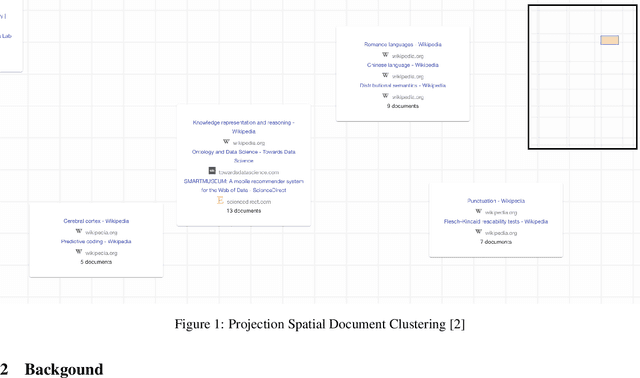
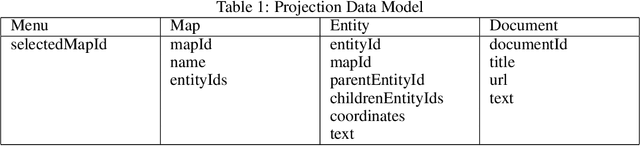
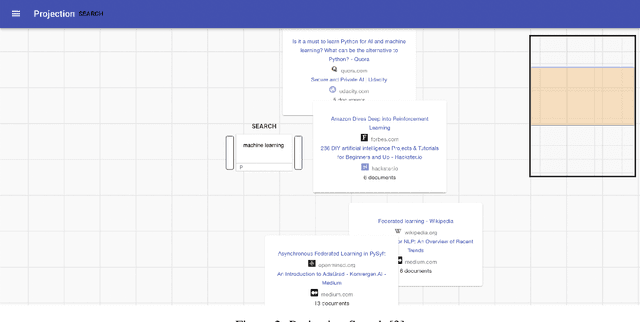
Communication of dense information between humans and machines is relatively low bandwidth. Many modern search and recommender systems operate as machine learning black boxes, giving little insight as to how they represent information or why they take certain actions. We present Projection, a mixed-initiative interface that aims to increase the bandwidth of communication between humans and machines throughout the research process. The interface supports adding context to searches and visualizing information in multiple dimensions with techniques such as hierarchical clustering and spatial projections. Potential customers have shown interest in the application integrating their research outlining and search processes, enabling them to structure their searches in hierarchies, and helping them visualize related spaces of knowledge.
Exploratory Search with Sentence Embeddings
Jul 22, 2020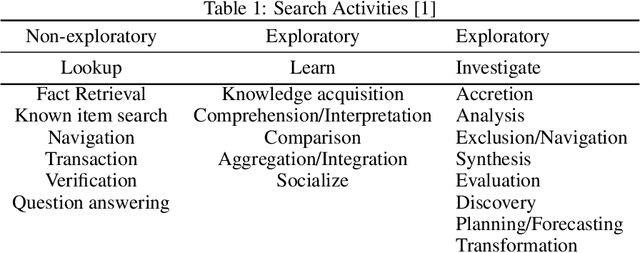
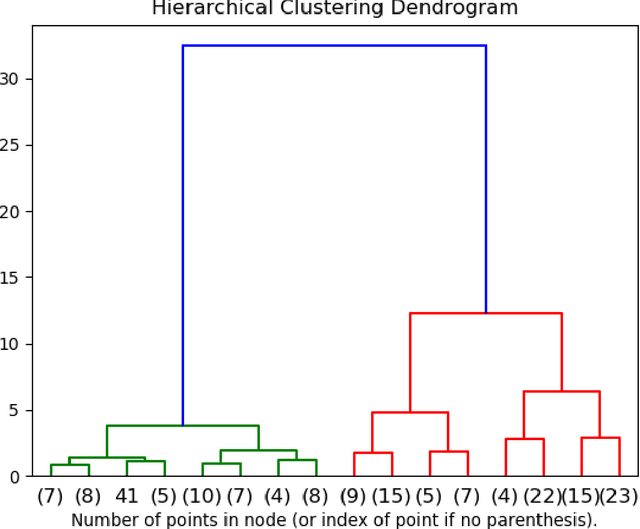

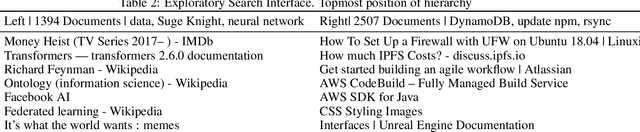
Exploratory search aims to guide users through a corpus rather than pinpointing exact information. We propose an exploratory search system based on hierarchical clusters and document summaries using sentence embeddings. With sentence embeddings, we represent documents as the mean of their embedded sentences, extract summaries containing sentences close to this document representation and extract keyphrases close to the document representation. To evaluate our search system, we scrape our personal search history over the past year and report our experience with the system. We then discuss motivating use cases of an exploratory search system of this nature and conclude with possible directions of future work.