 Add to Chrome
 Add to Firefox
 Add to Edge
Gypscie: A Cross-Platform AI Artifact Management System
Apr 11, 2026
Artificial Intelligence (AI) models, encompassing both traditional machine learning (ML) and more advanced approaches such as deep learning and large language models (LLMs), play a central role in modern applications. AI model lifecycle management involves the end-to-end process of managing these models, from data collection and preparation to model building, evaluation, deployment, and continuous monitoring. This process is inherently complex, as it requires the coordination of diverse services that manage AI artifacts such as datasets, dataflows, and models, all orchestrated to operate seamlessly. In this context, it is essential to isolate applications from the complexity of interacting with heterogeneous services, datasets, and AI platforms. In this paper, we introduce Gypscie, a cross-platform AI artifact management system. By providing a unified view of all AI artifacts, the Gypscie platform simplifies the development and deployment of AI applications. This unified view is realized through a knowledge graph that captures application semantics and a rule-based query language that supports reasoning over data and models. Model lifecycle activities are represented as high-level dataflows that can be scheduled across multiple platforms, such as servers, cloud platforms, or supercomputers. Finally, Gypscie records provenance information about the artifacts it produces, thereby enabling explainability. Our qualitative comparison with representative AI systems shows that Gypscie supports a broader range of functionalities across the AI artifact lifecycle. Our experimental evaluation demonstrates that Gypscie can successfully optimize and schedule dataflows on AI platforms from an abstract specification.

Towards a Spatiotemporal Fusion Approach to Precipitation Nowcasting
May 25, 2025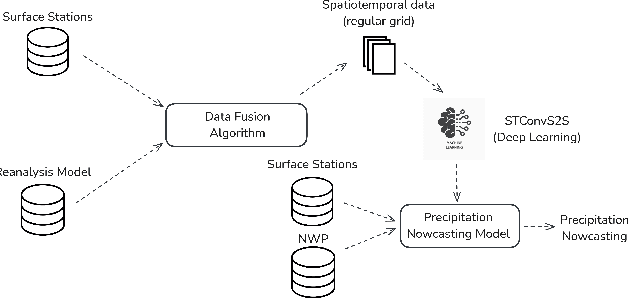
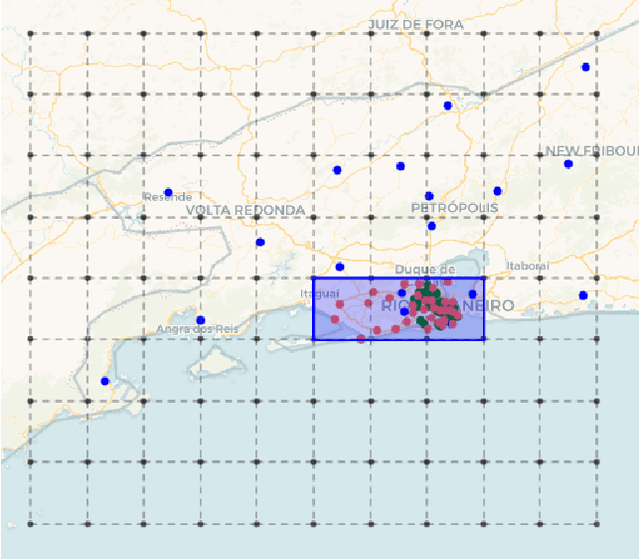
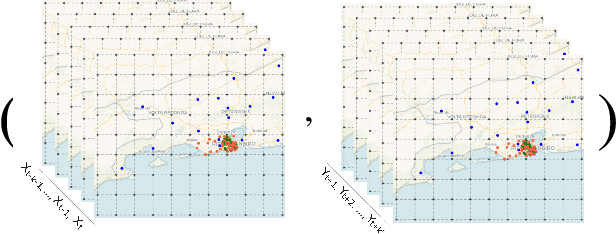
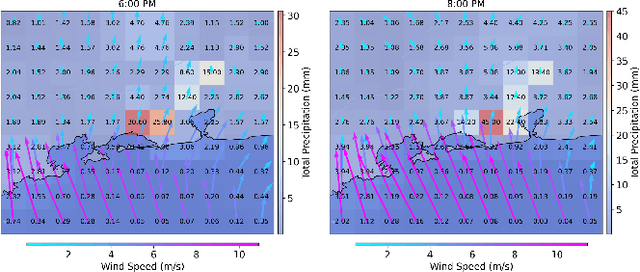
With the increasing availability of meteorological data from various sensors, numerical models and reanalysis products, the need for efficient data integration methods has become paramount for improving weather forecasts and hydrometeorological studies. In this work, we propose a data fusion approach for precipitation nowcasting by integrating data from meteorological and rain gauge stations in Rio de Janeiro metropolitan area with ERA5 reanalysis data and GFS numerical weather prediction. We employ the spatiotemporal deep learning architecture called STConvS2S, leveraging a structured dataset covering a 9 x 11 grid. The study spans from January 2011 to October 2024, and we evaluate the impact of integrating three surface station systems. Among the tested configurations, the fusion-based model achieves an F1-score of 0.2033 for forecasting heavy precipitation events (greater than 25 mm/h) at a one-hour lead time. Additionally, we present an ablation study to assess the contribution of each station network and propose a refined inference strategy for precipitation nowcasting, integrating the GFS numerical weather prediction (NWP) data with in-situ observations.