 Add to Chrome
 Add to Firefox
 Add to Edge
Reliable ORIS-assisted FSO Communications via HARQ
Jun 18, 2026
This paper studies a free-space optical (FSO) link assisted by an optical reconfigurable intelligent surface (ORIS) and enhanced by a hybrid automatic repeat request (HARQ) scheme. The ORIS creates a virtual line-of-sight path around obstacles, while HARQ recovers frames corrupted by turbulence, pointing jitter, and geometric loss through retransmission and combining. We first derive a tractable statistical model for the end-to-end transmitter-ORIS-receiver (Tx-ORIS-Rx) reflected channel by jointly accounting for atmospheric turbulence, ORIS-induced pointing errors, and geometric attenuation. Building on these results, we obtain closed-form outage probability (OP) expressions for HARQ with Chase combining (HARQ-CC) and analytical outage upper bounds for HARQ with incremental redundancy (HARQ-IR), valid for an arbitrary maximum number of transmission rounds. We further conduct a high signal-to-noise ratio (SNR) analysis that provides a thorough characterization of the outage behavior and reveals the diversity order of both schemes. In addition, we characterize the delay behavior of the truncated HARQ process through the mean number of transmission rounds and the conditional mean number of rounds given successful decoding. Finally, numerical and Monte Carlo results validate the proposed analysis and show that HARQ substantially improves ORIS-assisted FSO reliability, with HARQ-IR achieving lower outage and delay than HARQ-CC, even for a small number of retransmission rounds.

Optical RIS-enabled Multiple Access Communications
Feb 10, 2025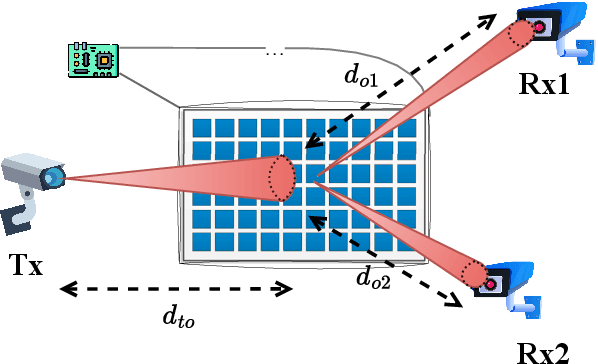
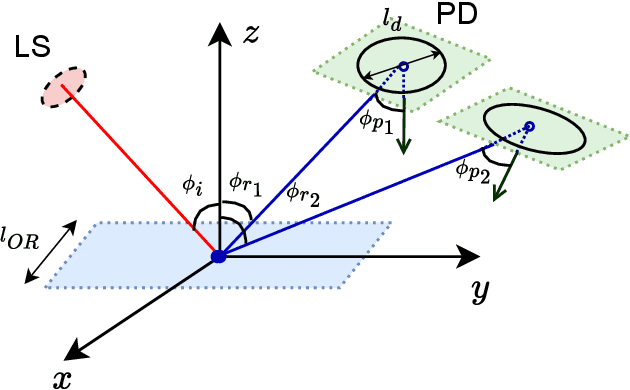
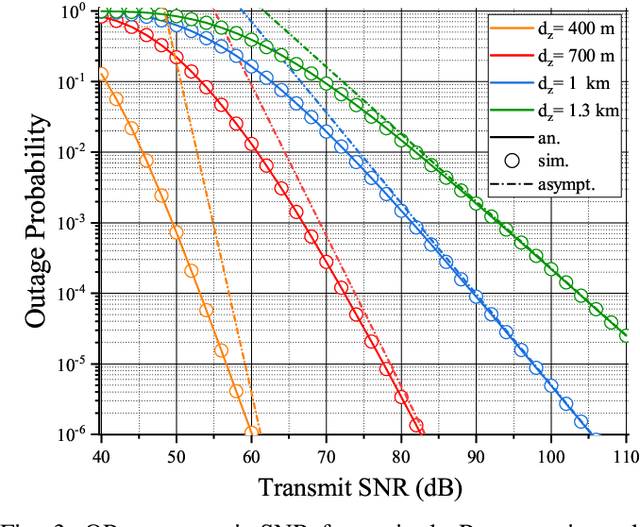
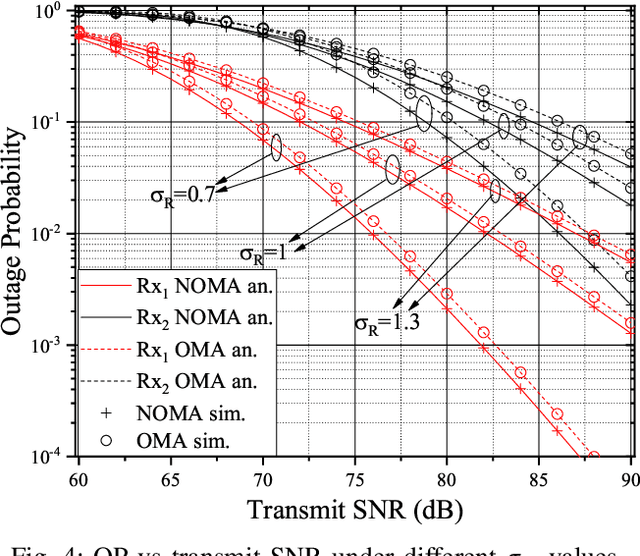
In this paper, we identify optical reconfigurable intelligent surfaces (ORISs) as key enablers of next-generation free-space optical (FSO) multiple access systems. By leveraging their beam steering and beam splitting capabilities, ORISs are able to effectively address line-of-sight (LoS) constraints, while enabling multi-user connectivity. We consider an ORIS-assisted non-orthogonal multiple access (NOMA) system model consisting of a single transmitter (Tx) and two receivers (Rxs). We derive novel analytical expressions to characterize the statistical particularities of the Tx-ORIS-Rx communication channel. Building upon the aforementioned expressions, we investigate the outage performance of the Rxs by deriving exact analytical expressions for the outage probability (OP) of each Rx. To provide deeper insights into the impact of various system parameters and physical conditions on the outage performance of each Rx, we conduct a high signal-to-noise ratio (SNR) analysis, that returns asymptotic expressions for the Rxs OPs at the high-SNR regime. Monte Carlo simulations validate the analysis, demonstrate the effectiveness of ORIS-enabled NOMA under a variety of configurations and physical scenarios, and showcase its superiority over its orthogonal-based counterpart.
On the Reliability and Security of Ambient Backscatter Uplink NOMA Networks
May 11, 2024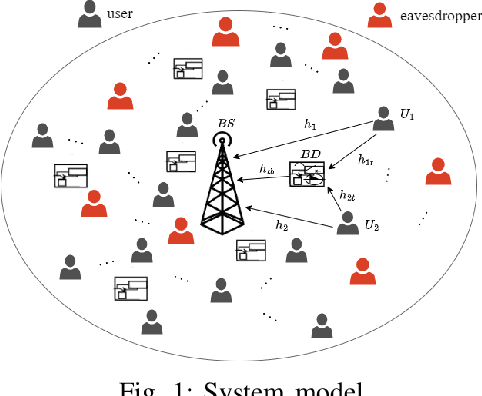
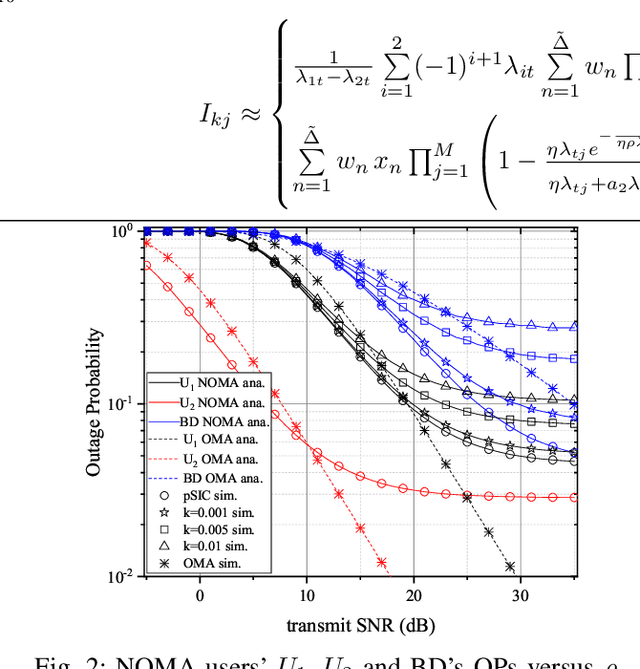
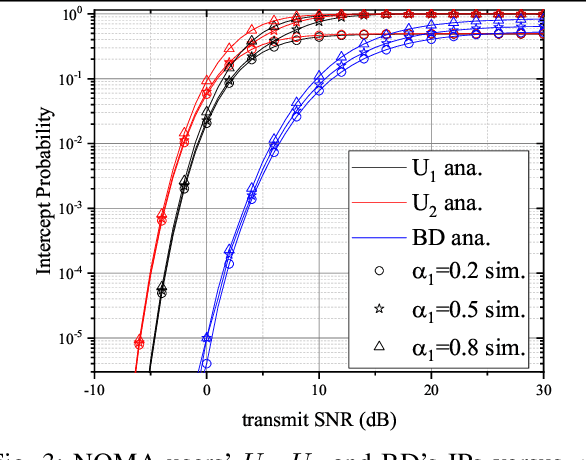
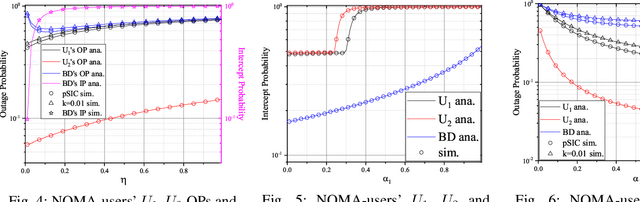
A fundamental objective of the forthcoming sixth-generation wireless networks is to concurrently serve a vast array of devices many of which, such as Internet-of-Things (IoT) sensors, are projected to have low power requirements or even operate in a battery-free manner. To achieve this goal, non-orthogonal multiple access (NOMA) and ambient backscatter communications (AmBC) are regarded as two pivotal and promising technologies. In this work, we present a novel analytical framework for studying the reliability and security of uplink NOMA-based AmBC systems. Specifically, closed-form analytical expressions for both NOMA-users' and IoT backscatter device's (BD's) outage probabilities (OPs) are derived for both cases of perfect and imperfect successive interference cancellation (SIC). In addition, assuming that one NOMA-user transmits an artificial noise in order to enhance system's security, the physical layer security (PLS) of the system is investigated by extracting analytical expressions for NOMA-users' and BD's intercept probabilities (IPs). To gain insightful understandings, an asymptotic analysis is carried out by focusing on the high signal-to-noise (SNR) regime, which reveals that NOMA-users and BDs face outage floors in the high SNR regime as well as that IPs reach constant values at high SNR. Additionally, practical insights regarding how different system parameters affect these OP floors and IP constant values are extracted. Numerical results verify the accuracy of othe developed theoretical framework, offer performance comparisons between the presented NOMA-based AmBC system and a conventional orthogonal multiple access-based AmBC system, and reveal the impact of different system parameters on the reliability and security of NOMA-based AmBC networks.