 Add to Chrome
 Add to Firefox
 Add to Edge
Towards a Unified Multidimensional Explainability Metric: Evaluating Trustworthiness in AI Models
Jul 15, 2026
In this paper, we present a comprehensive framework for assessing the explainability of various XAI methods, such as LIME and SHAP, across multiple datasets and machine learning models, with the ultimate goal of creating a unified multidimensional explainability score. Our methodology focuses on three key aspects of explainability: fidelity, simplicity, and stability. We leverage benchmarking experiments to systematically evaluate these aspects and use the insights gained to construct an offline knowledge base. This knowledge base captures the explainability scores for each registered model and serves as a valuable resource for context-dependent evaluation of explainability. By analyzing the complementary characteristics and metadata of AI models, datasets, and XAI methods, the knowledge base will enable the estimation of explainability scores for previously unseen datasets and models. Properties like fidelity, simplicity, and stability may vary significantly based on the dataset, underlying model, and domain expertise of the end user. We demonstrate our framework by applying it to three open-source datasets, discussing the implications of the obtained results in relation to the characteristics of the datasets. Our work contributes to the growing field of XAI by providing a robust and versatile tool for evaluating and comparing the explainability of various XAI methods, ultimately supporting the development of more transparent and trustworthy AI systems.

Bridging Industrial Expertise and XR with LLM-Powered Conversational Agents
Apr 07, 2025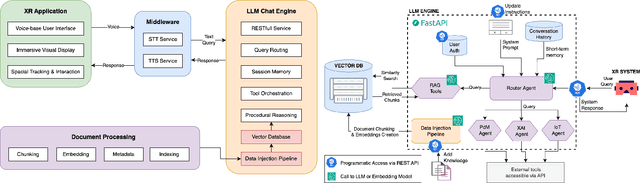
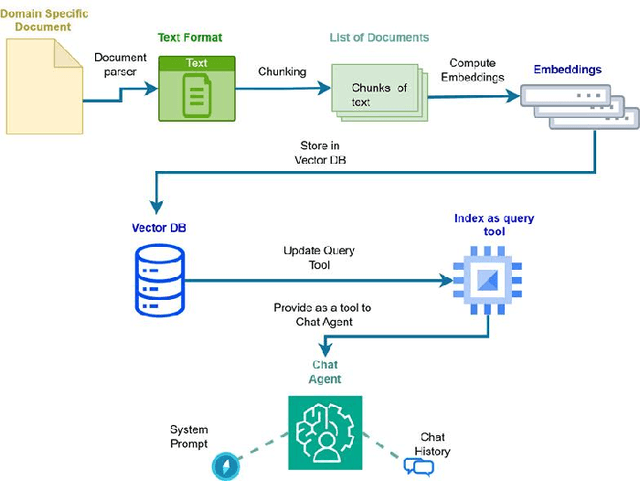
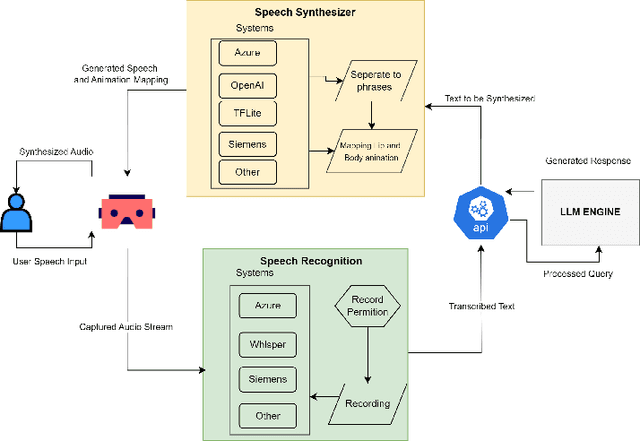
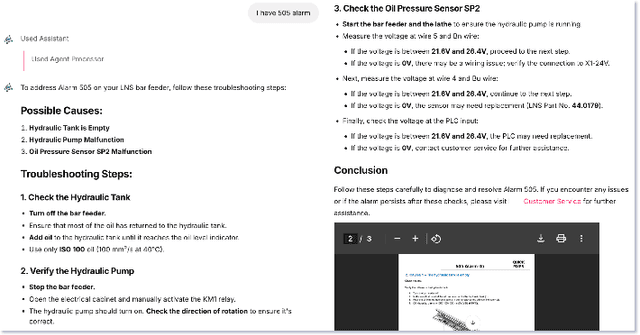
This paper introduces a novel integration of Retrieval-Augmented Generation (RAG) enhanced Large Language Models (LLMs) with Extended Reality (XR) technologies to address knowledge transfer challenges in industrial environments. The proposed system embeds domain-specific industrial knowledge into XR environments through a natural language interface, enabling hands-free, context-aware expert guidance for workers. We present the architecture of the proposed system consisting of an LLM Chat Engine with dynamic tool orchestration and an XR application featuring voice-driven interaction. Performance evaluation of various chunking strategies, embedding models, and vector databases reveals that semantic chunking, balanced embedding models, and efficient vector stores deliver optimal performance for industrial knowledge retrieval. The system's potential is demonstrated through early implementation in multiple industrial use cases, including robotic assembly, smart infrastructure maintenance, and aerospace component servicing. Results indicate potential for enhancing training efficiency, remote assistance capabilities, and operational guidance in alignment with Industry 5.0's human-centric and resilient approach to industrial development.