 Add to Chrome
 Add to Firefox
 Add to Edge
A Fast Model Counting Algorithm for Two-Variable Logic with Counting and Modulo Counting Quantifiers
May 05, 2026
Weighted first-order model counting (WFOMC) is a central task in lifted probabilistic inference: It asks for the weighted sum of all models of a first-order sentence over a finite domain. A long line of work has identified domain-liftable fragments of first-order logic, that is, syntactic classes for which WFOMC can be solved in time polynomial in the domain size. Among them, the two-variable fragment with counting quantifiers, $\mathbf{C}^2$, is one of the most expressive known liftable fragments. Existing algorithms for $\mathbf{C}^2$, however, establish tractability through multi-stage reductions that eliminate counting quantifiers via cardinality constraints, which introduces substantial practical overhead as the domain size grows. In this paper, we introduce IncrementalWFOMC3, a lifted algorithm for WFOMC on $\mathbf{C}^2$ and its modulo counting extension, $\mathbf{C}^2_{\text{mod}}$. Instead of relying on reduction techniques, IncrementalWFOMC3 operates directly on a Scott normal form that retains counting quantifiers throughout inference. This direct treatment yields two main results. First, we derive a tighter data-complexity bound for WFOMC in $\mathbf{C}^2$, reducing the degree of the polynomial from quadratic to linear in the counting parameters. Second, we prove that $\mathbf{C}^2_{\text{mod}}$ is domain-liftable, extending tractability from $\mathbf{C}^2$ to a richer fragment with native modulo counting support. Finally, our empirical evaluation shows that IncrementalWFOMC3 delivers orders-of-magnitude runtime improvements and better scalability than both existing WFOMC algorithms and state-of-the-art propositional model counters.

Fourier Transformers for Latent Crystallographic Diffusion and Generative Modeling
Feb 12, 2026The discovery of new crystalline materials calls for generative models that handle periodic boundary conditions, crystallographic symmetries, and physical constraints, while scaling to large and structurally diverse unit cells. We propose a reciprocal-space generative pipeline that represents crystals through a truncated Fourier transform of the species-resolved unit-cell density, rather than modeling atomic coordinates directly. This representation is periodicity-native, admits simple algebraic actions of space-group symmetries, and naturally supports variable atomic multiplicities during generation, addressing a common limitation of particle-based approaches. Using only nine Fourier basis functions per spatial dimension, our approach reconstructs unit cells containing up to 108 atoms per chemical species. We instantiate this pipeline with a transformer variational autoencoder over complex-valued Fourier coefficients, and a latent diffusion model that generates in the compressed latent space. We evaluate reconstruction and latent diffusion on the LeMaterial benchmark and compare unconditional generation against coordinate-based baselines in the small-cell regime ($\leq 16$ atoms per unit cell).
Vector Field Oriented Diffusion Model for Crystal Material Generation
Dec 20, 2023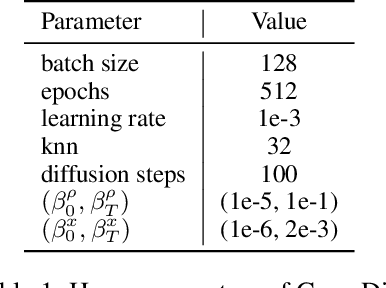
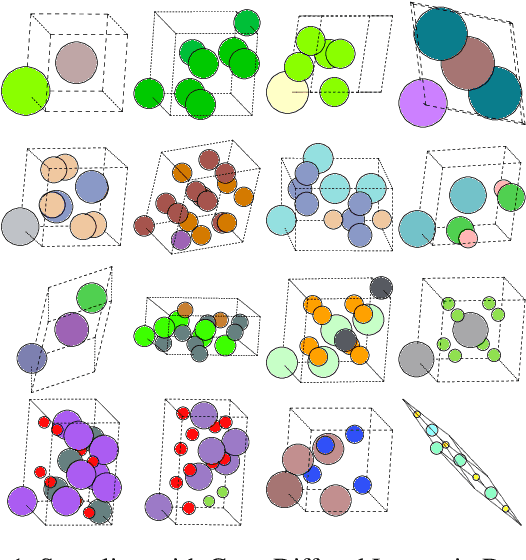
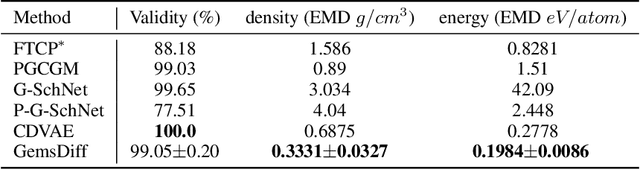
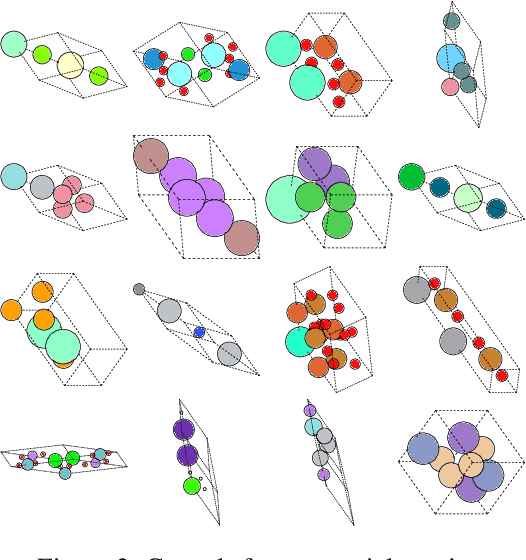
Discovering crystal structures with specific chemical properties has become an increasingly important focus in material science. However, current models are limited in their ability to generate new crystal lattices, as they only consider atomic positions or chemical composition. To address this issue, we propose a probabilistic diffusion model that utilizes a geometrically equivariant GNN to consider atomic positions and crystal lattices jointly. To evaluate the effectiveness of our model, we introduce a new generation metric inspired by Frechet Inception Distance, but based on GNN energy prediction rather than InceptionV3 used in computer vision. In addition to commonly used metrics like validity, which assesses the plausibility of a structure, this new metric offers a more comprehensive evaluation of our model's capabilities. Our experiments on existing benchmarks show the significance of our diffusion model. We also show that our method can effectively learn meaningful representations.
Unified Model for Crystalline Material Generation
Jun 07, 2023One of the greatest challenges facing our society is the discovery of new innovative crystal materials with specific properties. Recently, the problem of generating crystal materials has received increasing attention, however, it remains unclear to what extent, or in what way, we can develop generative models that consider both the periodicity and equivalence geometric of crystal structures. To alleviate this issue, we propose two unified models that act at the same time on crystal lattice and atomic positions using periodic equivariant architectures. Our models are capable to learn any arbitrary crystal lattice deformation by lowering the total energy to reach thermodynamic stability. Code and data are available at https://github.com/aklipf/GemsNet.
Equivariant Message Passing Neural Network for Crystal Material Discovery
Feb 01, 2023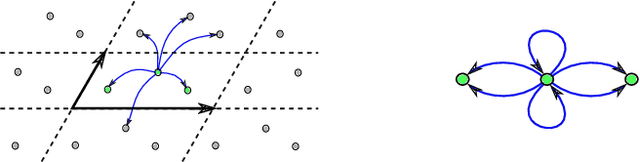


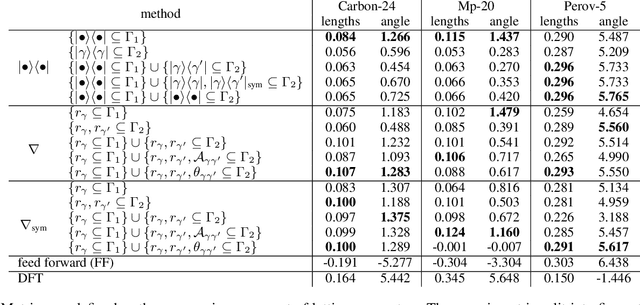
Automatic material discovery with desired properties is a fundamental challenge for material sciences. Considerable attention has recently been devoted to generating stable crystal structures. While existing work has shown impressive success on supervised tasks such as property prediction, the progress on unsupervised tasks such as material generation is still hampered by the limited extent to which the equivalent geometric representations of the same crystal are considered. To address this challenge, we propose EMPNN a periodic equivariant message-passing neural network that learns crystal lattice deformation in an unsupervised fashion. Our model equivalently acts on lattice according to the deformation action that must be performed, making it suitable for crystal generation, relaxation and optimisation. We present experimental evaluations that demonstrate the effectiveness of our approach.