 Add to Chrome
 Add to Firefox
 Add to Edge
How Far Can Root Cause Analysis Go on Real-World Telemetry Data?
Jul 15, 2026
Identifying root causes in production microservice failures requires reasoning over large-scale, multimodal telemetry spanning metrics, logs, and traces, a problem that has proved resistant to both classical and LLM-based approaches. The OpenRCA dataset exemplifies these challenges: it is large-scale, multimodal, and lacks detailed domain knowledge, and yields consistently low accuracy across all existing methods. We show that classical causal discovery methods and existing LLM-based multi-agent systems fail to reliably identify root causes on this benchmark, and present a Structured Multi-Agent RCA pipeline that substantially outperforms existing LLM-based and classical baselines, supporting both domain-knowledge and knowledge-free operating modes. To diagnose where failures originate, we introduce a reverse reasoning agent that, given the correct answer, identifies which signals in the extracted anomalies support it and determines whether Stage~1 had access to those signals, classifying each failure as Reasoning Gap (evidence present but unused) or Data Ambiguity (evidence genuinely absent). This analysis reveals that the required evidence is present in the vast majority of failures: the bottleneck is not data access but the agent's ability to reason over it correctly. We further introduce an automated rule mining pipeline that systematically extracts discrimination rules from reverse reasoning reports, reducing reliance on manual knowledge curation. Across all configurations, model reasoning capability and domain knowledge are the primary constraints: stronger models embed more domain expertise, and explicit knowledge injection partially compensates for this gap. Reasoning performance remains practically bounded even when evidence extraction is perfect: scaffold engineering and better data pipelines alone cannot close this gap; progress requires improvements at the model level.

STOCKTAKE: Measuring the Gap Between Perception and Action in LLM Agents with a Fair Oracle
Jul 15, 2026LLM agents are increasingly evaluated on multi-week decision tasks in which the state that drives cost is never directly observed. On such tasks the final cost cannot say why an agent failed: it may have misread the world, or read it correctly and still failed to act (the knowing-doing gap). Existing evaluations cannot separate these two failures; their reference policies either read privileged information the agent never sees, or are missing altogether. We introduce STOCKTAKE, a 26-week supply-chain replenishment benchmark built as a factored partially observable Markov decision process with six hidden factor processes, designed so that a fair reference policy is computable: an exact Bayes filter per factor drives a rollout policy on the identical observation stream the agent receives. Scoring each run between a symptom-blind base-stock floor (0) and this oracle (1) yields a skill score, and grading each week's written rationale yields a stated-belief detection lag and a knowing-doing rate, so state estimation and control are measured separately. On fifty seeds with curated stress profiles, Claude Sonnet 5, GPT-5.4, DeepSeek-V4-Pro, and Grok 4.5 detect 84-88% of hidden failures, typically within a week of onset, yet span skill scores from 0.62 to -0.23: two of the four end below the symptom-blind floor while naming factors slightly faster than the two that beat it. The failure has two faces. Where stress persists, 34-43% of correctly diagnosed stress weeks still end in stockout for every model, a rate that partly reflects the severity of the weeks models notice. That rate also runs opposite to skill: the two models under the floor stock out least on diagnosed weeks, so under-response is only one face of the gap, and their traces point to the other, responses whose cost exceeds what they protect. STOCKTAKE measures both directions of that failure.
ReTreVal: Reasoning Tree with Validation -- A Hybrid Framework for Enhanced LLM Multi-Step Reasoning
Jan 06, 2026Multi-step reasoning remains a key challenge for Large Language Models (LLMs), particularly in complex domains such as mathematics and creative writing. While recent approaches including ReAct, Reflexion, and Self-Refine improve reasoning through iterative refinement and reflection, they often lack structured exploration of alternative solution paths and persistent learning across problems. We propose ReTreVal (Reasoning Tree with Validation), a hybrid framework that integrates Tree-of-Thoughts exploration, self-refinement, LLM-based critique scoring, and reflexion memory to enable bounded and validated multi-step reasoning. ReTreVal constructs a structured reasoning tree with adaptive depth based on problem complexity, where each node undergoes iterative self-critique and refinement guided by explicit LLM-generated feedback. A dual validation mechanism evaluates reasoning quality, coherence, and correctness at each node while persistently storing insights from successful reasoning paths and failure patterns in a reflexion memory buffer, enabling cross-problem learning. Critique-based pruning retains only the top-k highest-scoring nodes at each level, controlling computational cost while preserving high-quality solution paths. We evaluate ReTreVal against ReAct, Reflexion, and Self-Refine across 500 mathematical problems and creative writing tasks using Qwen 2.5 7B as the underlying LLM, and demonstrate that ReTreVal consistently outperforms existing methods through its combination of structured exploration, critique-driven refinement, and cross-problem memory, making it particularly effective for tasks requiring exploratory reasoning, rigorous verification, and knowledge transfer.
ReflexGrad: Three-Way Synergistic Architecture for Zero-Shot Generalization in LLM Agents
Nov 18, 2025
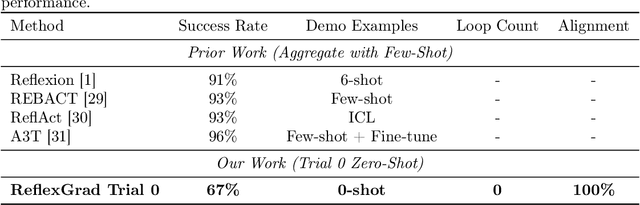
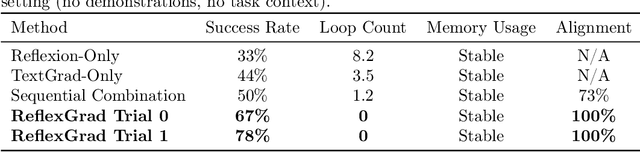
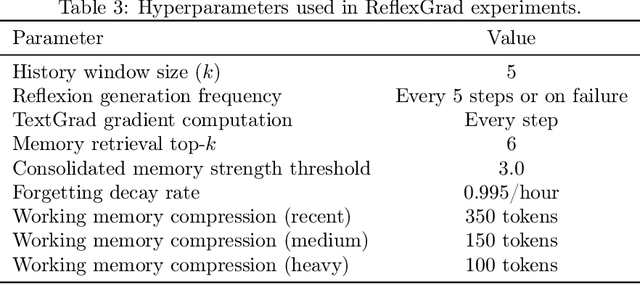
Enabling agents to learn from experience and generalize across diverse tasks without task-specific training remains a fundamental challenge in reinforcement learning and decision-making. While recent approaches have explored episodic memory (Reflexion), gradient-based prompt optimization (TextGrad),and hierarchical task decomposition independently, their potential for synergistic integration remains unexplored. We introduce ReflexGrad, a novel architecture that tightly couples three complementary mechanisms: (1) LLM-based hierarchical TODO decomposition for strategic planning, (2) history-aware causal reflection that analyzes recent action patterns to identify failure root causes and enable within-trial learning, and (3) gradient-based optimization for systematic improvement. Unlike prior work relying on few-shot demonstrations, our system achieves true zero-shot generalization through pure LLM semantic reasoning,requiring no task-specific examples, fine-tuning, or hardcoded similarity metrics. Evaluated on ALFWorld benchmark tasks, ReflexGrad demonstrates 67% zero-shot success rate on Trial 0 without any prior task experience or demonstrations, establishing effective performance on first exposure. Through empirical analysis, we identify the architectural mechanisms underlying stable convergence (zero action loops) and effective cross-task transfer (67% to 78% improvement).Our work demonstrates that synergistic integration of complementary learning mechanisms enables robust zero-shot generalization that approaches few-shot baselines from prior work.