 Add to Chrome
 Add to Firefox
 Add to Edge
Transformers know more than they can tell -- Learning the Collatz sequence
Nov 13, 2025
We investigate transformer prediction of long Collatz steps, a complex arithmetic function that maps odd integers to their distant successors in the Collatz sequence ( $u_{n+1}=u_n/2$ if $u_n$ is even, $u_{n+1}=(3u_n+1)/2$ if $u_n$ is odd). Model accuracy varies with the base used to encode input and output. It can be as high as $99.7\%$ for bases $24$ and $32$, and as low as $37$ and $25\%$ for bases $11$ and $3$. Yet, all models, no matter the base, follow a common learning pattern. As training proceeds, they learn a sequence of classes of inputs that share the same residual modulo $2^p$. Models achieve near-perfect accuracy on these classes, and less than $1\%$ for all other inputs. This maps to a mathematical property of Collatz sequences: the length of the loops involved in the computation of a long Collatz step can be deduced from the binary representation of its input. The learning pattern reflects the model learning to predict inputs associated with increasing loop lengths. An analysis of failure cases reveals that almost all model errors follow predictable patterns. Hallucination, a common feature of large language models, almost never happens. In over $90\%$ of failures, the model performs the correct calculation, but wrongly estimates loop lengths. Our observations give a full account of the algorithms learned by the models. They suggest that the difficulty of learning such complex arithmetic function lies in figuring the control structure of the computation -- the length of the loops. We believe that the approach outlined here, using mathematical problems as tools for understanding, explaining, and perhaps improving language models, can be applied to a broad range of problems and bear fruitful results.

Towards a Mathematics Formalisation Assistant using Large Language Models
Nov 14, 2022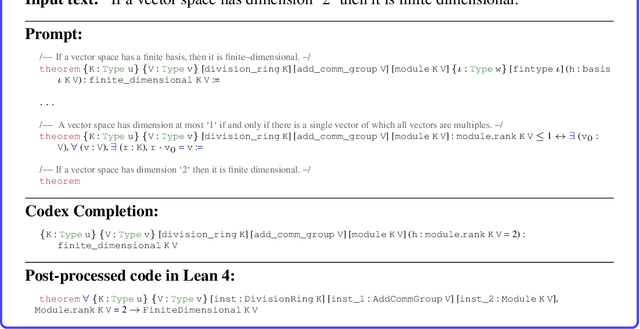


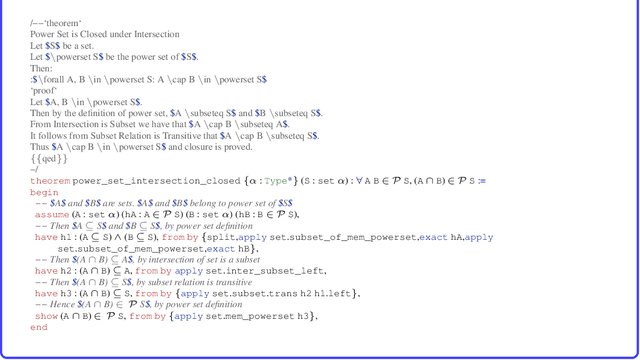
Mathematics formalisation is the task of writing mathematics (i.e., definitions, theorem statements, proofs) in natural language, as found in books and papers, into a formal language that can then be checked for correctness by a program. It is a thriving activity today, however formalisation remains cumbersome. In this paper, we explore the abilities of a large language model (Codex) to help with formalisation in the Lean theorem prover. We find that with careful input-dependent prompt selection and postprocessing, Codex is able to formalise short mathematical statements at undergrad level with nearly 75\% accuracy for $120$ theorem statements. For proofs quantitative analysis is infeasible and we undertake a detailed case study. We choose a diverse set of $13$ theorems at undergrad level with proofs that fit in two-three paragraphs. We show that with a new prompting strategy Codex can formalise these proofs in natural language with at least one out of twelve Codex completion being easy to repair into a complete proof. This is surprising as essentially no aligned data exists for formalised mathematics, particularly for proofs. These results suggest that large language models are a promising avenue towards fully or partially automating formalisation.