 Add to Chrome
 Add to Firefox
 Add to Edge
Next-Frame Feature Prediction for Multimodal Deepfake Detection and Temporal Localization
Nov 13, 2025
Recent multimodal deepfake detection methods designed for generalization conjecture that single-stage supervised training struggles to generalize across unseen manipulations and datasets. However, such approaches that target generalization require pretraining over real samples. Additionally, these methods primarily focus on detecting audio-visual inconsistencies and may overlook intra-modal artifacts causing them to fail against manipulations that preserve audio-visual alignment. To address these limitations, we propose a single-stage training framework that enhances generalization by incorporating next-frame prediction for both uni-modal and cross-modal features. Additionally, we introduce a window-level attention mechanism to capture discrepancies between predicted and actual frames, enabling the model to detect local artifacts around every frame, which is crucial for accurately classifying fully manipulated videos and effectively localizing deepfake segments in partially spoofed samples. Our model, evaluated on multiple benchmark datasets, demonstrates strong generalization and precise temporal localization.

A Multilateral Attention-enhanced Deep Neural Network for Disease Outbreak Forecasting: A Case Study on COVID-19
Aug 26, 2024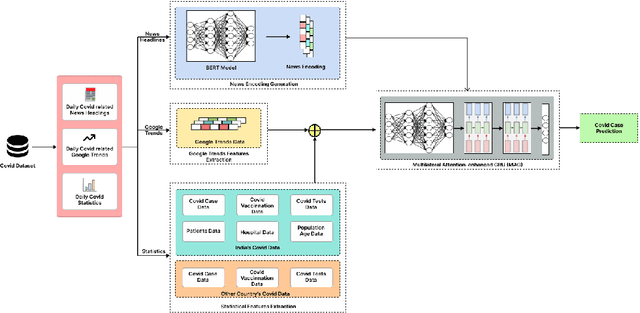
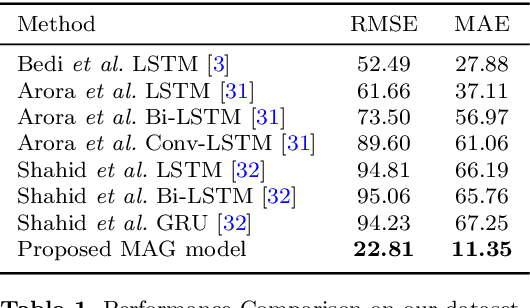
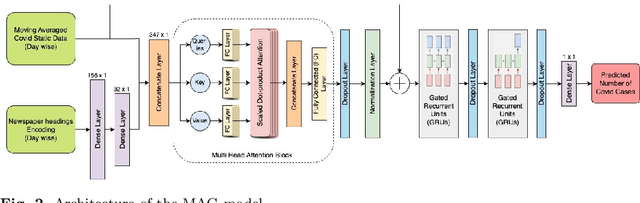
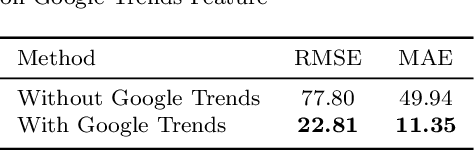
The worldwide impact of the recent COVID-19 pandemic has been substantial, necessitating the development of accurate forecasting models to predict the spread and course of a pandemic. Previous methods for outbreak forecasting have faced limitations by not utilizing multiple sources of input and yielding suboptimal performance due to the limited availability of data. In this study, we propose a novel approach to address the challenges of infectious disease forecasting. We introduce a Multilateral Attention-enhanced GRU model that leverages information from multiple sources, thus enabling a comprehensive analysis of factors influencing the spread of a pandemic. By incorporating attention mechanisms within a GRU framework, our model can effectively capture complex relationships and temporal dependencies in the data, leading to improved forecasting performance. Further, we have curated a well-structured multi-source dataset for the recent COVID-19 pandemic that the research community can utilize as a great resource to conduct experiments and analysis on time-series forecasting. We evaluated the proposed model on our COVID-19 dataset and reported the output in terms of RMSE and MAE. The experimental results provide evidence that our proposed model surpasses existing techniques in terms of performance. We also performed performance gain and qualitative analysis on our dataset to evaluate the impact of the attention mechanism and show that the proposed model closely follows the trajectory of the pandemic.
An Open Patch Generator based Fingerprint Presentation Attack Detection using Generative Adversarial Network
Jun 06, 2023



The low-cost, user-friendly, and convenient nature of Automatic Fingerprint Recognition Systems (AFRS) makes them suitable for a wide range of applications. This spreading use of AFRS also makes them vulnerable to various security threats. Presentation Attack (PA) or spoofing is one of the threats which is caused by presenting a spoof of a genuine fingerprint to the sensor of AFRS. Fingerprint Presentation Attack Detection (FPAD) is a countermeasure intended to protect AFRS against fake or spoof fingerprints created using various fabrication materials. In this paper, we have proposed a Convolutional Neural Network (CNN) based technique that uses a Generative Adversarial Network (GAN) to augment the dataset with spoof samples generated from the proposed Open Patch Generator (OPG). This OPG is capable of generating realistic fingerprint samples which have no resemblance to the existing spoof fingerprint samples generated with other materials. The augmented dataset is fed to the DenseNet classifier which helps in increasing the performance of the Presentation Attack Detection (PAD) module for the various real-world attacks possible with unknown spoof materials. Experimental evaluations of the proposed approach are carried out on the Liveness Detection (LivDet) 2015, 2017, and 2019 competition databases. An overall accuracy of 96.20\%, 94.97\%, and 92.90\% has been achieved on the LivDet 2015, 2017, and 2019 databases, respectively under the LivDet protocol scenarios. The performance of the proposed PAD model is also validated in the cross-material and cross-sensor attack paradigm which further exhibits its capability to be used under real-world attack scenarios.