 Add to Chrome
 Add to Firefox
 Add to Edge
The Replay Gap: Static Evaluation of Model Switching in LLM Agents Scores the Wrong World
Aug 08, 2026
LLM routers promise efficiency by matching each request to the cheapest adequate model, and are increasingly applied per step inside multi-step agents. Yet agentic routers are evaluated like single-turn routers: by replaying logged trajectories and substituting another model's recorded outputs, assuming the rest of the trajectory is unaffected. We test this assumption with branching rollouts: we fork live SWE-bench agent trajectories at controlled points, rebuild the environment, continue each fork with a different model, and compare against same-model control forks that isolate sampling and replay noise. Across six paired runs (~900 rollouts), swaps exceed their matched control floors by +0.25 to +0.66 normalized edit distance (multiplicity-corrected CIs exclude zero), rewriting 61-94% of post-fork actions; 74-77% of early swaps diverge at the first post-fork action, versus 6-35% of controls, leaving only 3% of replayed states valid. Divergence decreases with fork depth in both directions. All five outcome flips we observe occur in swap arms, upgrades rescuing unsolved instances and a downgrade losing the sole solve, and zero occur across 359 control forks. Scoring these same swaps with a log-stitching replay evaluator, replay mispredicts every success-relevant outcome call and predicts patches with 0.00-0.11 similarity to reality. Auditing the noise floor, temperature-0 "determinism" is configuration-dependent: FP8-served controls diverge on over 90% of forks while AWQ-served ones remain near-identical; and under tight budgets the stronger model more often exhausts its steps without submitting. Replay-based benchmarks score the wrong world for agentic routing; we release our harness and all trajectories.

Outage-Watch: Early Prediction of Outages using Extreme Event Regularizer
Sep 29, 2023

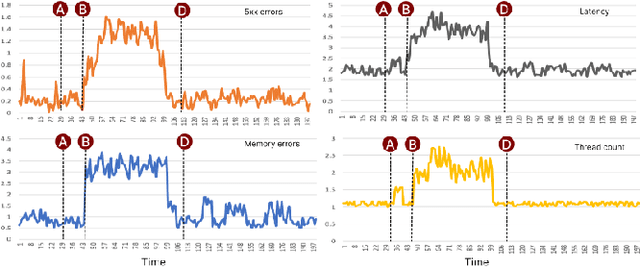

Cloud services are omnipresent and critical cloud service failure is a fact of life. In order to retain customers and prevent revenue loss, it is important to provide high reliability guarantees for these services. One way to do this is by predicting outages in advance, which can help in reducing the severity as well as time to recovery. It is difficult to forecast critical failures due to the rarity of these events. Moreover, critical failures are ill-defined in terms of observable data. Our proposed method, Outage-Watch, defines critical service outages as deteriorations in the Quality of Service (QoS) captured by a set of metrics. Outage-Watch detects such outages in advance by using current system state to predict whether the QoS metrics will cross a threshold and initiate an extreme event. A mixture of Gaussian is used to model the distribution of the QoS metrics for flexibility and an extreme event regularizer helps in improving learning in tail of the distribution. An outage is predicted if the probability of any one of the QoS metrics crossing threshold changes significantly. Our evaluation on a real-world SaaS company dataset shows that Outage-Watch significantly outperforms traditional methods with an average AUC of 0.98. Additionally, Outage-Watch detects all the outages exhibiting a change in service metrics and reduces the Mean Time To Detection (MTTD) of outages by up to 88% when deployed in an enterprise cloud-service system, demonstrating efficacy of our proposed method.