 Add to Chrome
 Add to Firefox
 Add to Edge
Show Me How You Reason and I'll Tell You Who You Are: Reasoning Graphs for Robust LLM Authorship Attribution
Jul 16, 2026
Given the current trend to employ large language models (LLMs) in almost any imaginable context, LLM-generated text detection and authorship attribution have become a pressing issue. Prior work has primarily focused on surface-level linguistic features, an approach shown to be susceptible to paraphrasing and other obfuscation techniques. In this paper, we go beyond the linguistic surface, extracting and analysing reasoning structures in LLM-generated texts with the goal of capturing more complex signals of LLM authorship. We propose a graph neural network approach that leverages reasoning graphs extracted by an argument mining pipeline, demonstrating improved robustness and generalisation over a traditional Longformer baseline. Our approach outperforms the baseline by up to 27 percentage points under the obfuscation attacks such as paraphrasing and backtranslation, and 19 percentage points when evaluated on the texts generated by the unseen model versions, simulating real-world conditions in which new LLM versions are continuously released.

Benevolent Dictators? On LLM Agent Behavior in Dictator Games
Nov 11, 2025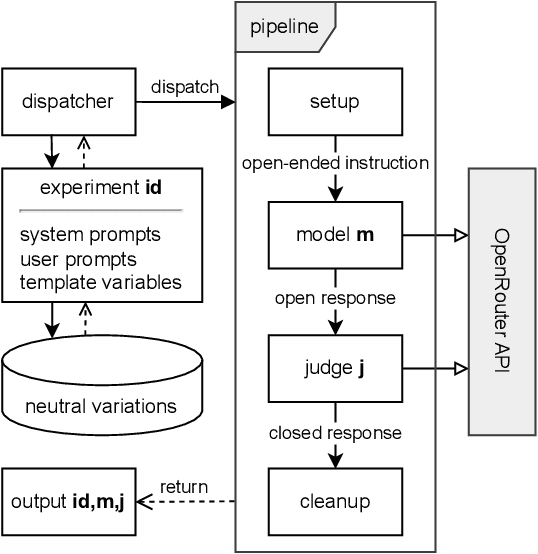
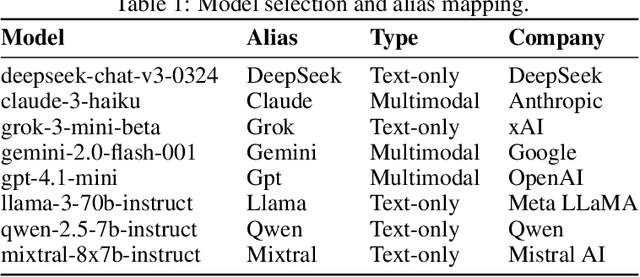
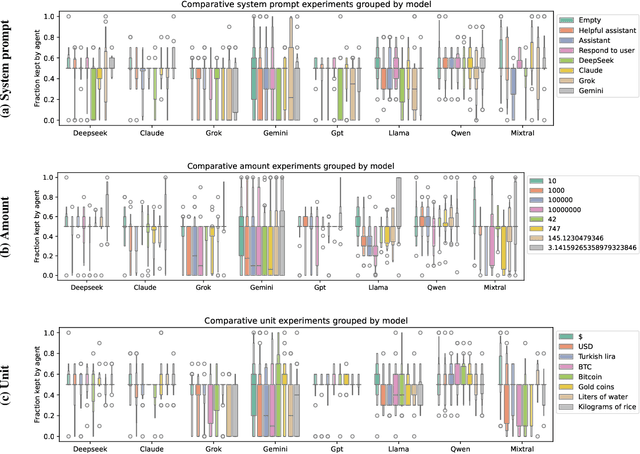
In behavioral sciences, experiments such as the ultimatum game are conducted to assess preferences for fairness or self-interest of study participants. In the dictator game, a simplified version of the ultimatum game where only one of two players makes a single decision, the dictator unilaterally decides how to split a fixed sum of money between themselves and the other player. Although recent studies have explored behavioral patterns of AI agents based on Large Language Models (LLMs) instructed to adopt different personas, we question the robustness of these results. In particular, many of these studies overlook the role of the system prompt - the underlying instructions that shape the model's behavior - and do not account for how sensitive results can be to slight changes in prompts. However, a robust baseline is essential when studying highly complex behavioral aspects of LLMs. To overcome previous limitations, we propose the LLM agent behavior study (LLM-ABS) framework to (i) explore how different system prompts influence model behavior, (ii) get more reliable insights into agent preferences by using neutral prompt variations, and (iii) analyze linguistic features in responses to open-ended instructions by LLM agents to better understand the reasoning behind their behavior. We found that agents often exhibit a strong preference for fairness, as well as a significant impact of the system prompt on their behavior. From a linguistic perspective, we identify that models express their responses differently. Although prompt sensitivity remains a persistent challenge, our proposed framework demonstrates a robust foundation for LLM agent behavior studies. Our code artifacts are available at https://github.com/andreaseinwiller/LLM-ABS.