 Add to Chrome
 Add to Firefox
 Add to Edge
AuAu: A Benchmark for Auditing Authoritarian Alignment in Large Language Models
Jun 15, 2026
The worldwide surge of authoritarianism, combined with the increasing central role in users' everyday lives, raises the question of to what extent specific models exhibit or promote authoritarian attitudes and characteristics. We introduce AuAu, a comprehensive benchmark that aims to assess the risk of LLMs generating responses with authoritarian tendencies. This benchmark combines three evaluation approaches: (i) psychometric questions from an extensive pool of 15 human validated instruments; (ii) contextual behavior vignettes probing intended actions in concrete situations; and (iii) responses to realistic user prompts. Unlike prior work, AuAu evaluates not only a general closeness towards authoritarianism but also the established sub-concepts Authoritarian Aggression, Authoritarian Submission, and Conventionalism. Evaluating 17 models from China, the EU, Russia, and the USA, we find that all tested models exhibit substantial authoritarian response rates under the psychometric evaluation, though rates drop significantly in increasingly more realistic downstream task. We further find that an authoritarian system prompt easily manipulates 15 out of 17 models to promote increased authoritarianism. Our results underscore the need for continued, systematic auditing of LLM-based AI systems to detect and ultimately mitigate undesired authoritarian tendencies in generated output. Our code and data are available at: https://github.com/andreaseinwiller/AuAu

Benevolent Dictators? On LLM Agent Behavior in Dictator Games
Nov 11, 2025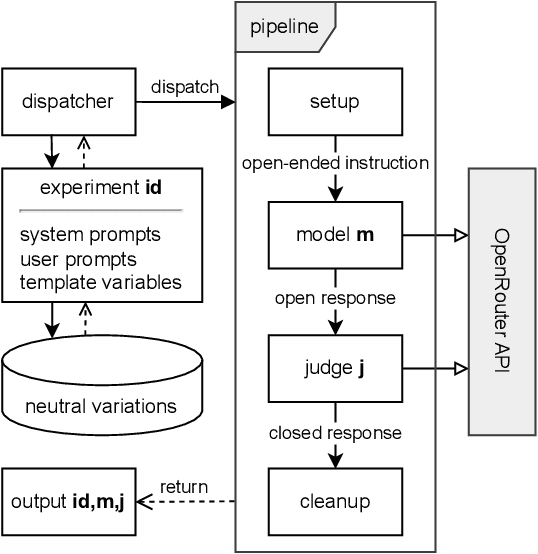
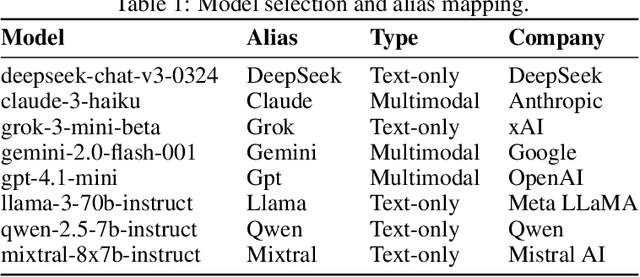
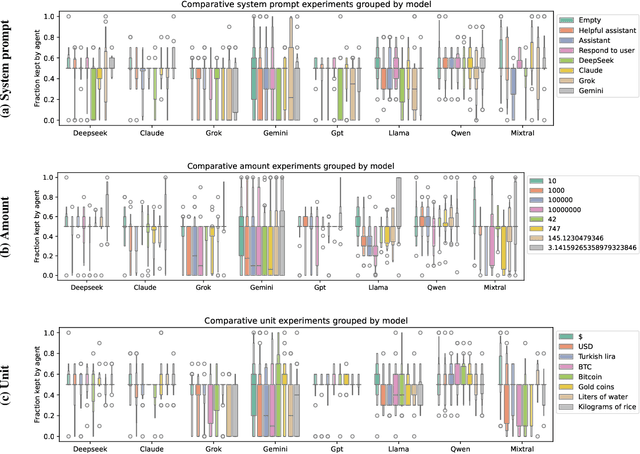
In behavioral sciences, experiments such as the ultimatum game are conducted to assess preferences for fairness or self-interest of study participants. In the dictator game, a simplified version of the ultimatum game where only one of two players makes a single decision, the dictator unilaterally decides how to split a fixed sum of money between themselves and the other player. Although recent studies have explored behavioral patterns of AI agents based on Large Language Models (LLMs) instructed to adopt different personas, we question the robustness of these results. In particular, many of these studies overlook the role of the system prompt - the underlying instructions that shape the model's behavior - and do not account for how sensitive results can be to slight changes in prompts. However, a robust baseline is essential when studying highly complex behavioral aspects of LLMs. To overcome previous limitations, we propose the LLM agent behavior study (LLM-ABS) framework to (i) explore how different system prompts influence model behavior, (ii) get more reliable insights into agent preferences by using neutral prompt variations, and (iii) analyze linguistic features in responses to open-ended instructions by LLM agents to better understand the reasoning behind their behavior. We found that agents often exhibit a strong preference for fairness, as well as a significant impact of the system prompt on their behavior. From a linguistic perspective, we identify that models express their responses differently. Although prompt sensitivity remains a persistent challenge, our proposed framework demonstrates a robust foundation for LLM agent behavior studies. Our code artifacts are available at https://github.com/andreaseinwiller/LLM-ABS.