 Add to Chrome
 Add to Firefox
 Add to Edge
All Models are Wrong, Knowing Where is Useful: On Model Uncertainty in Reinforcement Learning
May 31, 2026
Model-based reinforcement learning (MBRL) infers information about the environment from a learned dynamics model and bears the potential to address open problems such as data efficient and safe learning in robotics. However, inaccuracies of the learned dynamics model are typically exploited by the agent, substantially hampering the capabilities of MBRL methods. We present a framework for dealing with inaccuracies of probabilistic models through targeted handling of uncertainty that effectively mitigates model exploitation. We present recent successes in learning directly on hardware and safe exploration, and discuss future directions for uncertainty-aware MBRL.

Dyna-Style Safety Augmented Reinforcement Learning: Staying Safe in the Face of Uncertainty
Apr 28, 2026Safety remains an open problem in reinforcement learning (RL), especially during training. While safety filters are promising to address safe exploration, they are generally poorly suited for high-dimensional systems with unknown dynamics. We propose Dyna-style Safety Augmented Reinforcement Learning (Dyna-SAuR), a novel algorithm that learns both a scalable safety filter and a control policy using a learned uncertainty-aware dynamics model, while requiring minimal domain knowledge. The filter avoids failures and high uncertainty regions. Thus, better models expand the set of safe and certain states, reducing filter conservatism. We present the effectiveness of Dyna-SAuR on goal-reaching CartPole as well as MuJoCo Walker, reducing failures compared to state-of-the-art methods by 2 orders of magnitude.
Trust the Model Where It Trusts Itself -- Model-Based Actor-Critic with Uncertainty-Aware Rollout Adaption
May 29, 2024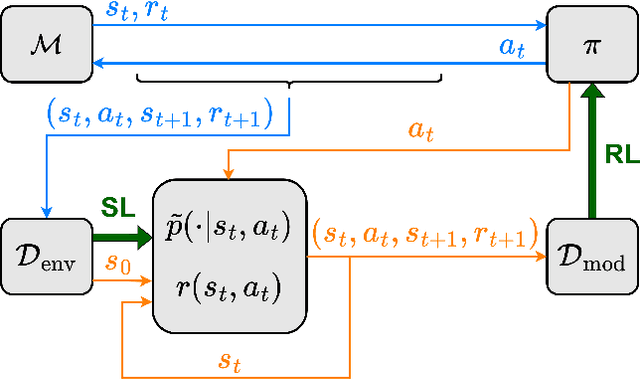
Dyna-style model-based reinforcement learning (MBRL) combines model-free agents with predictive transition models through model-based rollouts. This combination raises a critical question: 'When to trust your model?'; i.e., which rollout length results in the model providing useful data? Janner et al. (2019) address this question by gradually increasing rollout lengths throughout the training. While theoretically tempting, uniform model accuracy is a fallacy that collapses at the latest when extrapolating. Instead, we propose asking the question 'Where to trust your model?'. Using inherent model uncertainty to consider local accuracy, we obtain the Model-Based Actor-Critic with Uncertainty-Aware Rollout Adaption (MACURA) algorithm. We propose an easy-to-tune rollout mechanism and demonstrate substantial improvements in data efficiency and performance compared to state-of-the-art deep MBRL methods on the MuJoCo benchmark.