 Add to Chrome
 Add to Firefox
 Add to Edge
Cross-Entropy Games and Frost Training
May 26, 2026
We present Frost Training, a method for improving Monte Carlo-based policy optimization for a large family of LLM-as-a-judge tasks called Cross-Entropy Games. The key idea is to exploit the gradient of the reward function in embedding space. This signal is used in the Greedy Coordinate Gradient (GCG) jailbreaking technique; we demonstrate for the first time that it can also be used to boost model training. We validate our method using GRPO training for maximum-likelihood infilling. Frost Training improves the model's ability to generate high-scoring outputs, reaching higher maximum scores in a best-of-k setting, and does so at an increased speed.

Cognitive Training for Language Models: Towards General Capabilities via Cross-Entropy Games
Mar 23, 2026Defining a constructive process to build general capabilities for language models in an automatic manner is considered an open problem in artificial intelligence. Towards this, we consider the problem of building a curriculum of tasks that grows a model via relevant skill discovery. We provide a concrete framework for this task, using a family of tasks called cross-entropy games, which we postulate is universal in a suitable sense. We show that if it is possible to grow the curriculum for relevant skill discovery by iterating a greedy optimization algorithm, then, under natural assumptions, there is essentially only one meta-objective possible (up to a few hyperparameters). We call the resulting process cognitive training. We postulate that, given sufficiently capable language models as players and meta-samplers and sufficient training time, cognitive training provides a principled way to relevant skill discovery; and hence to the extent general capabilities are achievable via greedy curriculum learning, cognitive training would be a solution.
Looking for Complexity at Phase Boundaries in Continuous Cellular Automata
Mar 08, 2024
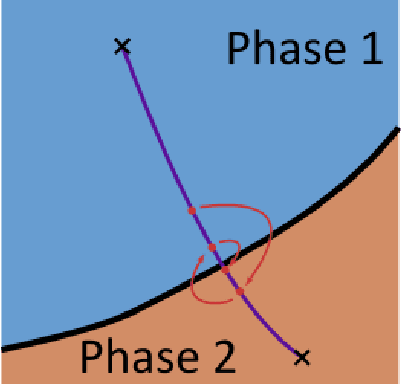
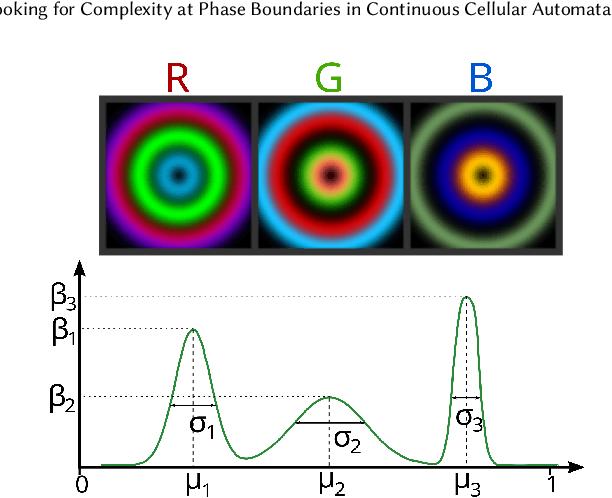
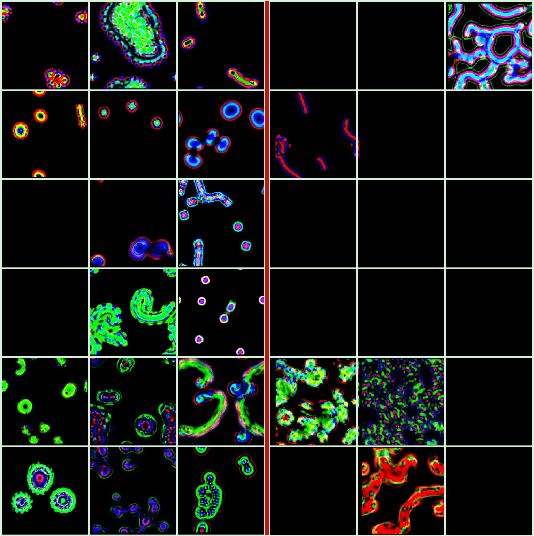
One key challenge in Artificial Life is designing systems that display an emergence of complex behaviors. Many such systems depend on a high-dimensional parameter space, only a small subset of which displays interesting dynamics. Focusing on the case of continuous systems, we introduce the 'Phase Transition Finder'(PTF) algorithm, which can be used to efficiently generate parameters lying at the border between two phases. We argue that such points are more likely to display complex behaviors, and confirm this by applying PTF to Lenia showing it can increase the frequency of interesting behaviors more than two-fold, while remaining efficient enough for large-scale searches.