 Add to Chrome
 Add to Firefox
 Add to Edge
Improving the Performance and Learning Stability of Parallelizable RNNs Designed for Ultra-Low Power Applications
May 12, 2026
Sequence learning is dominated by Transformers and parallelizable recurrent neural networks (RNNs) such as state-space models, yet learning long-term dependencies remains challenging, and state-of-the-art designs trade power consumption for performance. The Bistable Memory Recurrent Unit (BMRU) was introduced to enable hardware-software co-design of ultra-low power RNNs: quantized states with hysteresis provide persistent memory while mapping directly to analog primitives. However, BMRU performance lags behind parallelizable RNNs on complex sequential tasks. In this paper, we identify gradient blocking during state updates as a key limitation and propose a cumulative update formulation that restores gradient flow while preserving persistent memory, creating skip-connections through time. This leads to the Cumulative Memory Recurrent Unit (CMRU) and its relaxed variant, the $α$CMRU. Experiments show that the cumulative formulation dramatically improves convergence stability and reduces initialization sensitivity. The CMRU and $α$CMRU match or outperform Linear Recurrent Units (LRUs) and minimal Gated Recurrent Units (minGRUs) across diverse benchmarks at small model sizes, with particular advantages on tasks requiring discrete long-range retention, while the CMRU retains quantized states, persistent memory, and noise-resilient dynamics essential for analog implementation.

Fast reconstruction of degenerate populations of conductance-based neuron models from spike times
Sep 16, 2025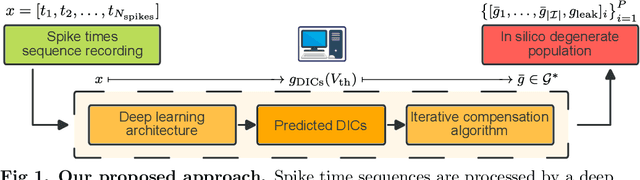

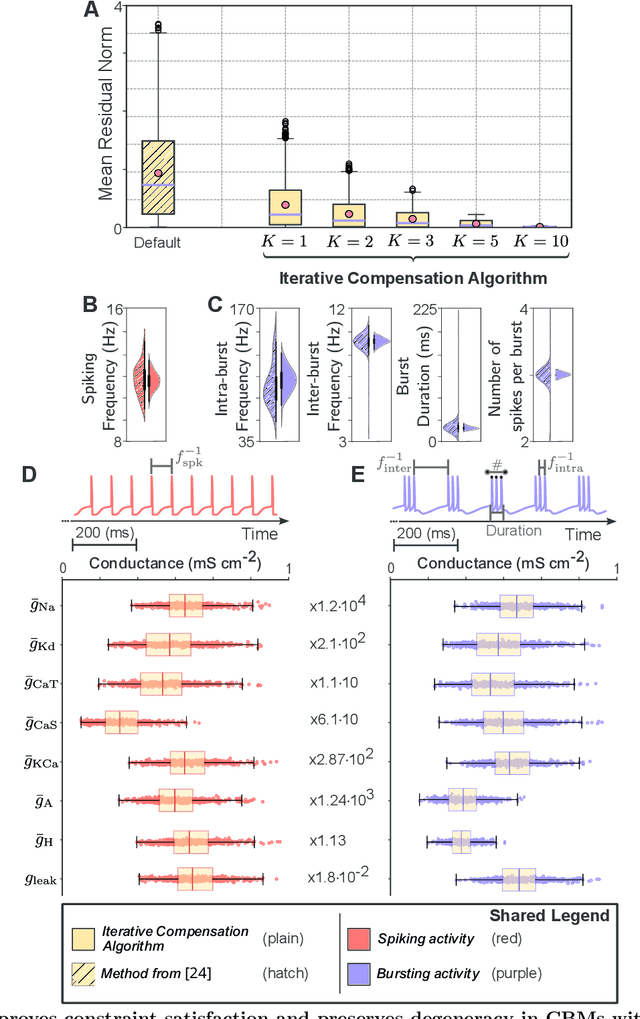
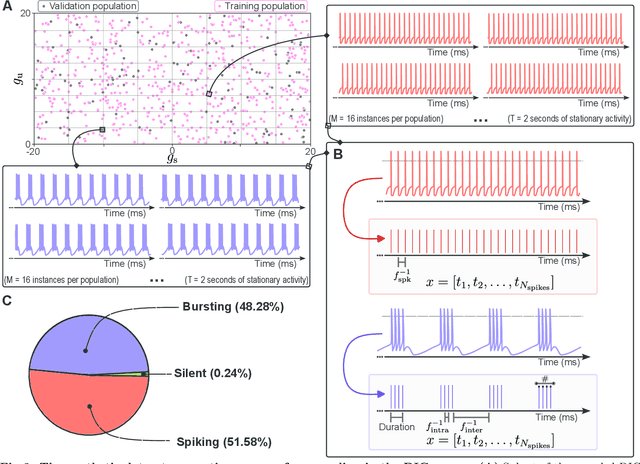
Neurons communicate through spikes, and spike timing is a crucial part of neuronal processing. Spike times can be recorded experimentally both intracellularly and extracellularly, and are the main output of state-of-the-art neural probes. On the other hand, neuronal activity is controlled at the molecular level by the currents generated by many different transmembrane proteins called ion channels. Connecting spike timing to ion channel composition remains an arduous task to date. To address this challenge, we developed a method that combines deep learning with a theoretical tool called Dynamic Input Conductances (DICs), which reduce the complexity of ion channel interactions into three interpretable components describing how neurons spike. Our approach uses deep learning to infer DICs directly from spike times and then generates populations of "twin" neuron models that replicate the observed activity while capturing natural variability in membrane channel composition. The method is fast, accurate, and works using only spike recordings. We also provide open-source software with a graphical interface, making it accessible to researchers without programming expertise.