 Add to Chrome
 Add to Firefox
 Add to Edge
LouvreSAE: Sparse Autoencoders for Interpretable and Controllable Style Transfer
Dec 22, 2025
Artistic style transfer in generative models remains a significant challenge, as existing methods often introduce style only via model fine-tuning, additional adapters, or prompt engineering, all of which can be computationally expensive and may still entangle style with subject matter. In this paper, we introduce a training- and inference-light, interpretable method for representing and transferring artistic style. Our approach leverages an art-specific Sparse Autoencoder (SAE) on top of latent embeddings of generative image models. Trained on artistic data, our SAE learns an emergent, largely disentangled set of stylistic and compositional concepts, corresponding to style-related elements pertaining brushwork, texture, and color palette, as well as semantic and structural concepts. We call it LouvreSAE and use it to construct style profiles: compact, decomposable steering vectors that enable style transfer without any model updates or optimization. Unlike prior concept-based style transfer methods, our method requires no fine-tuning, no LoRA training, and no additional inference passes, enabling direct steering of artistic styles from only a few reference images. We validate our method on ArtBench10, achieving or surpassing existing methods on style evaluations (VGG Style Loss and CLIP Score Style) while being 1.7-20x faster and, critically, interpretable.

DART-Eval: A Comprehensive DNA Language Model Evaluation Benchmark on Regulatory DNA
Dec 06, 2024
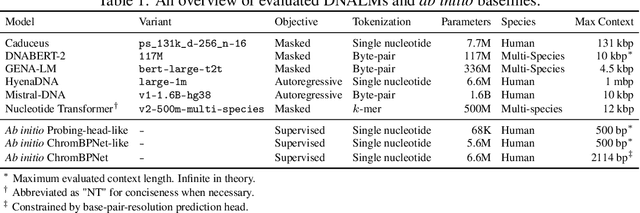
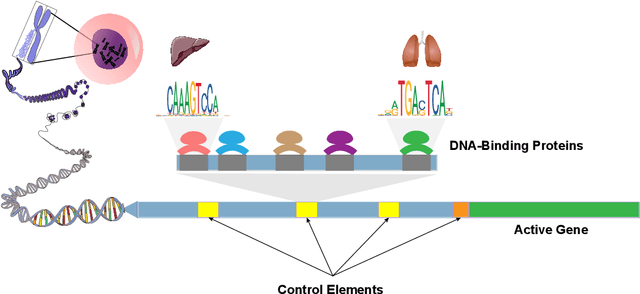
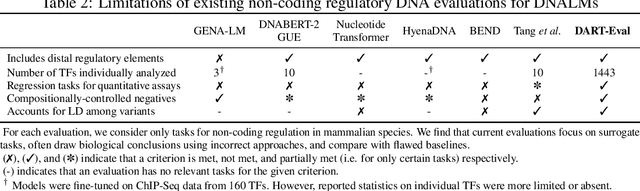
Recent advances in self-supervised models for natural language, vision, and protein sequences have inspired the development of large genomic DNA language models (DNALMs). These models aim to learn generalizable representations of diverse DNA elements, potentially enabling various genomic prediction, interpretation and design tasks. Despite their potential, existing benchmarks do not adequately assess the capabilities of DNALMs on key downstream applications involving an important class of non-coding DNA elements critical for regulating gene activity. In this study, we introduce DART-Eval, a suite of representative benchmarks specifically focused on regulatory DNA to evaluate model performance across zero-shot, probed, and fine-tuned scenarios against contemporary ab initio models as baselines. Our benchmarks target biologically meaningful downstream tasks such as functional sequence feature discovery, predicting cell-type specific regulatory activity, and counterfactual prediction of the impacts of genetic variants. We find that current DNALMs exhibit inconsistent performance and do not offer compelling gains over alternative baseline models for most tasks, while requiring significantly more computational resources. We discuss potentially promising modeling, data curation, and evaluation strategies for the next generation of DNALMs. Our code is available at https://github.com/kundajelab/DART-Eval.