 Add to Chrome
 Add to Firefox
 Add to Edge
Optimization-Embedded Active Multi-Fidelity Surrogate Learning for Multi-Condition Airfoil Shape Optimization
Mar 17, 2026
Active multi-fidelity surrogate modeling is developed for multi-condition airfoil shape optimization to reduce high-fidelity CFD cost while retaining RANS-level accuracy. The framework couples a low-fidelity-informed Gaussian process regression transfer model with uncertainty-triggered sampling and a synchronized elitism rule embedded in a hybrid genetic algorithm. Low-fidelity XFOIL evaluations provide inexpensive features, while sparse RANS simulations are adaptively allocated when predictive uncertainty exceeds a threshold; elite candidates are mandatorily validated at high fidelity, and the population is re-evaluated to prevent evolutionary selection based on outdated fitness values produced by earlier surrogate states. The method is demonstrated for a two-point problem at $Re=6\times10^6$ with cruise at $α=2^\circ$ (maximize $E=L/D$) and take-off at $α=10^\circ$ (maximize $C_L$) using a 12-parameter CST representation. Independent multi-fidelity surrogates per flight condition enable decoupled refinement. The optimized design improves cruise efficiency by 41.05% and take-off lift by 20.75% relative to the best first-generation individual. Over the full campaign, only 14.78% (cruise) and 9.5% (take-off) of evaluated individuals require RANS, indicating a substantial reduction in high-fidelity usage while maintaining consistent multi-point performance.

Active flow control for three-dimensional cylinders through deep reinforcement learning
Sep 04, 2023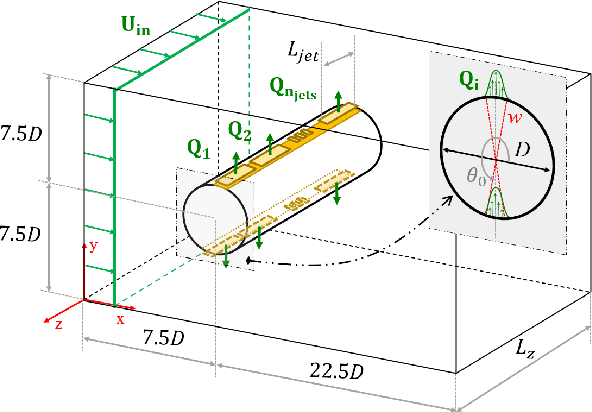
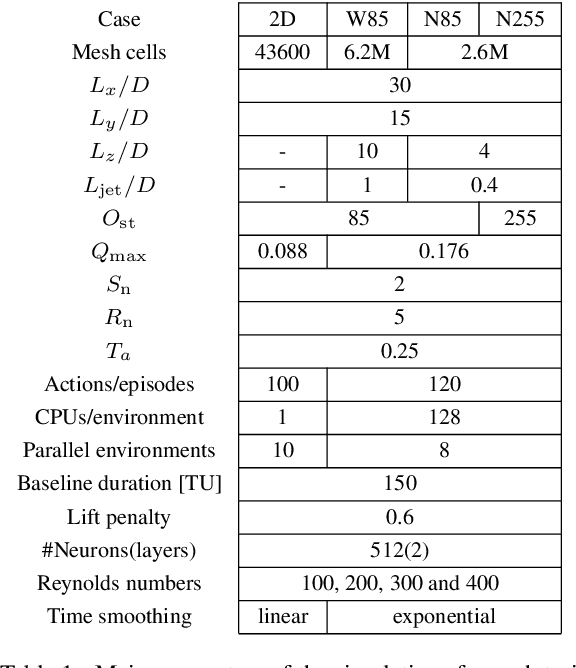
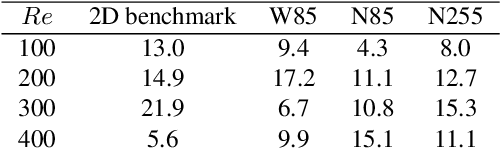
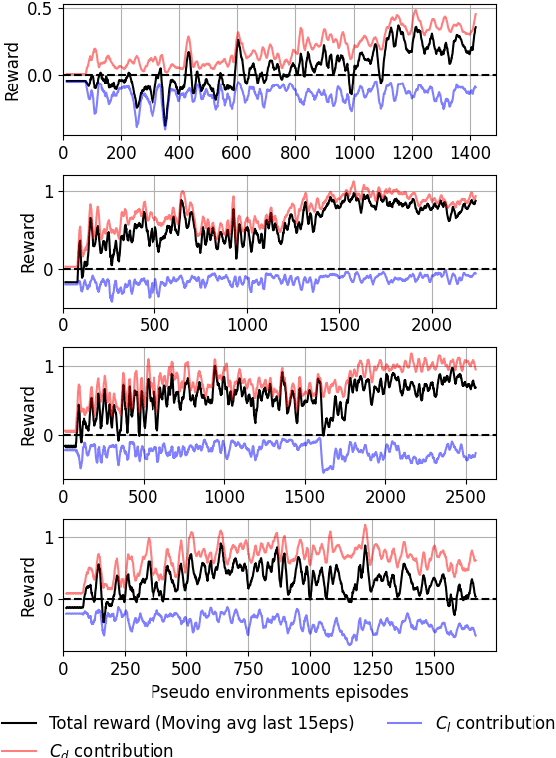
This paper presents for the first time successful results of active flow control with multiple independently controlled zero-net-mass-flux synthetic jets. The jets are placed on a three-dimensional cylinder along its span with the aim of reducing the drag coefficient. The method is based on a deep-reinforcement-learning framework that couples a computational-fluid-dynamics solver with an agent using the proximal-policy-optimization algorithm. We implement a multi-agent reinforcement-learning framework which offers numerous advantages: it exploits local invariants, makes the control adaptable to different geometries, facilitates transfer learning and cross-application of agents and results in significant training speedup. In this contribution we report significant drag reduction after applying the DRL-based control in three different configurations of the problem.