 Add to Chrome
 Add to Firefox
 Add to Edge
Mask, Sample, Revise: A Revisable CTMC Inference Stack for Guided Discrete Flow Matching Text-to-Speech
Jun 12, 2026
Recent alignment-free non-autoregressive (NAR) text-to-speech (TTS) models formulate synthesis as a conditional infilling task, bypassing explicit duration predictors and external aligners. When speech is represented with neural codec tokens, the infilling problem becomes discrete, making Discrete Flow Matching (DFM), a Continuous-Time Markov Chain (CTMC) framework for discrete generation, a natural fit. However, inference-time control for stable low-step conditional infilling remains underexplored. We propose Mask, Sample, Revise, an inference-time CTMC stack for alignment-free DFM-TTS. The stack combines predictor-free guidance to strengthen text conditioning, prompt-matched conditional coupling to align the probability path with the acoustic prompt, and SC-ReMask, a schedule-constrained remasking mechanism that introduces token-to-mask transitions so early de-masking decisions can be revised. These components require no post-hoc fine-tuning and operate in a single tau-leaping sampler. Controlled ablations show that this stack improves intelligibility and robustness in the low-NFE prompted setting, outperforming unguided and guidance-only samplers with substantially more steps.

Tagarela - A Portuguese speech dataset from podcasts
Mar 16, 2026Despite significant advances in speech processing, Portuguese remains under-resourced due to the scarcity of public, large-scale, and high-quality datasets. To address this gap, we present a new dataset, named TAGARELA, composed of over 8,972 hours of podcast audio, specifically curated for training automatic speech recognition (ASR) and text-to-speech (TTS) models. Notably, its scale rivals English's GigaSpeech (10kh), enabling state-of-the-art Portuguese models. To ensure data quality, the corpus was subjected to an audio pre-processing pipeline and subsequently transcribed using a mixed strategy: we applied ASR models that were previously trained on high-fidelity transcriptions generated by proprietary APIs, ensuring a high level of initial accuracy. Finally, to validate the effectiveness of this new resource, we present ASR and TTS models trained exclusively on our dataset and evaluate their performance, demonstrating its potential to drive the development of more robust and natural speech technologies for Portuguese. The dataset is released publicly, available at https://freds0.github.io/TAGARELA/, to foster the development of robust speech technologies.
MiJaBench: Revealing Minority Biases in Large Language Models via Hate Speech Jailbreaking
Jan 07, 2026Current safety evaluations of large language models (LLMs) create a dangerous illusion of universality, aggregating "Identity Hate" into scalar scores that mask systemic vulnerabilities against specific populations. To expose this selective safety, we introduce MiJaBench, a bilingual (English and Portuguese) adversarial benchmark comprising 44,000 prompts across 16 minority groups. By generating 528,000 prompt-response pairs from 12 state-of-the-art LLMs, we curate MiJaBench-Align, revealing that safety alignment is not a generalized semantic capability but a demographic hierarchy: defense rates fluctuate by up to 33\% within the same model solely based on the target group. Crucially, we demonstrate that model scaling exacerbates these disparities, suggesting that current alignment techniques do not create principle of non-discrimination but reinforces memorized refusal boundaries only for specific groups, challenging the current scaling laws of security. We release all datasets and scripts to encourage research into granular demographic alignment at GitHub.
MedPT: A Massive Medical Question Answering Dataset for Brazilian-Portuguese Speakers
Nov 14, 2025While large language models (LLMs) show transformative potential in healthcare, their development remains focused on high-resource languages, creating a critical barrier for others as simple translation fails to capture unique clinical and cultural nuances, such as endemic diseases. To address this, we introduce MedPT, the first large-scale, real-world corpus for Brazilian Portuguese, comprising 384,095 authentic question-answer pairs from patient-doctor interactions. The dataset underwent a meticulous multi-stage curation protocol, using a hybrid quantitative-qualitative analysis to filter noise and contextually enrich thousands of ambiguous queries. We further augmented the corpus via LLM-driven annotation, classifying questions into seven semantic types to capture user intent. Our analysis reveals its thematic breadth (3,200 topics) and unique linguistic properties, like the natural asymmetry in patient-doctor communication. To validate its utility, we benchmark a medical specialty routing task: fine-tuning a 1.7B parameter model achieves an outstanding 94\% F1-score on a 20-class setup. Furthermore, our qualitative error analysis shows misclassifications are not random but reflect genuine clinical ambiguities (e.g., between comorbid conditions), proving the dataset's deep semantic richness. We publicly release MedPT to foster the development of more equitable, accurate, and culturally-aware medical technologies for the Portuguese-speaking world.
ToxSyn-PT: A Large-Scale Synthetic Dataset for Hate Speech Detection in Portuguese
Jun 11, 2025We present ToxSyn-PT, the first large-scale Portuguese corpus that enables fine-grained hate-speech classification across nine legally protected minority groups. The dataset contains 53,274 synthetic sentences equally distributed between minorities groups and toxicity labels. ToxSyn-PT is created through a novel four-stage pipeline: (1) a compact, manually curated seed; (2) few-shot expansion with an instruction-tuned LLM; (3) paraphrase-based augmentation; and (4) enrichment, plus additional neutral texts to curb overfitting to group-specific cues. The resulting corpus is class-balanced, stylistically diverse, and free from the social-media domain that dominate existing Portuguese datasets. Despite domain differences with traditional benchmarks, experiments on both binary and multi-label classification on the corpus yields strong results across five public Portuguese hate-speech datasets, demonstrating robust generalization even across domain boundaries. The dataset is publicly released to advance research on synthetic data and hate-speech detection in low-resource settings.
Deep Learning Brasil at ABSAPT 2022: Portuguese Transformer Ensemble Approaches
Nov 08, 2023
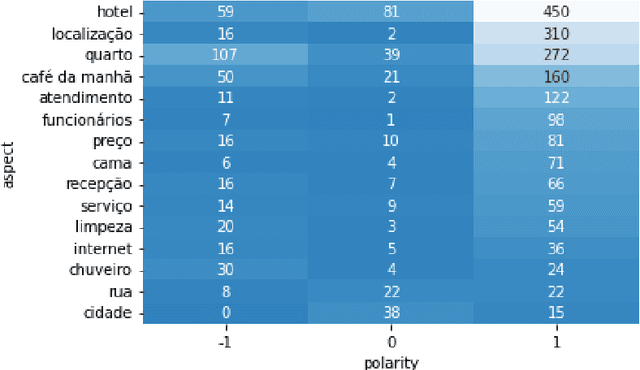

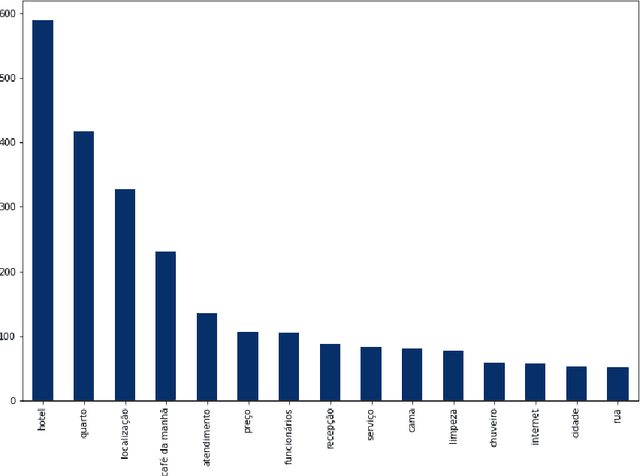
Aspect-based Sentiment Analysis (ABSA) is a task whose objective is to classify the individual sentiment polarity of all entities, called aspects, in a sentence. The task is composed of two subtasks: Aspect Term Extraction (ATE), identify all aspect terms in a sentence; and Sentiment Orientation Extraction (SOE), given a sentence and its aspect terms, the task is to determine the sentiment polarity of each aspect term (positive, negative or neutral). This article presents we present our participation in Aspect-Based Sentiment Analysis in Portuguese (ABSAPT) 2022 at IberLEF 2022. We submitted the best performing systems, achieving new state-of-the-art results on both subtasks.