 Add to Chrome
 Add to Firefox
 Add to Edge
A Function-Space Dichotomy for Compositional Learning: Exponential Sub-Optimality of the Neural Tangent Kernel
Jul 07, 2026
A persistent empirical observation is that trained neural networks outperform their neural tangent kernel (NTK) limit on tasks with compositional structure, yet a quantitative account of $\textbf{when}$ and $\textbf{by how much}$ has been lacking. Working on the unit circle, we give such an account through a dichotomy between two complexity measures of the target: its $\textbf{Fourier complexity}$, which controls NTK kernel regression, and its $\textbf{architectural complexity}$, which controls learning over depth-$L$, width-$w$ ReLU networks with the variation norm of the weights bounded by $R$. We first characterize the minimax rate of the architecture class $\mathcal{C}_{L,w,R}$, pinning it down up to a single factor of $L$: between $Ω(Lw^2R^2/n)$ and $\tilde{O}(L^2w^2R^2/n)$. We then show the NTK estimator sits $\textbf{exponentially}$ above this floor whenever the two complexities decouple: for the depth-$L$ iterated sawtooth, NTK regression needs $Ω(4^L)$ samples while the minimax floor is polynomial in $L$. Numerical experiments confirm the theoretical claims: on bandlimited smooth targets, the NTK is competitive or better, while on the hypercube sparse-parity model, a standard two-layer network beats the NTK by four to six orders of magnitude in test error. The gap is thus a function-space property, a mismatch between the kernel's smoothness bias and the target's compositional structure, rather than a generic kernel-versus-network phenomenon.

High-Resolution Flood Mapping With Sentinel-1 and Sentinel-2 via Misalignment-Robust Cross-Sensor Learning and Generative Despeckling
Jun 29, 2026Reliable high-resolution flood extent mapping from satellite imagery remains constrained by limited data fidelity and sensor-specific artifacts. Multispectral optical imagery is degraded by clouds, shadows, and urban confounders, while synthetic aperture radar (SAR) imagery is affected by speckle noise and sensor co-registration uncertainty. This work presents an integrated flood mapping framework that jointly addresses these limitations through curated datasets and novel learning strategies. We introduce a new Sentinel-2 (S2) and Sentinel-1 (S1) dataset covering the contiguous United States, featuring pixel-accurate 10 m water masks with emphasis on challenging weather conditions and urban environments that are underrepresented in existing benchmarks. High-quality S2 annotations are manually produced using rigorous geospatial labeling protocols and transferred to SAR imagery through weakly labeled temporally coincident acquisitions. To address SAR-specific artifacts, a shift-invariant loss function is employed to tolerate residual geolocation uncertainty between SAR imagery and optical-derived labels, and a Conditional Variational Autoencoder (CVAE) is trained on multitemporal SAR composites to suppress speckle while preserving flood-relevant spatial structure. Experiments using UNet and UNet++ architectures demonstrate strong multispectral performance (AUPRC up to 0.956) and statistically significant improvements in SAR flood mapping when using shift-invariant loss and CVAE-based despeckling compared to classical filters. These results underscore the importance of dataset fidelity, misalignment-robust training, and demonstrate the viability of generative despeckling for operational flood mapping.
Feature Selection integrated Deep Learning for Ultrahigh Dimensional and Highly Correlated Feature Space
Sep 18, 2022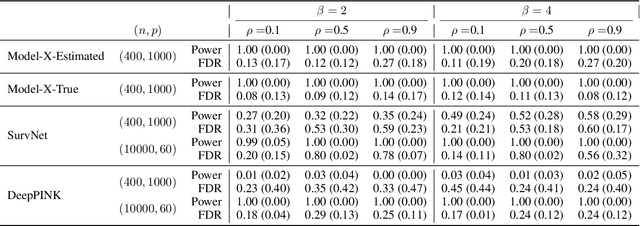
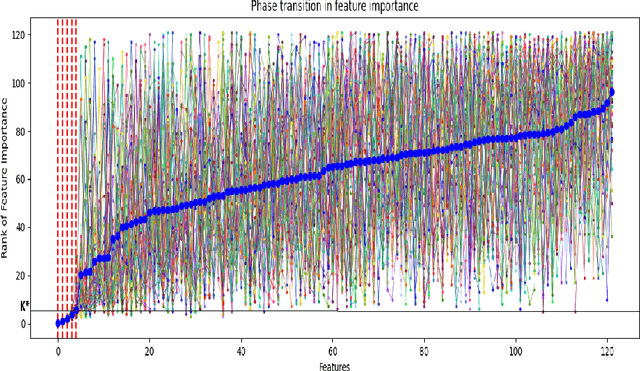
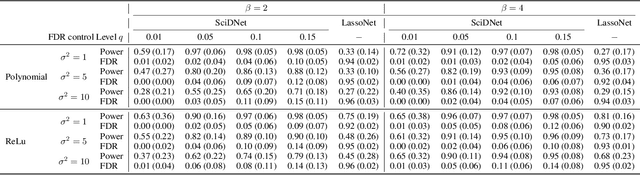

In recent years, deep learning has been a topic of interest in almost all disciplines due to its impressive empirical success in analyzing complex data sets, such as imaging, genetics, climate, and medical data. While most of the developments are treated as black-box machines, there is an increasing interest in interpretable, reliable, and robust deep learning models applicable to a broad class of applications. Feature-selected deep learning is proven to be promising in this regard. However, the recent developments do not address the situations of ultra-high dimensional and highly correlated feature selection in addition to the high noise level. In this article, we propose a novel screening and cleaning strategy with the aid of deep learning for the cluster-level discovery of highly correlated predictors with a controlled error rate. A thorough empirical evaluation over a wide range of simulated scenarios demonstrates the effectiveness of the proposed method by achieving high power while having a minimal number of false discoveries. Furthermore, we implemented the algorithm in the riboflavin (vitamin $B_2$) production dataset in the context of understanding the possible genetic association with riboflavin production. The gain of the proposed methodology is illustrated by achieving lower prediction error compared to other state-of-the-art methods.