 Add to Chrome
 Add to Firefox
 Add to Edge
Adaptable phase retrieval for coherent transition radiation spectroscopy based on differentiable physics information
Apr 28, 2026
Coherent transition radiation (CTR) spectroscopy is a critical diagnostic for characterizing the longitudinal structure of relativistic electron bunches in laser-plasma and conventional accelerators. In practice, recovering the bunch profile from a measured CTR spectrum is an ill-posed phase-retrieval problem. Traditionally, this is addressed using Gerchberg-Saxton (GS)-type iterative algorithms. However, these implementations often rely on explicit inverse propagators, making them difficult to adapt to sophisticated experimental forward models. In this work, we introduce a flexible gradient-based framework for CTR phase retrieval. By leveraging a differentiable forward model, we propose a phase-only gradient descent (GD-Phase) approach that enforces the measured spectral amplitude as a hard constraint while optimizing the Fourier phase under physical real-space priors. Using synthetic CTR spectra spanning multi-peaked and strongly modulated profiles, we benchmark GD-Phase against traditional GS and a real-space amplitude-parametrized gradient descent (GD-Amp) algorithm. Unlike traditional methods, this formulation allows for the seamless inclusion of arbitrary differentiable experimental effects into the reconstruction loop. We demonstrate that this physics-informed approach not only reproduces the fidelity of GS methods but also establishes a robust baseline for incorporating multi-diagnostic constraints and uncertainty quantification. This enables the systematic extension to higher-dimensional, multimodal, and uncertainty-aware diagnostics, facilitating fast and scalable phase retrieval in realistic experimental settings.

Learning Electron Bunch Distribution along a FEL Beamline by Normalising Flows
Feb 27, 2023Understanding and control of Laser-driven Free Electron Lasers remain to be difficult problems that require highly intensive experimental and theoretical research. The gap between simulated and experimentally collected data might complicate studies and interpretation of obtained results. In this work we developed a deep learning based surrogate that could help to fill in this gap. We introduce a surrogate model based on normalising flows for conditional phase-space representation of electron clouds in a FEL beamline. Achieved results let us discuss further benefits and limitations in exploitability of the models to gain deeper understanding of fundamental processes within a beamline.
* 7 pages, 5 figures
Data-Driven Shadowgraph Simulation of a 3D Object
Jun 01, 2021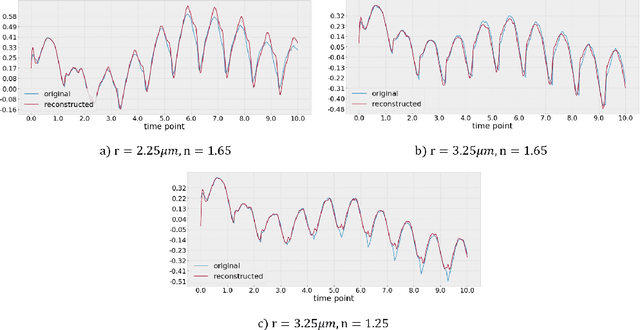
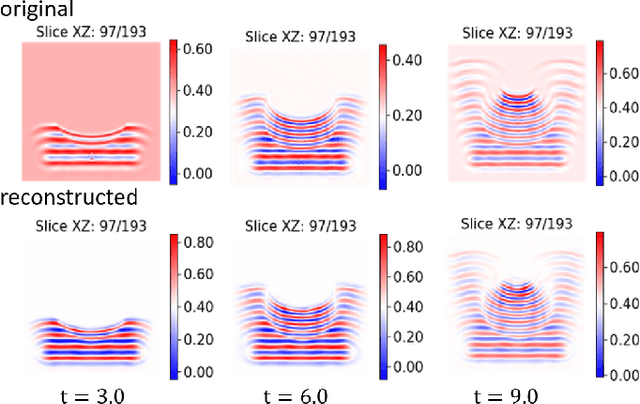
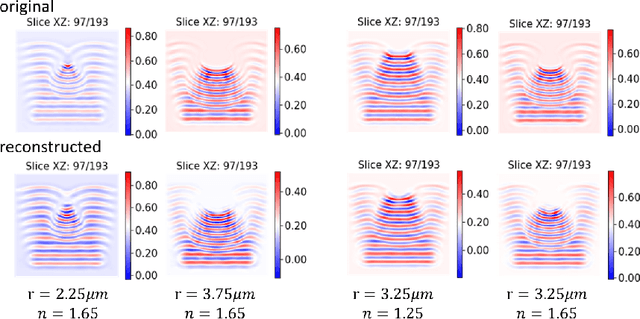
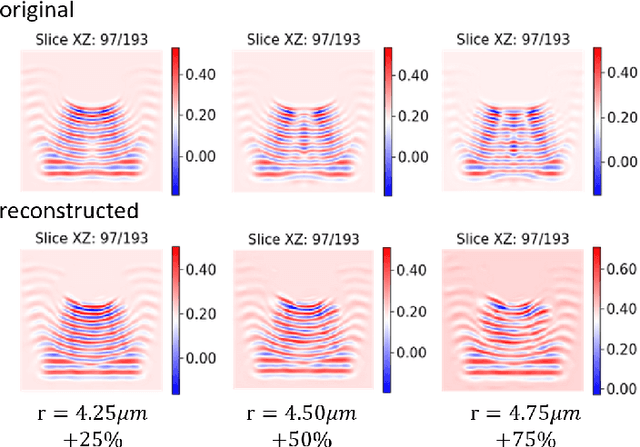
In this work we propose a deep neural network based surrogate model for a plasma shadowgraph - a technique for visualization of perturbations in a transparent medium. We are substituting the numerical code by a computationally cheaper projection based surrogate model that is able to approximate the electric fields at a given time without computing all preceding electric fields as required by numerical methods. This means that the projection based surrogate model allows to recover the solution of the governing 3D partial differential equation, 3D wave equation, at any point of a given compute domain and configuration without the need to run a full simulation. This model has shown a good quality of reconstruction in a problem of interpolation of data within a narrow range of simulation parameters and can be used for input data of large size.