 Add to Chrome
 Add to Firefox
 Add to Edge
Hybrid Neural Network and Conventional Controller Approach for Robust Control of Highly Unstable Systems: Application to Tilt-Rotor Control
Jun 07, 2026
Multirotors are widely used in applications ranging from surveillance to precision agriculture, yet conventional designs remain limited by their under-actuation. Tilt-rotor configurations overcome this limitation by enabling full actuation. This paper investigates neural-network-based control strategies for a fully actuated tilt-rotor system with four thrust-vectoring inputs. Our work is structured in two parts. First, we deliberately present a negative result by evaluating a direct input-output control approach. In this method, multilayer perceptrons (MLPs), long short-term memory (LSTM) networks, and transformer models are trained to map system states and their desired values directly to control signals. We show that this strategy fails to stabilize the system, highlighting the inherent difficulty of applying direct input-output learning to highly unstable plants. Second, as the main contribution, we propose a neural-network-enhanced sliding mode controller (SMC). The method decomposes the system dynamics into input-independent and input-dependent components, with the former learned from a small dataset using lightweight networks, thereby reducing real-time computational demands. Moreover, the proposed method can be trained using flight logs collected from low-performance controllers, and the resulting dynamic model learned from real-world data can be used in simulation. We further compare MLP- and LSTM-based implementations under model uncertainties and external disturbances, demonstrating the robustness and effectiveness of the proposed approach; in particular, the controller with the LSTM plant dynamics predictor achieves superior performance to its MLP-based counterpart while also exhibiting lower runtime.

Self-Tuning PID Control via a Hybrid Actor-Critic-Based Neural Structure for Quadcopter Control
Jul 03, 2023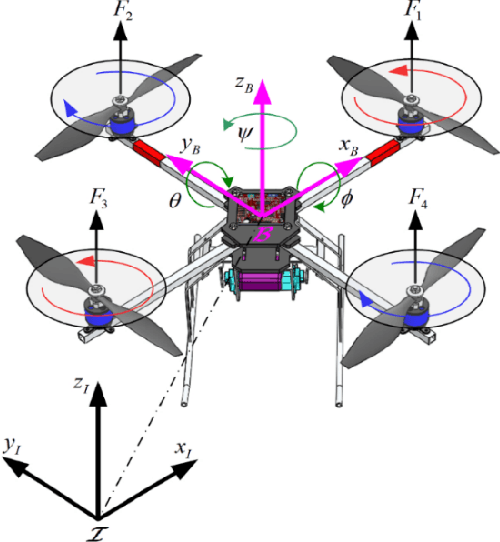


Proportional-Integrator-Derivative (PID) controller is used in a wide range of industrial and experimental processes. There are a couple of offline methods for tuning PID gains. However, due to the uncertainty of model parameters and external disturbances, real systems such as Quadrotors need more robust and reliable PID controllers. In this research, a self-tuning PID controller using a Reinforcement-Learning-based Neural Network for attitude and altitude control of a Quadrotor has been investigated. An Incremental PID, which contains static and dynamic gains, has been considered and only the variable gains have been tuned. To tune dynamic gains, a model-free actor-critic-based hybrid neural structure was used that was able to properly tune PID gains, and also has done the best as an identifier. In both tunning and identification tasks, a Neural Network with two hidden layers and sigmoid activation functions has been learned using Adaptive Momentum (ADAM) optimizer and Back-Propagation (BP) algorithm. This method is online, able to tackle disturbance, and fast in training. In addition to robustness to mass uncertainty and wind gust disturbance, results showed that the proposed method had a better performance when compared to a PID controller with constant gains.