 Add to Chrome
 Add to Firefox
 Add to Edge
KATANA: A Fast, Low-Power Mapping of Kalman Filters onto Edge NPUs for Real-Time Tracking
Jun 12, 2026
State estimation is the closed-loop core of every real-time tracking system, from radar surveillance and counter-UAV defense to autonomous driving and robotics. These deployments run on edge platforms, where defense systems mount on vehicles and drones, and civilian pipelines live on cars and handheld devices. Here, every additional watt of compute erodes mission duration or operational range. Two hard constraints follow: each new measurement must be fused before the next control cycle, and the total compute must fit within a strict battery and thermal power envelope. The Linear and Extended Kalman Filters (LKF, EKF) are dominant estimators on these systems, but today they execute almost exclusively on CPUs, which serialize multi-object tracking (MOT) updates, or on custom FPGA/ASIC accelerators that lengthen design cycles. Contemporary AI-PC SoCs, like the Intel Core Ultra Series 1 and 2, integrate a low-power, data-parallel Neural Processing Unit (NPU). We therefore ask whether the Kalman filter can be mapped onto this existing matrix engine to meet real-time and low-power budgets simultaneously, avoiding a dedicated accelerator and keeping the CPU and GPU free for primary workloads. We present KATANA, an NPU-aware optimization framework delivering the first end-to-end mapping of the LKF and EKF onto a commercial NPU, alongside a cross-platform characterization on shipping AI-PC silicon. KATANA applies three algebraic graph rewrites: subtract-to-add reformulation via a precomputed negative-projection matrix H_neg, static-shape tensor fusion, and block-diagonal batched parallelization, ensuring 100% of operations execute on the DPU matrix engine. On the Series 2, the optimized batched EKF reaches 223.35 FPS at 13.43 W active power, and the LKF reaches 408.73 FPS at 14.05 W, delivering up to a 97.9% reduction in dynamic energy versus the CPU implementation.

XAMBA: Enabling Efficient State Space Models on Resource-Constrained Neural Processing Units
Feb 10, 2025State-Space Models (SSMs) have emerged as efficient alternatives to transformers for sequential data tasks, offering linear or near-linear scalability with sequence length, making them ideal for long-sequence applications in NLP, vision, and edge AI, including real-time transcription, translation, and contextual search. These applications require lightweight, high-performance models for deployment on resource-constrained devices like laptops and PCs. Designing specialized accelerators for every emerging neural network is costly and impractical; instead, optimizing models for existing NPUs in AI PCs provides a scalable solution. To this end, we propose XAMBA, the first framework to enable and optimize SSMs on commercial off-the-shelf (COTS) state-of-the-art (SOTA) NPUs. XAMBA follows a three-step methodology: (1) enabling SSMs on NPUs, (2) optimizing performance to meet KPI requirements, and (3) trading accuracy for additional performance gains. After enabling SSMs on NPUs, XAMBA mitigates key bottlenecks using CumBA and ReduBA, replacing sequential CumSum and ReduceSum operations with matrix-based computations, significantly improving execution speed and memory efficiency. Additionally, ActiBA enhances performance by approximating expensive activation functions (e.g., Swish, Softplus) using piecewise linear mappings, reducing latency with minimal accuracy loss. Evaluations on an Intel Core Ultra Series 2 AI PC show that XAMBA achieves up to 2.6X speed-up over the baseline. Our implementation is available at https://github.com/arghadippurdue/XAMBA.
GraNNite: Enabling High-Performance Execution of Graph Neural Networks on Resource-Constrained Neural Processing Units
Feb 10, 2025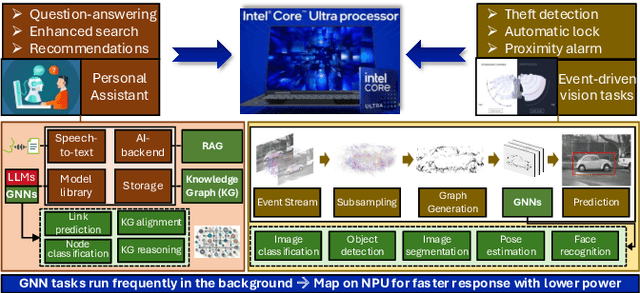
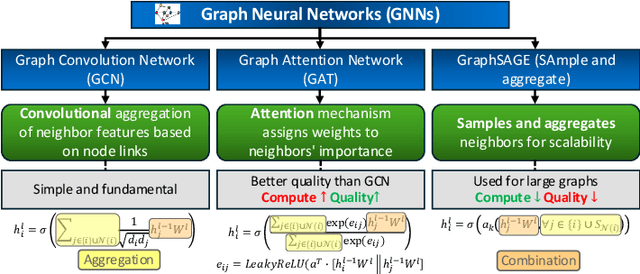
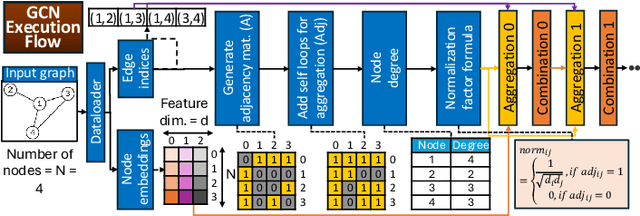
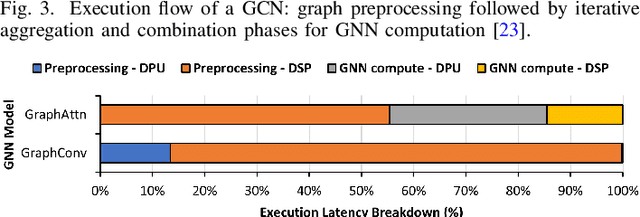
Graph Neural Networks (GNNs) are vital for learning from graph-structured data, enabling applications in network analysis, recommendation systems, and speech analytics. Deploying them on edge devices like client PCs and laptops enhances real-time processing, privacy, and cloud independence. GNNs aid Retrieval-Augmented Generation (RAG) for Large Language Models (LLMs) and enable event-based vision tasks. However, irregular memory access, sparsity, and dynamic structures cause high latency and energy overhead on resource-constrained devices. While modern edge processors integrate CPUs, GPUs, and NPUs, NPUs designed for data-parallel tasks struggle with irregular GNN computations. We introduce GraNNite, the first hardware-aware framework optimizing GNN execution on commercial-off-the-shelf (COTS) SOTA DNN accelerators via a structured three-step methodology: (1) enabling NPU execution, (2) optimizing performance, and (3) trading accuracy for efficiency gains. Step 1 employs GraphSplit for workload distribution and StaGr for static aggregation, while GrAd and NodePad handle dynamic graphs. Step 2 boosts performance using EffOp for control-heavy tasks and GraSp for sparsity exploitation. Graph Convolution optimizations PreG, SymG, and CacheG reduce redundancy and memory transfers. Step 3 balances quality versus efficiency, where QuantGr applies INT8 quantization, and GrAx1, GrAx2, and GrAx3 accelerate attention, broadcast-add, and SAGE-max aggregation. On Intel Core Ultra AI PCs, GraNNite achieves 2.6X to 7.6X speedups over default NPU mappings and up to 8.6X energy gains over CPUs and GPUs, delivering 10.8X and 6.7X higher performance than CPUs and GPUs, respectively, across GNN models.