 Add to Chrome
 Add to Firefox
 Add to Edge
Information Abundance Paradox: Long-Context Training Undermines Parametric Knowledge
Aug 12, 2026
Large language models are increasingly trained and deployed with long contexts that span documents, code repositories, and interaction histories. This scaling reflects the implicit assumption that training on longer contexts will only help the model by exposing it to richer evidence. We challenge this view by studying how the context window shapes a model's mode of learning, shifting it between parametric internalization and contextualization. We propose the Information Abundance Paradox, which hypothesizes that abundant relevant information in the training context can reduce the incentive to encode that information parametrically, thereby increasing reliance on context. In pretraining with long documents, increasing the context window improves language modeling, natural language understanding, and closed-book MCQA only up to an intermediate optimum, after which performance consistently declines. In supervised fine-tuning, more task-relevant train-time context improves performance with supporting context, but reduces robustness when context is absent or misleading at test time. Our analysis suggests that this behavior arises when longer context provides a lower complexity solution. Mechanistically, training with informative context shifts gradient pressure from feed-forward networks, often linked to parametric knowledge, toward attention modules, and causal interventions show that this shift increases reliance on context during inference. Overall, these findings support the Information Abundance Paradox and suggest that scaling toward near-infinite context is not simply a matter of supplying more data, even when high-quality long-context data is abundant.

Trust Functions: Near-Lossless Weak-to-Strong Generalization by Learning When to Trust the Weak Teacher
May 31, 2026Weak-to-strong generalization studies how to improve a strong student using supervision from a weaker teacher when reliable labels are scarce. We view this primarily as a data selection problem, where the key challenge is to identify which weak labels are reliable enough to serve as a training signal. To address this, we introduce trust functions that assign each weak label a scalar trust score and use these scores to filter weak supervision. Across several domains, including world knowledge, quantitative reasoning, and strategy games, trust filtering yields students that match and sometimes surpass ground-truth supervision, achieving near-lossless weak-to-strong generalization. Moreover, trust functions enable an iterative weak-to-strong chain that compounds gains by training a student and reusing it as the next teacher, amplifying the gains. There are several mechanisms to which advantage of trust functions can be attributed.
WorldAPIs: The World Is Worth How Many APIs? A Thought Experiment
Jul 10, 2024AI systems make decisions in physical environments through primitive actions or affordances that are accessed via API calls. While deploying AI agents in the real world involves numerous high-level actions, existing embodied simulators offer a limited set of domain-salient APIs. This naturally brings up the questions: how many primitive actions (APIs) are needed for a versatile embodied agent, and what should they look like? We explore this via a thought experiment: assuming that wikiHow tutorials cover a wide variety of human-written tasks, what is the space of APIs needed to cover these instructions? We propose a framework to iteratively induce new APIs by grounding wikiHow instruction to situated agent policies. Inspired by recent successes in large language models (LLMs) for embodied planning, we propose a few-shot prompting to steer GPT-4 to generate Pythonic programs as agent policies and bootstrap a universe of APIs by 1) reusing a seed set of APIs; and then 2) fabricate new API calls when necessary. The focus of this thought experiment is on defining these APIs rather than their executability. We apply the proposed pipeline on instructions from wikiHow tutorials. On a small fraction (0.5%) of tutorials, we induce an action space of 300+ APIs necessary for capturing the rich variety of tasks in the physical world. A detailed automatic and human analysis of the induction output reveals that the proposed pipeline enables effective reuse and creation of APIs. Moreover, a manual review revealed that existing simulators support only a small subset of the induced APIs (9 of the top 50 frequent APIs), motivating the development of action-rich embodied environments.
PARADISE: Evaluating Implicit Planning Skills of Language Models with Procedural Warnings and Tips Dataset
Mar 06, 2024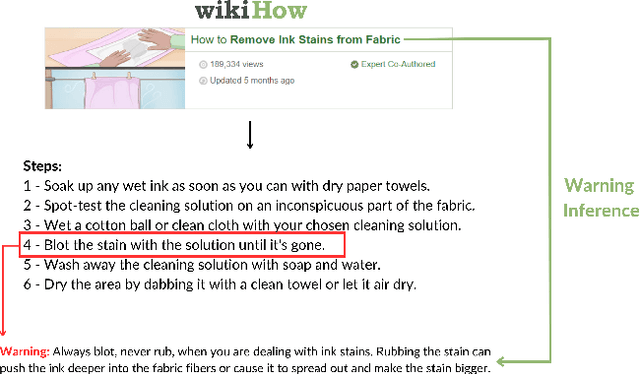


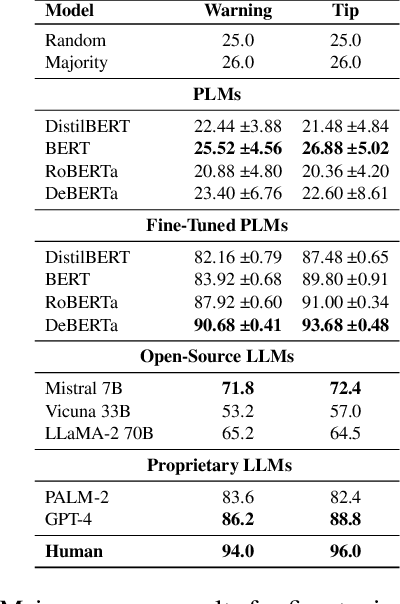
Recently, there has been growing interest within the community regarding whether large language models are capable of planning or executing plans. However, most prior studies use LLMs to generate high-level plans for simplified scenarios lacking linguistic complexity and domain diversity, limiting analysis of their planning abilities. These setups constrain evaluation methods (e.g., predefined action space), architectural choices (e.g., only generative models), and overlook the linguistic nuances essential for realistic analysis. To tackle this, we present PARADISE, an abductive reasoning task using Q\&A format on practical procedural text sourced from wikiHow. It involves warning and tip inference tasks directly associated with goals, excluding intermediary steps, with the aim of testing the ability of the models to infer implicit knowledge of the plan solely from the given goal. Our experiments, utilizing fine-tuned language models and zero-shot prompting, reveal the effectiveness of task-specific small models over large language models in most scenarios. Despite advancements, all models fall short of human performance. Notably, our analysis uncovers intriguing insights, such as variations in model behavior with dropped keywords, struggles of BERT-family and GPT-4 with physical and abstract goals, and the proposed tasks offering valuable prior knowledge for other unseen procedural tasks. The PARADISE dataset and associated resources are publicly available for further research exploration with https://github.com/GGLAB-KU/paradise.