 Add to Chrome
 Add to Firefox
 Add to Edge
On improving learning capability of ELM and an application to brain-computer interface
Jul 14, 2019
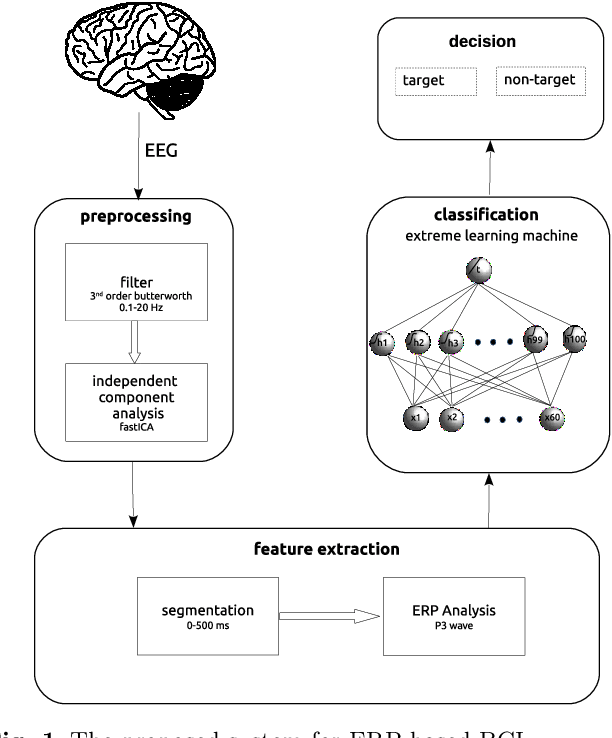
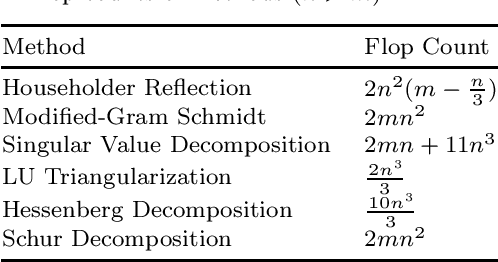

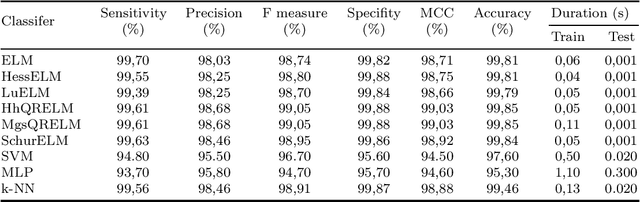
As a type of pseudoinverse learning, extreme learning machine (ELM) is able to achieve high performances in a rapid pace on benchmark datasets. However, when it is applied to real life large data, decline related to low-convergence of singular value decomposition (SVD) method occurs. Our study aims to resolve this issue via replacing SVD with theoretically and empirically much efficient 5 number of methods: lower upper triangularization, Hessenberg decomposition, Schur decomposition, modified Gram Schmidt algorithm and Householder reflection. Comparisons were made on electroencephalography based brain-computer interface classification problem to decide which method is the most useful. Results of subject-based classifications suggested that if priority was given to training pace, Hessenberg decomposition method, whereas if priority was given to performances Householder reflection method should be preferred.

Regularized HessELM and Inclined Entropy Measurement for Congestive Heart Failure Prediction
Jul 12, 2019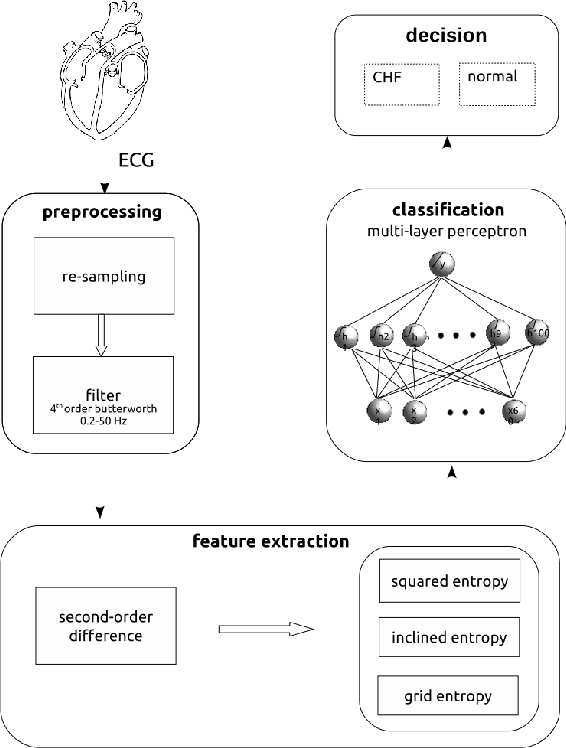
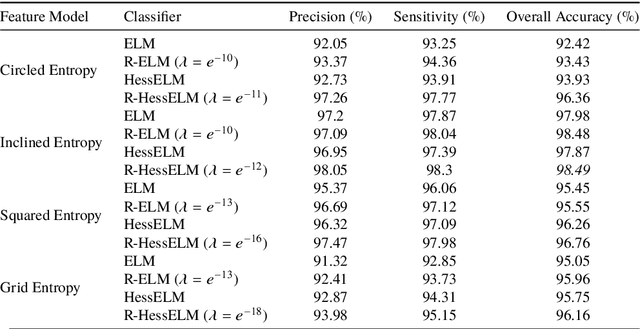
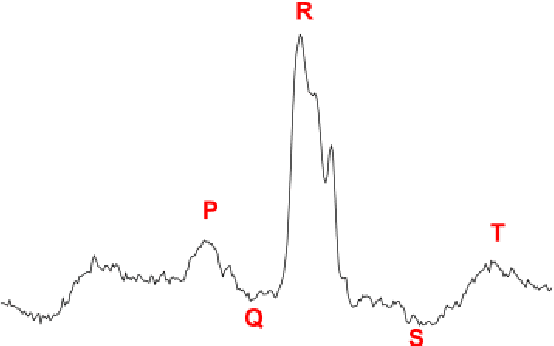
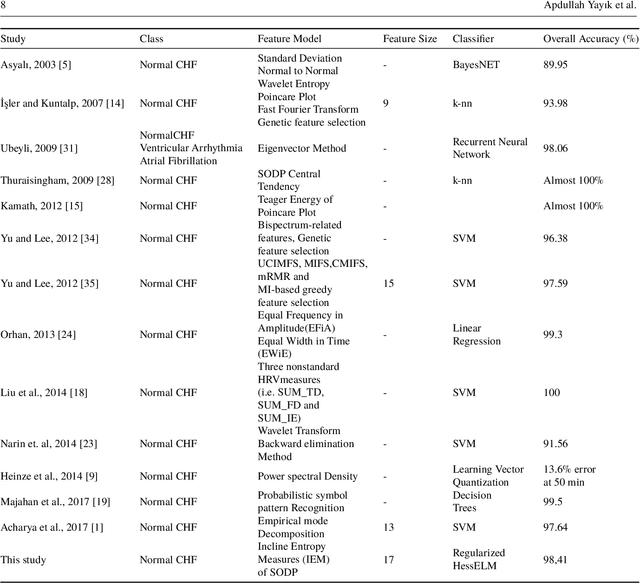
Our study concerns with automated predicting of congestive heart failure (CHF) through the analysis of electrocardiography (ECG) signals. A novel machine learning approach, regularized hessenberg decomposition based extreme learning machine (R-HessELM), and feature models; squared, circled, inclined and grid entropy measurement were introduced and used for prediction of CHF. This study proved that inclined entropy measurements features well represent characteristics of ECG signals and together with R-HessELM approach overall accuracy of 98.49% was achieved.
Deep Learning with ConvNET Predicts Imagery Tasks Through EEG
Jul 12, 2019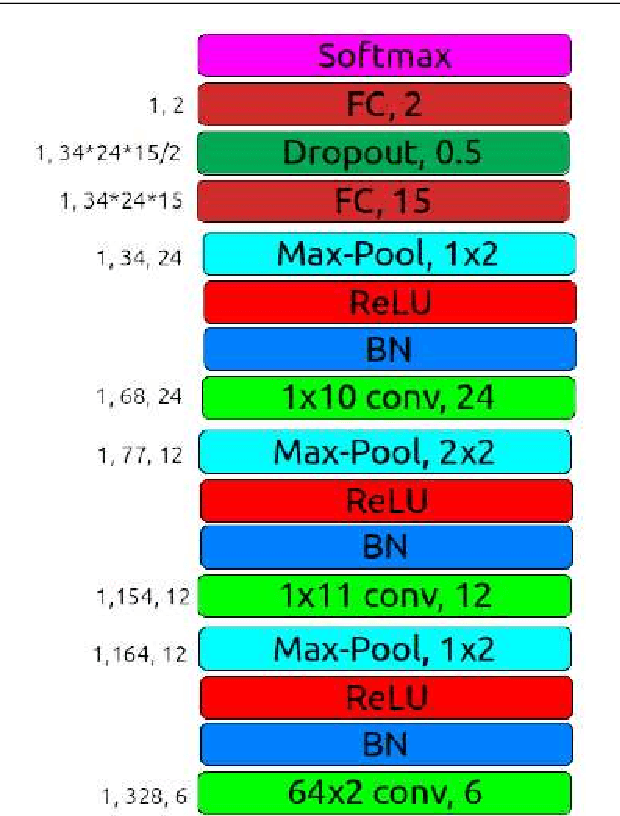
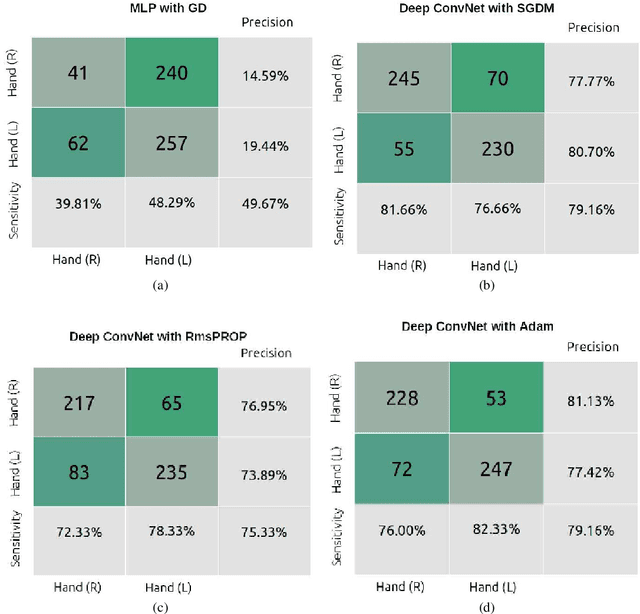
Deep learning with convolutional neural networks (ConvNets) have dramatically improved learning capabilities of computer vision applications just through considering raw data without any prior feature extraction. Nowadays, there is rising curiosity in interpreting and analyzing electroencephalography (EEG) dynamics with ConvNets. Our study focused on ConvNets of different structures, constructed for predicting imagined left and right movements on a subject-independent basis through raw EEG data. Results showed that recently advanced methods in machine learning field, i.e. adaptive moments and batch normalization together with dropout strategy, improved ConvNets predicting ability, outperforming that of conventional fully-connected neural networks with widely-used spectral features.