 Add to Chrome
 Add to Firefox
 Add to Edge
Physics-Aware Heterogeneous GNN Architecture for Real-Time BESS Optimization in Unbalanced Distribution Systems
Dec 10, 2025
Battery energy storage systems (BESS) have become increasingly vital in three-phase unbalanced distribution grids for maintaining voltage stability and enabling optimal dispatch. However, existing deep learning approaches often lack explicit three-phase representation, making it difficult to accurately model phase-specific dynamics and enforce operational constraints--leading to infeasible dispatch solutions. This paper demonstrates that by embedding detailed three-phase grid information--including phase voltages, unbalanced loads, and BESS states--into heterogeneous graph nodes, diverse GNN architectures (GCN, GAT, GraphSAGE, GPS) can jointly predict network state variables with high accuracy. Moreover, a physics-informed loss function incorporates critical battery constraints--SoC and C-rate limits--via soft penalties during training. Experimental validation on the CIGRE 18-bus distribution system shows that this embedding-loss approach achieves low prediction errors, with bus voltage MSEs of 6.92e-07 (GCN), 1.21e-06 (GAT), 3.29e-05 (GPS), and 9.04e-07 (SAGE). Importantly, the physics-informed method ensures nearly zero SoC and C-rate constraint violations, confirming its effectiveness for reliable, constraint-compliant dispatch.

SafePowerGraph: Safety-aware Evaluation of Graph Neural Networks for Transmission Power Grids
Jul 17, 2024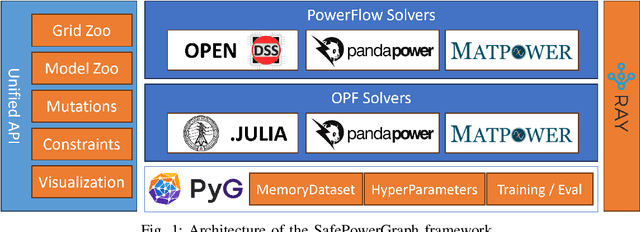

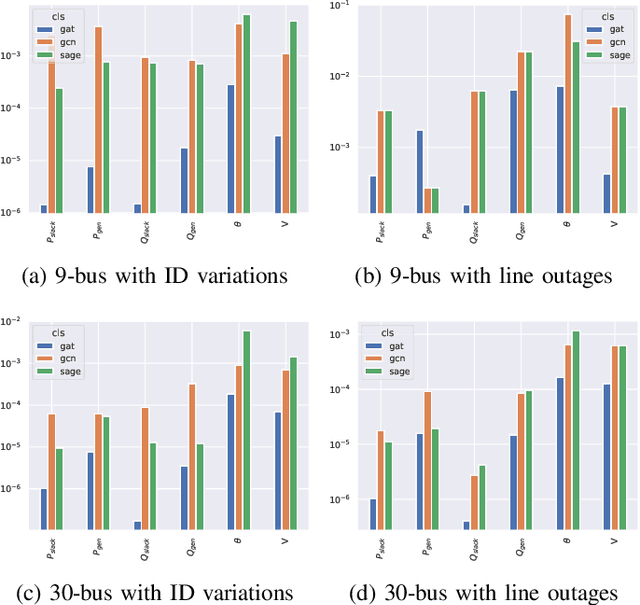
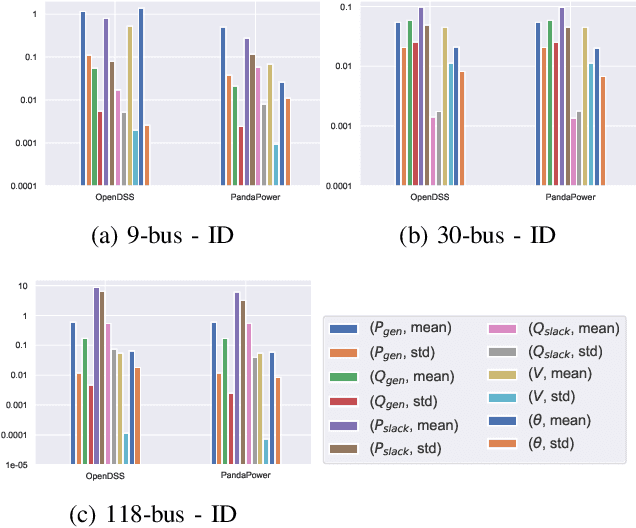
Power grids are critical infrastructures of paramount importance to modern society and their rapid evolution and interconnections has heightened the complexity of power systems (PS) operations. Traditional methods for grid analysis struggle with the computational demands of large-scale RES and ES integration, prompting the adoption of machine learning (ML) techniques, particularly Graph Neural Networks (GNNs). GNNs have proven effective in solving the alternating current (AC) Power Flow (PF) and Optimal Power Flow (OPF) problems, crucial for operational planning. However, existing benchmarks and datasets completely ignore safety and robustness requirements in their evaluation and never consider realistic safety-critical scenarios that most impact the operations of the power grids. We present SafePowerGraph, the first simulator-agnostic, safety-oriented framework and benchmark for GNNs in PS operations. SafePowerGraph integrates multiple PF and OPF simulators and assesses GNN performance under diverse scenarios, including energy price variations and power line outages. Our extensive experiments underscore the importance of self-supervised learning and graph attention architectures for GNN robustness. We provide at https://github.com/yamizi/SafePowerGraph our open-source repository, a comprehensive leaderboard, a dataset and model zoo and expect our framework to standardize and advance research in the critical field of GNN for power systems.
PowerFlowMultiNet: Multigraph Neural Networks for Unbalanced Three-Phase Distribution Systems
Mar 12, 2024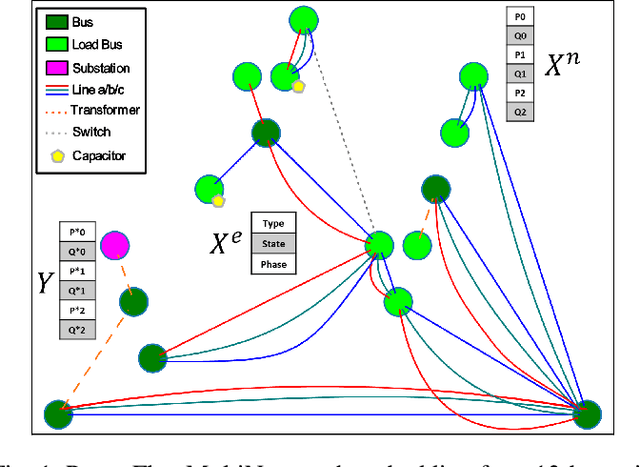
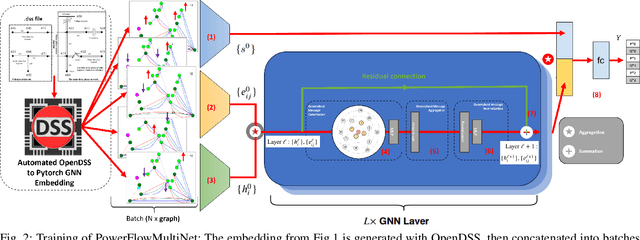
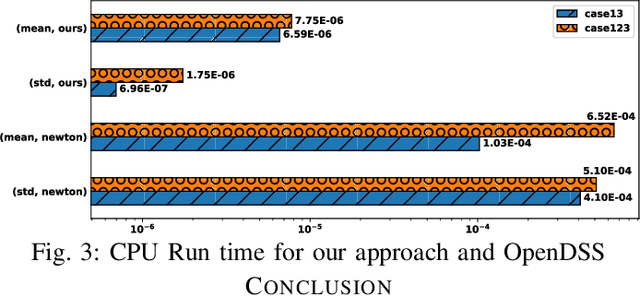
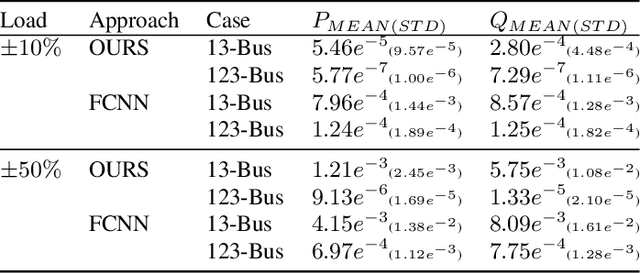
Efficiently solving unbalanced three-phase power flow in distribution grids is pivotal for grid analysis and simulation. There is a pressing need for scalable algorithms capable of handling large-scale unbalanced power grids that can provide accurate and fast solutions. To address this, deep learning techniques, especially Graph Neural Networks (GNNs), have emerged. However, existing literature primarily focuses on balanced networks, leaving a critical gap in supporting unbalanced three-phase power grids. This letter introduces PowerFlowMultiNet, a novel multigraph GNN framework explicitly designed for unbalanced three-phase power grids. The proposed approach models each phase separately in a multigraph representation, effectively capturing the inherent asymmetry in unbalanced grids. A graph embedding mechanism utilizing message passing is introduced to capture spatial dependencies within the power system network. PowerFlowMultiNet outperforms traditional methods and other deep learning approaches in terms of accuracy and computational speed. Rigorous testing reveals significantly lower error rates and a notable hundredfold increase in computational speed for large power networks compared to model-based methods.