 Add to Chrome
 Add to Firefox
 Add to Edge
Federated Temporal Attention Intelligence for Cyber-Resilient IoMT: Lightweight Digital Twins and PPO-Driven Honeypot Deception
Jun 19, 2026
The rapid proliferation of Internet of Medical Things (IoMT) devices introduces critical cybersecurity vulnerabilities in healthcare environments where resource-constrained medical devices operate under strict latency requirements and stringent data-privacy regulations. To address these challenges, this paper presents the Lightweight Digital Twin and Federated Reinforcement Learning (LDT-FRL) framework, a privacy-preserving defense architecture integrating four complementary mechanisms: a Temporal Attention Encoder (TAE) built on a GRU backbone with learned temporal self-attention for flow-level threat classification; lightweight LSTM-based Digital Twins trained on normal-class traffic to generate per-device anomaly scores that gate the TAE classifier through a learned sigmoid coupling; a Federated Proximal Policy Optimization (PPO) agent selecting among ALLOW, ISOLATE, and HONEYPOT_REDIRECT actions based on a seven-dimensional state; and an intelligent honeypot layer that converts redirected suspicious traffic into actionable threat intelligence. A federated aggregation strategy employing EMA-smoothed per-client validation losses as inverse-weighted FedAvg coefficients stabilizes global model updates under non-IID client distributions. Evaluated on CICDDoS 2019 and TON-IoT benchmarks, LDT-FRL achieves 99.66% and 99.95% test accuracy respectively, with macro-F1 scores of 0.9913 and 0.9995, converging 81% faster than the DTFL-CD baseline while attaining perfect F1=1.000 on the severely imbalanced MITM class. Explainability analysis via SHAP, LIME, Grad-CAM, and counterfactual methods confirms that the TAE focuses on semantically meaningful flow features, providing interpretable evidence for each defense decision.

Privacy-Preserving Federated Temporal Graph Learning with Digital Twin--Guided Adaptive Deception for Cyber-Resilient IoMT
Jun 19, 2026The rapid proliferation of IoT and IoMT devices introduces critical cybersecurity vulnerabilities in healthcare and industrial environments where resource-constrained devices operate under strict latency and data-privacy regulations. This paper presents the Federated Temporal Graph Convolutional Network with Advantage Actor-Critic (Federated TGCN-A2C), a privacy-preserving defense architecture integrating four mechanisms: a PyG-based Temporal GCN using GCNConv layers with global mean pooling and a learned anomaly gate for flow-level threat classification; LSTM-based Digital Twins generating per-device anomaly scores gating the classifier via learned sigmoid coupling; a Federated A2C agent selecting among ALLOW, ISOLATE, and HONEYPOT-REDIRECT actions based on a seven-dimensional state capturing confidence, entropy, anomaly magnitude, and traffic composition; and an enhanced honeypot layer converting suspicious traffic into threat intelligence with adaptive thresholds. Federated aggregation employs EMA-smoothed per-client validation losses as inverse-weighted FedAvg coefficients to stabilize global model updates under non-IID distributions, with cosine-annealed learning rates per round. Evaluated on CICDDoS 2019 and TON-IoT benchmarks, the framework achieves 99.48% and 99.61% test accuracy with weighted-F1 scores of 0.9948 and 0.9961, converging within 25 and 10 federated rounds, outperforming Fed-Inforce-Fusion by 0.21 percentage points while covering three additional attack categories. All sixteen CICDDoS 2019 classes achieve F1 of at least 0.9237 and all ten TON-IoT classes achieve F1 of at least 0.9488, including the severely imbalanced MITM category. Post-hoc explainability via SHAP, LIME, Grad-CAM, and counterfactual analysis confirms decisions are grounded in semantically meaningful flow features, supporting regulatory accountability in clinical deployments.
ASTRO: Adaptive Spatio-Temporal Reinforcement Optimization for GNN Powered Anomly Detection in Cyber Physical Systems
May 24, 2026Anomaly detection in Industrial Internet of Things (IIoT) environments is essential to protect the Industrial Control Systems (ICS) and Cyber-Physical Systems (CPS) from occuring run time false data injection and other malicious attacks. The increasing complexity of sensor networks and interconnected control loops makes it difficult to identify anomalous behavior hidden within high-dimensional and time-dependent signals. To address these challenges, this article introduces Adaptive Spatio-Temporal Reinforcement Optimization ASTRO (ASTRO), a novel anomaly detection framework that pioneers the use of reinforcement learning for dynamic threshold optimization. By integrating a Deep Q-Network (DQN) with Graph Neural Networks (GNNs), temporal modelling and a Multi-Head Attention mechanism, ASTRO continuously adapts its decision boundaries to improve detection accuracy. The GNN component models the spatial relations among sensors, Temporal model captures time series dependencies and the attention layer highlights most informative time steps. The model generates continuous anomaly scores, which are transformed into binary decisions using an adaptive threshold, optimized via a Deep Q-Network (DQN). The ASTRO approach is evaluated on two real world industrial benchmarks: the Secure Water Treatment (SWaT) and Water Distribution (WADI) datasets. The proposed model achieves an exceptional performance on the SWaT with F1 score of 0.990. Moreover, on highly complex 127 end devices WADI dataset, it secures F1 score of 0.788, outperforming state-of-the-art baselines by nearly 14%. Results across multiple runs confirm consistent generalization and stability. These experiments demonstrate that the ASTRO framework is highly practical and scalable method for strengthening the large scale cyber physical infrastructures
A Fusion-Driven Approach of Attention-Based CNN-BiLSTM for Protein Family Classification -- ProFamNet
Oct 21, 2024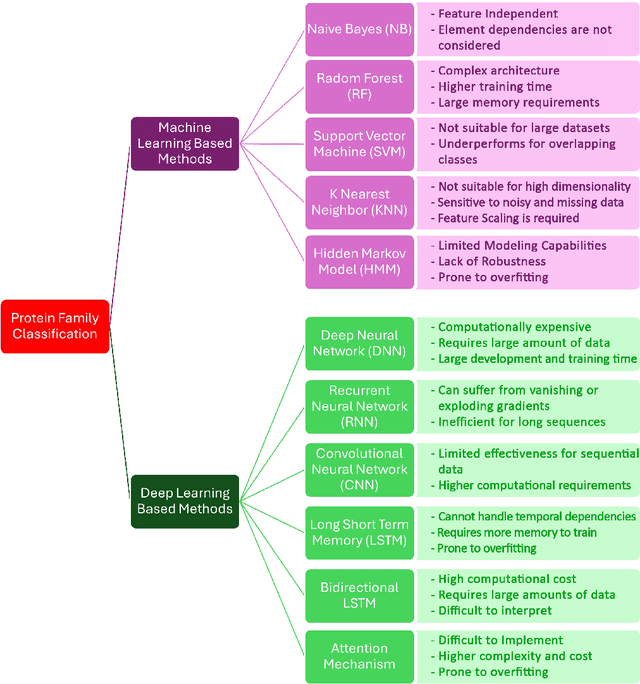

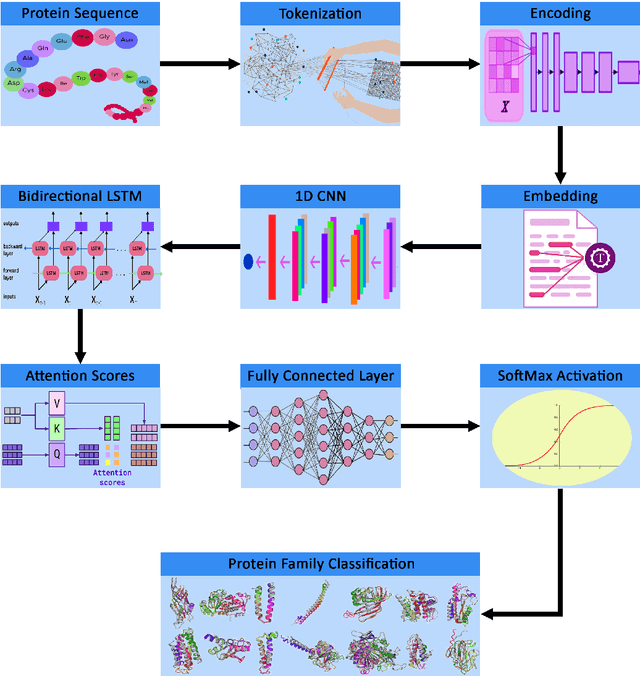
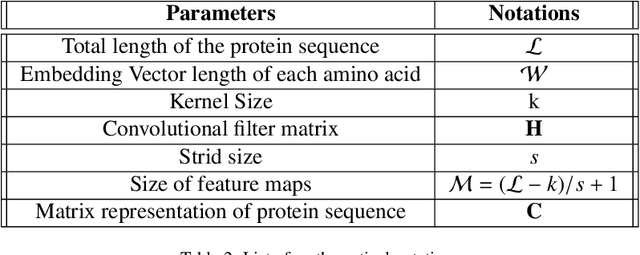
Advanced automated AI techniques allow us to classify protein sequences and discern their biological families and functions. Conventional approaches for classifying these protein families often focus on extracting N-Gram features from the sequences while overlooking crucial motif information and the interplay between motifs and neighboring amino acids. Recently, convolutional neural networks have been applied to amino acid and motif data, even with a limited dataset of well-characterized proteins, resulting in improved performance. This study presents a model for classifying protein families using the fusion of 1D-CNN, BiLSTM, and an attention mechanism, which combines spatial feature extraction, long-term dependencies, and context-aware representations. The proposed model (ProFamNet) achieved superior model efficiency with 450,953 parameters and a compact size of 1.72 MB, outperforming the state-of-the-art model with 4,578,911 parameters and a size of 17.47 MB. Further, we achieved a higher F1 score (98.30% vs. 97.67%) with more instances (271,160 vs. 55,077) in fewer training epochs (25 vs. 30).