 Add to Chrome
 Add to Firefox
 Add to Edge
The Art of Being Difficult: Combining Human and AI Strengths to Find Adversarial Instances for Heuristics
Jan 23, 2026
We demonstrate the power of human-LLM collaboration in tackling open problems in theoretical computer science. Focusing on combinatorial optimization, we refine outputs from the FunSearch algorithm [Romera-Paredes et al., Nature 2023] to derive state-of-the-art lower bounds for standard heuristics. Specifically, we target the generation of adversarial instances where these heuristics perform poorly. By iterating on FunSearch's outputs, we identify improved constructions for hierarchical $k$-median clustering, bin packing, the knapsack problem, and a generalization of Lovász's gasoline problem - some of these have not seen much improvement for over a decade, despite intermittent attention. These results illustrate how expert oversight can effectively extrapolate algorithmic insights from LLM-based evolutionary methods to break long-standing barriers. Our findings demonstrate that while LLMs provide critical initial patterns, human expertise is essential for transforming these patterns into mathematically rigorous and insightful constructions. This work highlights that LLMs are a strong collaborative tool in mathematics and computer science research.

Finding Increasingly Large Extremal Graphs with AlphaZero and Tabu Search
Nov 06, 2023
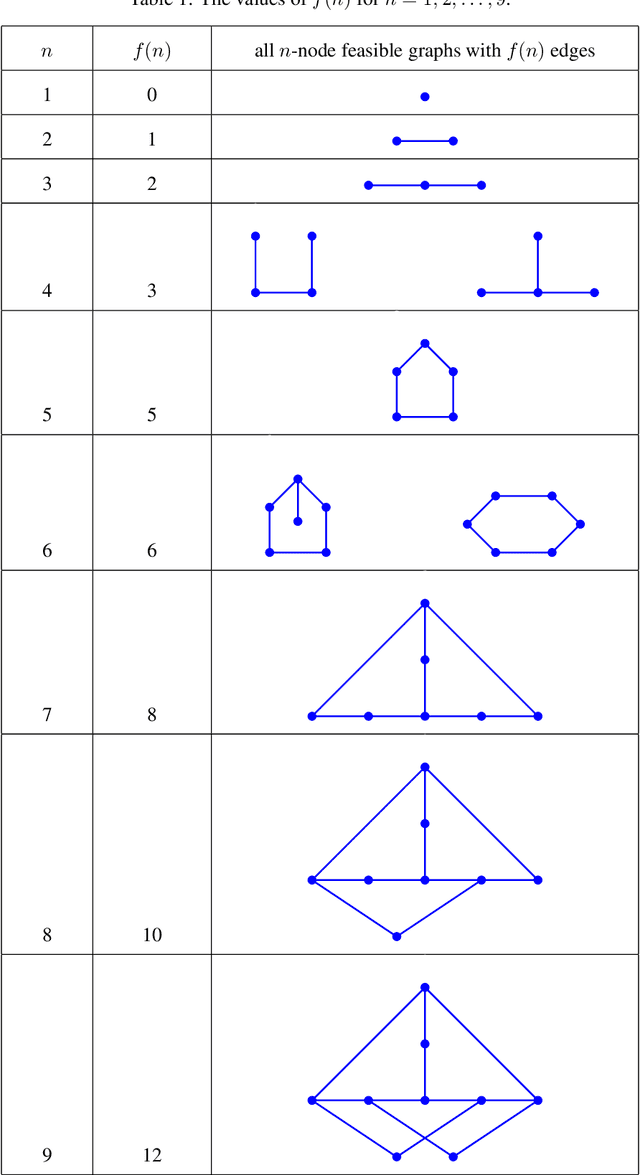
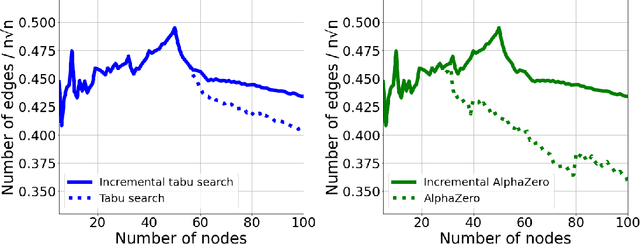

This work studies a central extremal graph theory problem inspired by a 1975 conjecture of Erd\H{o}s, which aims to find graphs with a given size (number of nodes) that maximize the number of edges without having 3- or 4-cycles. We formulate this problem as a sequential decision-making problem and compare AlphaZero, a neural network-guided tree search, with tabu search, a heuristic local search method. Using either method, by introducing a curriculum -- jump-starting the search for larger graphs using good graphs found at smaller sizes -- we improve the state-of-the-art lower bounds for several sizes. We also propose a flexible graph-generation environment and a permutation-invariant network architecture for learning to search in the space of graphs.