 Add to Chrome
 Add to Firefox
 Add to Edge
Can "AI" Be a Doctor? A Study of Empathy, Readability, and Alignment in Clinical LLMs
Apr 22, 2026
Large Language Models (LLMs) are increasingly deployed in healthcare, yet their communicative alignment with clinical standards remains insufficiently quantified. We conduct a multidimensional evaluation of general-purpose and domain-specialized LLMs across structured medical explanations and real-world physician-patient interactions, analyzing semantic fidelity, readability, and affective resonance. Baseline models amplify affective polarity relative to physicians (Very Negative: 43.14-45.10% vs. 37.25%) and, in larger architectures such as GPT-5 and Claude, produce substantially higher linguistic complexity (FKGL up to 16.91-17.60 vs. 11.47-12.50 in physician-authored responses). Empathy-oriented prompting reduces extreme negativity and lowers grade-level complexity (up to -6.87 FKGL points for GPT-5) but does not significantly increase semantic fidelity. Collaborative rewriting yields the strongest overall alignment. Rephrase configurations achieve the highest semantic similarity to physician answers (up to mean = 0.93) while consistently improving readability and reducing affective extremity. Dual stakeholder evaluation shows that no model surpasses physicians on epistemic criteria, whereas patients consistently prefer rewritten variants for clarity and emotional tone. These findings suggest that LLMs function most effectively as collaborative communication enhancers rather than replacements for clinical expertise.

Brain3D: Brain Report Automation via Inflated Vision Transformers in 3D
Feb 25, 2026Current medical vision-language models (VLMs) process volumetric brain MRI using 2D slice-based approximations, fragmenting the spatial context required for accurate neuroradiological interpretation. We developed \textbf{Brain3D}, a staged vision-language framework for automated radiology report generation from 3D brain tumor MRI. Our approach inflates a pretrained 2D medical encoder into a native 3D architecture and progressively aligns it with a causal language model through three stages: contrastive grounding, supervised projector warmup, and LoRA-based linguistic specialization. Unlike generalist 3D medical VLMs, \textbf{Brain3D} is tailored to neuroradiology, where hemispheric laterality, tumor infiltration patterns, and anatomical localization are critical. Evaluated on 468 subjects (BraTS pathological cases plus healthy controls), our model achieves a Clinical Pathology F1 of 0.951 versus 0.413 for a strong 2D baseline while maintaining perfect specificity on healthy scans. The staged alignment proves essential: contrastive grounding establishes visual-textual correspondence, projector warmup stabilizes conditioning, and LoRA adaptation shifts output from verbose captions to structured clinical reports\footnote{Our code is publicly available for transparency and reproducibility
SOLVE-Med: Specialized Orchestration for Leading Vertical Experts across Medical Specialties
Nov 05, 2025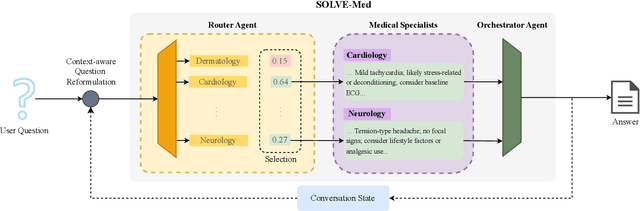
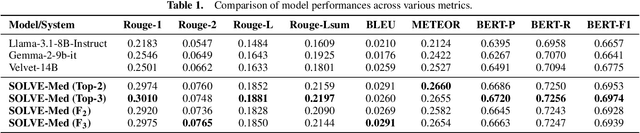
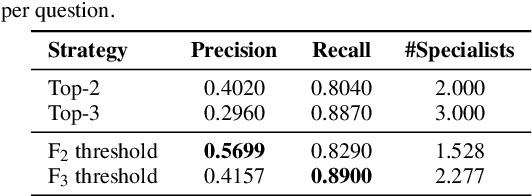
Medical question answering systems face deployment challenges including hallucinations, bias, computational demands, privacy concerns, and the need for specialized expertise across diverse domains. Here, we present SOLVE-Med, a multi-agent architecture combining domain-specialized small language models for complex medical queries. The system employs a Router Agent for dynamic specialist selection, ten specialized models (1B parameters each) fine-tuned on specific medical domains, and an Orchestrator Agent that synthesizes responses. Evaluated on Italian medical forum data across ten specialties, SOLVE-Med achieves superior performance with ROUGE-1 of 0.301 and BERTScore F1 of 0.697, outperforming standalone models up to 14B parameters while enabling local deployment. Our code is publicly available on GitHub: https://github.com/PRAISELab-PicusLab/SOLVE-Med.
Combating Biomedical Misinformation through Multi-modal Claim Detection and Evidence-based Verification
Sep 17, 2025Misinformation in healthcare, from vaccine hesitancy to unproven treatments, poses risks to public health and trust in medical systems. While machine learning and natural language processing have advanced automated fact-checking, validating biomedical claims remains uniquely challenging due to complex terminology, the need for domain expertise, and the critical importance of grounding in scientific evidence. We introduce CER (Combining Evidence and Reasoning), a novel framework for biomedical fact-checking that integrates scientific evidence retrieval, reasoning via large language models, and supervised veracity prediction. By integrating the text-generation capabilities of large language models with advanced retrieval techniques for high-quality biomedical scientific evidence, CER effectively mitigates the risk of hallucinations, ensuring that generated outputs are grounded in verifiable, evidence-based sources. Evaluations on expert-annotated datasets (HealthFC, BioASQ-7b, SciFact) demonstrate state-of-the-art performance and promising cross-dataset generalization. Code and data are released for transparency and reproducibility: https://github.com/PRAISELab-PicusLab/CER
Combining Evidence and Reasoning for Biomedical Fact-Checking
Sep 17, 2025Misinformation in healthcare, from vaccine hesitancy to unproven treatments, poses risks to public health and trust in medical systems. While machine learning and natural language processing have advanced automated fact-checking, validating biomedical claims remains uniquely challenging due to complex terminology, the need for domain expertise, and the critical importance of grounding in scientific evidence. We introduce CER (Combining Evidence and Reasoning), a novel framework for biomedical fact-checking that integrates scientific evidence retrieval, reasoning via large language models, and supervised veracity prediction. By integrating the text-generation capabilities of large language models with advanced retrieval techniques for high-quality biomedical scientific evidence, CER effectively mitigates the risk of hallucinations, ensuring that generated outputs are grounded in verifiable, evidence-based sources. Evaluations on expert-annotated datasets (HealthFC, BioASQ-7b, SciFact) demonstrate state-of-the-art performance and promising cross-dataset generalization. Code and data are released for transparency and reproducibility: https: //github.com/PRAISELab-PicusLab/CER.