 Add to Chrome
 Add to Firefox
 Add to Edge
Long-term Power Grid Planning via Answer Set Programming
May 19, 2026
The Power grid is a critical infrastructure underpinning all aspects of modern society and its services. Maintaining its effectiveness requires continuous adaptations. In particular, addressing sustainability targets, demand patterns, and urbanisation trends requires implementing changes to the network. Actual developments can potentially span over a decade, with supply continuity and service quality that must be preserved throughout by ensuring conformance to several topological and combinatorial invariants. Long-term power grid planning deals with the above process, and although planning languages could be a natural choice, the kind of properties and invariants needed are cumbersome to express in such languages; on the contrary, they can be elegantly and succinctly encoded in Answer Set Programming (ASP). In this paper, we propose the first approach to automate and optimise the long-term power grid planning process using ASP. Experimental evaluations conducted on synthetic and real-world grid data confirm the expressive power of the proposed ASP-based approach and demonstrate its effectiveness.

Direct Encoding of Declare Constraints in ASP
Dec 13, 2024Answer Set Programming (ASP), a well-known declarative logic programming paradigm, has recently found practical application in Process Mining. In particular, ASP has been used to model tasks involving declarative specifications of business processes. In this area, Declare stands out as the most widely adopted declarative process modeling language, offering a means to model processes through sets of constraints valid traces must satisfy, that can be expressed in Linear Temporal Logic over Finite Traces (LTLf). Existing ASP-based solutions encode Declare constraints by modeling the corresponding LTLf formula or its equivalent automaton which can be obtained using established techniques. In this paper, we introduce a novel encoding for Declare constraints that directly models their semantics as ASP rules, eliminating the need for intermediate representations. We assess the effectiveness of this novel approach on two Process Mining tasks by comparing it with alternative ASP encodings and a Python library for Declare. Under consideration in Theory and Practice of Logic Programming (TPLP).
Enumerating Minimal Unsatisfiable Cores of LTLf formulas
Sep 14, 2024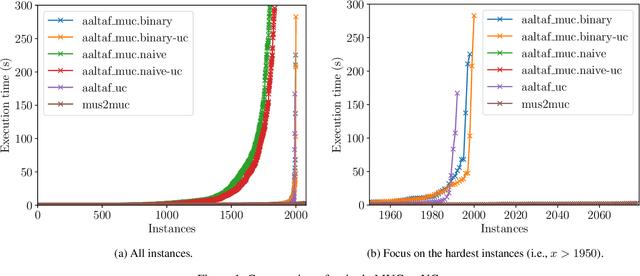
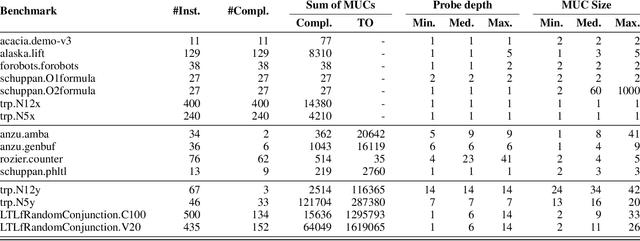
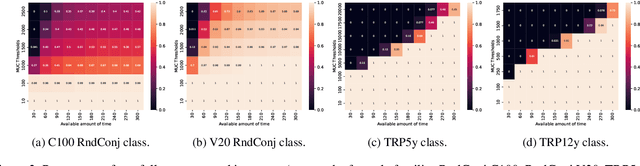
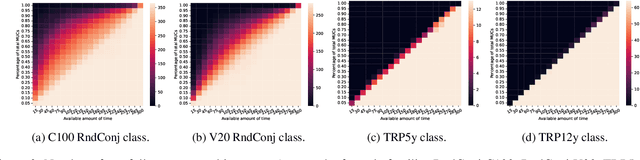
Linear Temporal Logic over finite traces ($\text{LTL}_f$) is a widely used formalism with applications in AI, process mining, model checking, and more. The primary reasoning task for $\text{LTL}_f$ is satisfiability checking; yet, the recent focus on explainable AI has increased interest in analyzing inconsistent formulas, making the enumeration of minimal explanations for infeasibility a relevant task also for $\text{LTL}_f$. This paper introduces a novel technique for enumerating minimal unsatisfiable cores (MUCs) of an $\text{LTL}_f$ specification. The main idea is to encode a $\text{LTL}_f$ formula into an Answer Set Programming (ASP) specification, such that the minimal unsatisfiable subsets (MUSes) of the ASP program directly correspond to the MUCs of the original $\text{LTL}_f$ specification. Leveraging recent advancements in ASP solving yields a MUC enumerator achieving good performance in experiments conducted on established benchmarks from the literature.
Continuous reasoning for adaptive container image distribution in the cloud-edge continuum
Jul 17, 2024Cloud-edge computing requires applications to operate across diverse infrastructures, often triggered by cyber-physical events. Containers offer a lightweight deployment option but pulling images from central repositories can cause delays. This article presents a novel declarative approach and open-source prototype for replicating container images across the cloud-edge continuum. Considering resource availability, network QoS, and storage costs, we leverage logic programming to (i) determine optimal initial placements via Answer Set Programming (ASP) and (ii) adapt placements using Prolog-based continuous reasoning. We evaluate our solution through simulations, showcasing how combining ASP and Prolog continuous reasoning can balance cost optimisation and prompt decision-making in placement adaptation at increasing infrastructure sizes.